







Question: Problem #4 (30 points) A continuous-flow reaction catalyzed using urease immobilized in Ca-alginate beads ( R =0.5cm) is found to have a suboptimal effectiveness factor
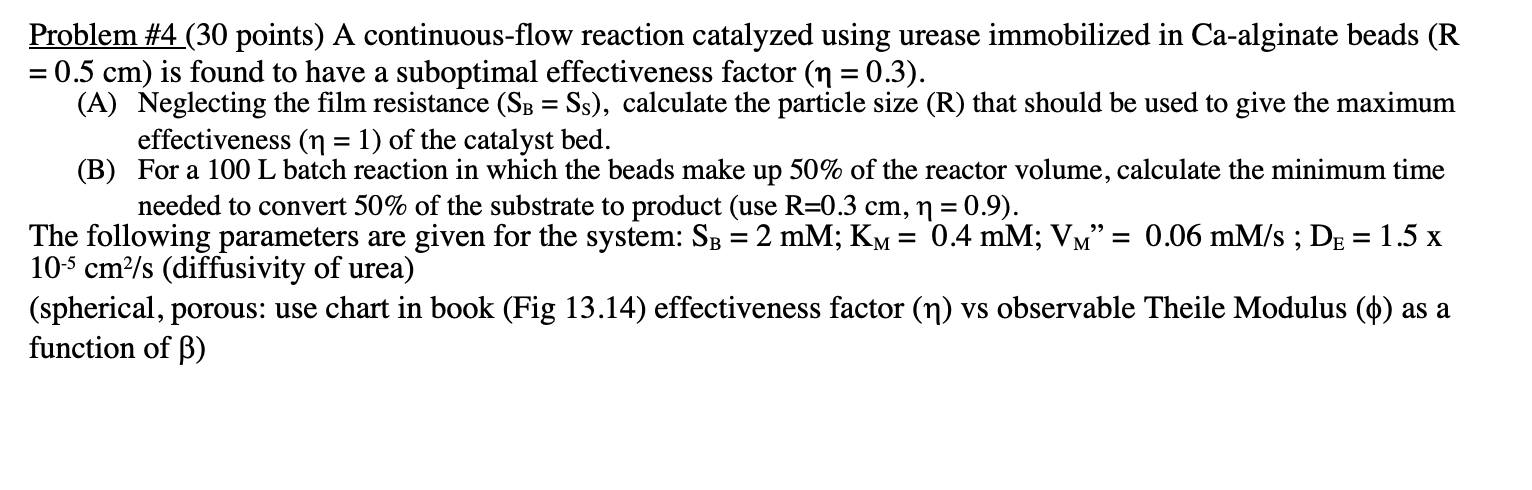
Problem \#4 (30 points) A continuous-flow reaction catalyzed using urease immobilized in Ca-alginate beads ( R =0.5cm) is found to have a suboptimal effectiveness factor (=0.3). (A) Neglecting the film resistance (SB=SS), calculate the particle size (R) that should be used to give the maximum effectiveness (=1) of the catalyst bed. (B) For a 100L batch reaction in which the beads make up 50% of the reactor volume, calculate the minimum time needed to convert 50% of the substrate to product (use R=0.3cm,=0.9 ). The following parameters are given for the system: SB=2mM;KM=0.4mM;VM =0.06mM/s;DE=1.5x 105cm2/s (diffusivity of urea) (spherical, porous: use chart in book (Fig 13.14) effectiveness factor () vs observable Theile Modulus () as a function of )
Step by Step Solution
There are 3 Steps involved in it

Get step-by-step solutions from verified subject matter experts
 Study Help