







Question: Problem 4 A modified man-in-the-middle attack on Diffie-Hellman (10 marks) Suppose Alice and Bob wish to generate a shared cryptographic key using the Diffie-Hellman protocol.
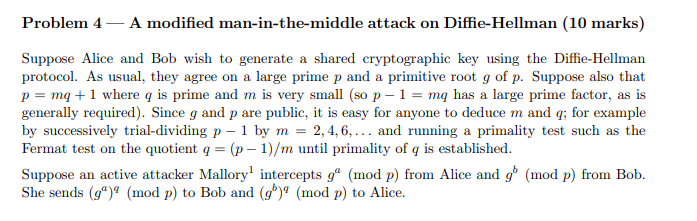

Problem 4 A modified man-in-the-middle attack on Diffie-Hellman (10 marks) Suppose Alice and Bob wish to generate a shared cryptographic key using the Diffie-Hellman protocol. As usual, they agree on a large prime p and a primitive root g of p. Suppose also that p = mq +1 where q is prime and m is very small (so p-1 = mq has a large prime factor, as is generally required). Since g and p are public, it is easy for anyone to deduce m and q; for example by successively trial-dividing p - 1 by m = 2, 4, 6, ... and running a primality test such as the Fermat test on the quotient q = (P-1)/m until primality of q is established. Suppose an active attacker Malloryintercepts g (mod p) from Alice and g (mod p) from Bob. She sends (94)9 (mod p) to Bob and (g) (mod p) to Alice. c. (4 marks) What is the advantage of this variation of the man-in-the-middle attack over the version we discussed in class? Recall that for the attack from class, Mallory simply suppresses the messages g (mod p) and g (mod p) between Alice and Bob and replaces them with her own number g (mod p), which results in the shared key gle (mod p) between Mallory and Alice and the shared key gbe (mod p) between Mallory and Bob. Problem 4 A modified man-in-the-middle attack on Diffie-Hellman (10 marks) Suppose Alice and Bob wish to generate a shared cryptographic key using the Diffie-Hellman protocol. As usual, they agree on a large prime p and a primitive root g of p. Suppose also that p = mq +1 where q is prime and m is very small (so p-1 = mq has a large prime factor, as is generally required). Since g and p are public, it is easy for anyone to deduce m and q; for example by successively trial-dividing p - 1 by m = 2, 4, 6, ... and running a primality test such as the Fermat test on the quotient q = (P-1)/m until primality of q is established. Suppose an active attacker Malloryintercepts g (mod p) from Alice and g (mod p) from Bob. She sends (94)9 (mod p) to Bob and (g) (mod p) to Alice. c. (4 marks) What is the advantage of this variation of the man-in-the-middle attack over the version we discussed in class? Recall that for the attack from class, Mallory simply suppresses the messages g (mod p) and g (mod p) between Alice and Bob and replaces them with her own number g (mod p), which results in the shared key gle (mod p) between Mallory and Alice and the shared key gbe (mod p) between Mallory and Bob
Step by Step Solution
There are 3 Steps involved in it

Get step-by-step solutions from verified subject matter experts
 Study Help