







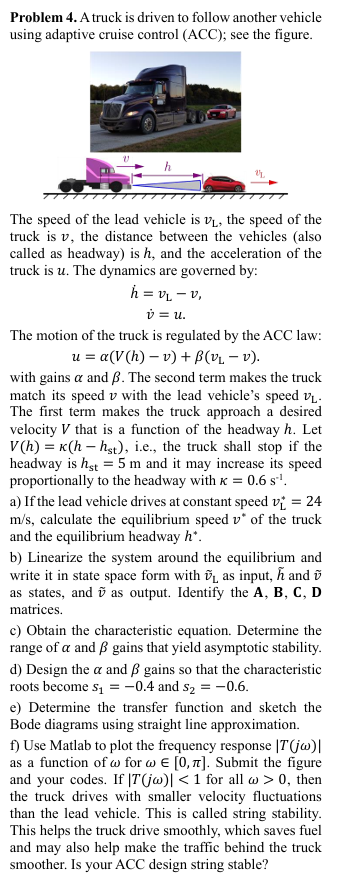
Question: Problem 4 . A truck is driven to follow another vehicle using adaptive cruise control ( ACC ) ; see the figure. The speed of
Problem A truck is driven to follow another vehicle
using adaptive cruise control ACC; see the figure.
The speed of the lead vehicle is vL the speed of the
truck is v the distance between the vehicles also
called as headway is h and the acceleration of the
truck is u The dynamics are governed by:
hvLv
vu
The motion of the truck is regulated by the ACC law:
ualpha Vhvbeta vLv
with gains alpha and beta The second term makes the truck
match its speed v with the lead vehicle's speed vL
The first term makes the truck approach a desired
velocity V that is a function of the headway h Let
Vhkappa hhst ie the truck shall stop if the
headway is hstm and it may increase its speed
proportionally to the headway with kappa s
avL
ms calculate the equilibrium speed v of the truck
and the equilibrium headway h
btildevL as input, tildeh and tildev
as states, and tildev as output. Identify the ABCD
matrices.
calpha and beta gains that yield asymptotic stability.
dalpha and beta gains so that the characteristic
roots become s and s
eTjomega
as a function of omega for omega inpi Submit the figure
and your codes. If Tjomega for all omega then
the truck drives with smaller velocity fluctuations
than the lead vehicle. This is called string stability.
This helps the truck drive smoothly, which saves fuel
and may also help make the traffic behind the truck
smoother. Is your ACC design string stable?
Step by Step Solution
There are 3 Steps involved in it
1 Expert Approved Answer
Step: 1 Unlock

Question Has Been Solved by an Expert!
Get step-by-step solutions from verified subject matter experts
Step: 2 Unlock
Step: 3 Unlock
 Study Help