







Question: Problem #4 (a) What is a BTB, what is it used for, and what is stored in it? How it is different from a return
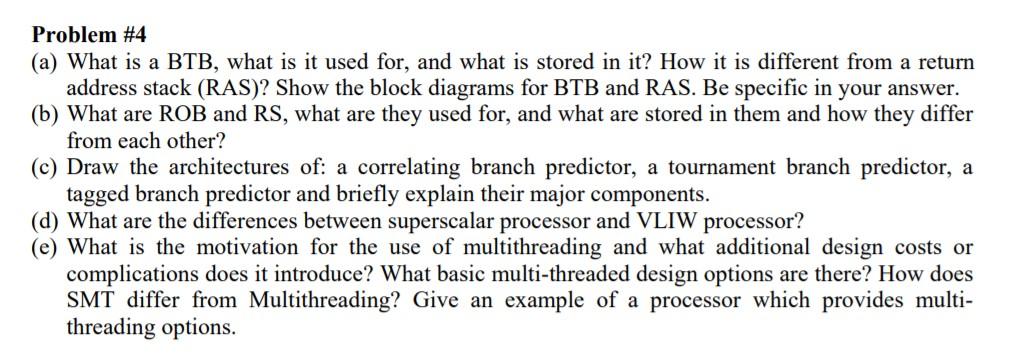
Problem #4 (a) What is a BTB, what is it used for, and what is stored in it? How it is different from a return address stack (RAS)? Show the block diagrams for BTB and RAS. Be specific in your answer. (b) What are ROB and RS, what are they used for, and what are stored in them and how they differ from each other? (c) Draw the architectures of: a correlating branch predictor, a tournament branch predictor, a tagged branch predictor and briefly explain their major components. (d) What are the differences between superscalar processor and VLIW processor? (e) What is the motivation for the use of multithreading and what additional design costs or complications does it introduce? What basic multi-threaded design options are there? How does SMT differ from Multithreading? Give an example of a processor which provides multi- threading options. Problem #4 (a) What is a BTB, what is it used for, and what is stored in it? How it is different from a return address stack (RAS)? Show the block diagrams for BTB and RAS. Be specific in your answer. (b) What are ROB and RS, what are they used for, and what are stored in them and how they differ from each other? (c) Draw the architectures of: a correlating branch predictor, a tournament branch predictor, a tagged branch predictor and briefly explain their major components. (d) What are the differences between superscalar processor and VLIW processor? (e) What is the motivation for the use of multithreading and what additional design costs or complications does it introduce? What basic multi-threaded design options are there? How does SMT differ from Multithreading? Give an example of a processor which provides multi- threading options
Step by Step Solution
There are 3 Steps involved in it

Get step-by-step solutions from verified subject matter experts
 Study Help