







Question: Problem 4 . Activity Independence. Consider a research team studying the activity patterns of individuals within a social network. They maintain a matrix (
Problem Activity Independence.
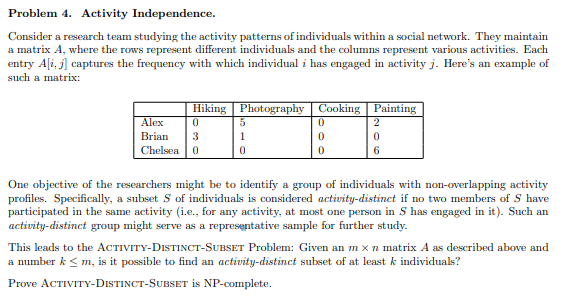
Consider a research team studying the activity patterns of individuals within a social network. They maintain a matrix A where the rows represent different individuals and the columns represent various activities. Each entry Ai j captures the frequency with which individual i has engaged in activity j Here's an example of such a matrix:
One objective of the researchers might be to identify a group of individuals with nonoverlapping activity profiles. Specifically, a subset S of individuals is considered activitydistinct if no two members of S have participated in the same activity ie for any activity, at most one person in S has engaged in it Such an activitydistinct group might serve as a representative sample for further study.
This leads to the ActivityDistinctSubset Problem: Given an m times n matrix A as described above and a number k leq m is it possible to find an activitydistinct subset of at least k individuals?
Prove ActivityDistinctSubset is NPcomplete.
Step by Step Solution
There are 3 Steps involved in it
1 Expert Approved Answer
Step: 1 Unlock

Question Has Been Solved by an Expert!
Get step-by-step solutions from verified subject matter experts
Step: 2 Unlock
Step: 3 Unlock
 Study Help