







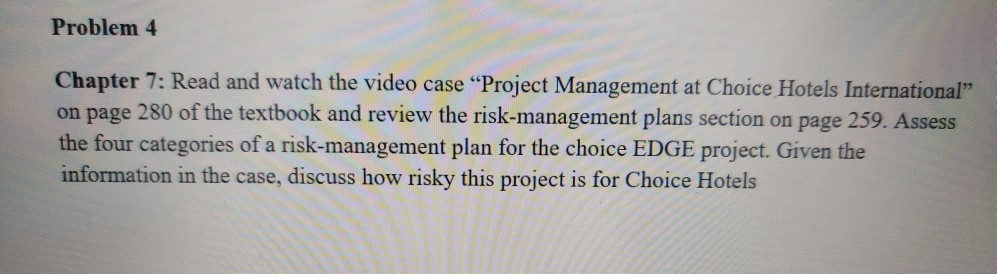
Question: Problem 4 Chapter 7: Read and watch the video case Project Management at Choice Hotels International on page 280 of the textbook and review the
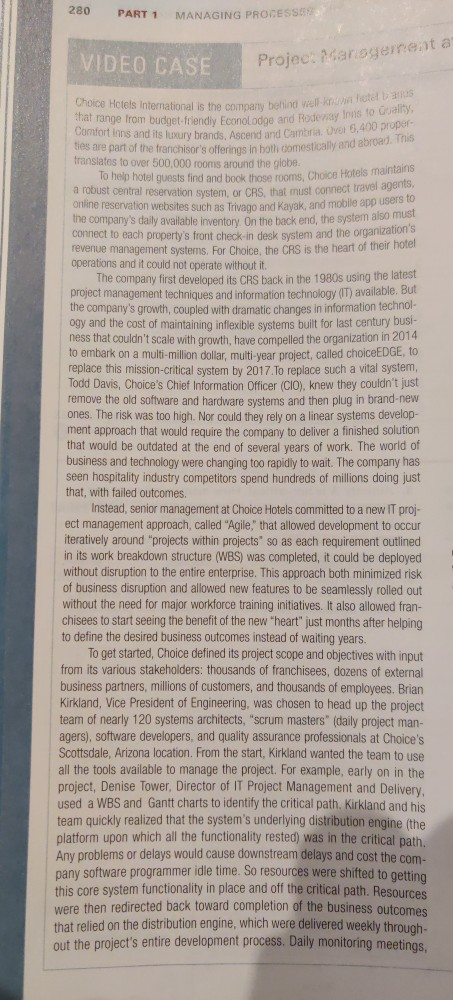
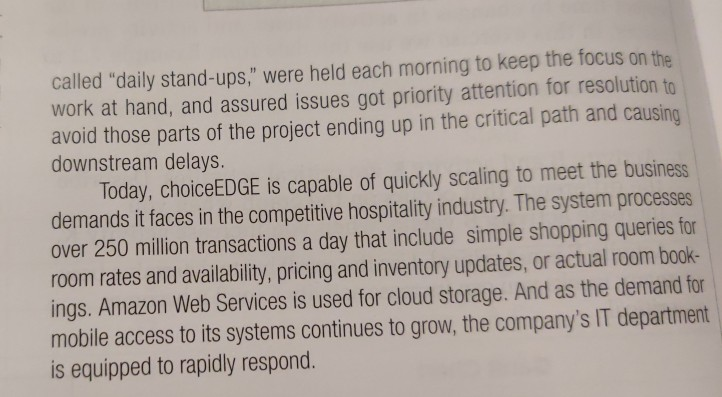
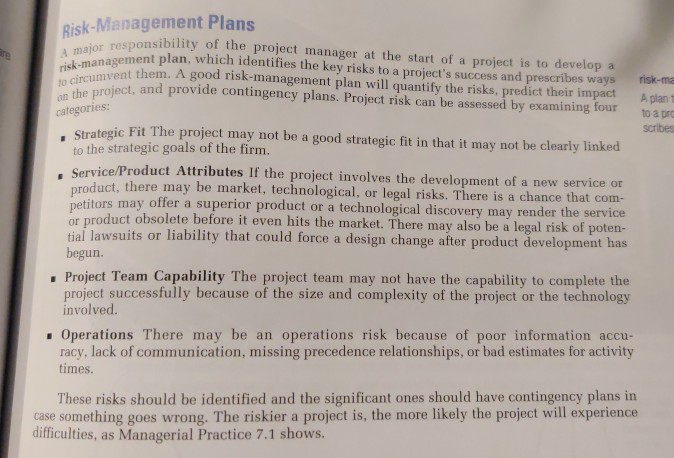
Problem 4 Chapter 7: Read and watch the video case Project Management at Choice Hotels International on page 280 of the textbook and review the risk-management plans section on page 259. Assess the four categories of a risk-management plan for the choice EDGE project. Given the information in the case, discuss how risky this project is for Choice Hotels 280 PART 1 MANAGING PROCESSEN VIDEO CASE Projec, darsgerret a company behind well-knote D S endly Econolodge and Rodeway Inns to Quality, 5. Ascend and Cambria Urol 5,400 proper Offerings in both domestically and abroad. This Choice Hotels International is the company behind well- dia range from budget-friendly Econolodge and Rodeways Comfort Inns and its luxury brands, Ascend and Cambria. Ovo ties are part of the franchisor's offerings in both comestically and a translates to over 500,000 rooms around the globe. to help hotel guests find and book those rooms Choice Hotels maintains sort travel agents a robust central reservation system or CRS that must connect travel age online reservation websites such as Trivago and Kayak, and mobile app users the company's daily available inventory. On the back end, the system also must connect to each property's front check-in desk system and the organizations revenue management systems, For Choice, the CRS is the heart of their hotel operations and it could not operate without it. The company first developed its CRS back in the 1980s using the latest project management techniques and information technology (IT) available. But the company's growth, coupled with dramatic changes in information technol- ogy and the cost of maintaining inflexible systems built for last century busi- ness that couldn't scale with growth, have compelled the organization in 2014 to embark on a multi-million dollar, multi-year project, called choiceEDGE, to replace this mission-critical system by 2017.To replace such a vital system, lodd Davis, Choice's Chief Information Officer (CIO), knew they couldn't just remove the old software and hardware systems and then plug in brand-new ones. The risk was too high. Nor could they rely on a linear systems develop- ment approach that would require the company to deliver a finished solution that would be outdated at the end of several years of work. The world of business and technology were changing too rapidly to wait. The company has seen hospitality industry competitors spend hundreds of millions doing just that, with failed outcomes. Instead, senior management at Choice Hotels committed to a new IT proj ect management approach, called "Agile," that allowed development to occur iteratively around "projects within projects so as each requirement outlined in its work breakdown structure (WBS) was completed, it could be deployed without disruption to the entire enterprise. This approach both minimized risk of business disruption and allowed new features to be seamlessly rolled out without the need for major workforce training initiatives. It also allowed fran- chisees to start seeing the benefit of the new "heart" just months after helping to define the desired business outcomes instead of waiting years. To get started, Choice defined its project scope and objectives with input from its various stakeholders: thousands of franchisees, dozens of external business partners, millions of customers, and thousands of employees. Brian Kirkland, Vice President of Engineering, was chosen to head up the project team of nearly 120 systems architects, "scrum masters" (daily project man- agers), software developers, and quality assurance professionals at Choice's Scottsdale, Arizona location. From the start, Kirkland wanted the team to use all the tools available to manage the project. For example, early on in the project, Denise Tower, Director of IT Project Management and Delivery used a WBS and Gantt charts to identify the critical path. Kirkland and his team quickly realized that the system's underlying distribution engine (the platform upon which all the functionality rested) was in the critical path. Any problems or delays would cause downstream delays and cost the com pany software programmer idle time. So resources were shifted to getting this core system functionality in place and off the critical path. Resources were then redirected back toward completion of the business outcomes that relied on the distribution engine, which were delivered weekly through out the project's entire development process. Daily monitoring meetings called "daily stand-ups," were held each morning to keep the focus on the work at hand, and assured issues got priority attention for resolution to avoid those parts of the project ending up in the critical path and causing downstream delays. Today, choice EDGE is capable of quickly scaling to meet the business demands it faces in the competitive hospitality industry. The system processes over 250 million transactions a day that include simple shopping queries for room rates and availability, pricing and inventory updates, or actual room book- ings. Amazon Web Services is used for cloud storage. And as the demand for mobile access to its systems continues to grow, the company's IT department is equipped to rapidly respond. A major responsi risk-management plan, which to circumvent them. A categories: Risk Management Plans responsibility of the project manager at the start of a project is to develop a opment plan, which identities the key risks to a proiect's success and prescribes ways cumvent them. A good risk-management plan will quantify the risks, predict their impact - roiect, and provide contingency plans. Project risk can be assessed by examining four A plant to a pro scribes Strategic Fit The project may not be a good strategic fit in that it may not be clearly linked to the strategic goals of the firm. Service/Product Attributes If the project involves the development of a new service or product, there may be market, technological, or legal risks. There is a chance that com- petitors may offer a superior product or a technological discovery may render the service or product obsolete before it even hits the market. There may also be a legal risk of poten- tial lawsuits or liability that could force a design change after product development has begun. Project Team Capability The project team may not have the capability to complete the project successfully because of the size and complexity of the project or the technology involved. Operations There may be an operations risk because of poor information accu racy, lack of communication, missing precedence relationships, or bad estimates for activity times. These risks should be identified and the significant ones should have contingency plans in case something goes wrong. The riskier a project is, the more likely the project will experience difficulties, as Managerial Practice 7.1 shows
Step by Step Solution
There are 3 Steps involved in it
1 Expert Approved Answer
Step: 1 Unlock

Question Has Been Solved by an Expert!
Get step-by-step solutions from verified subject matter experts
Step: 2 Unlock
Step: 3 Unlock
 Study Help