







Question: Problem 4 Consider a priority encoder with 8 inputs X1, X6, ..., X1, X, and 3 outputs Y2, Y1 and Yo. If one of the
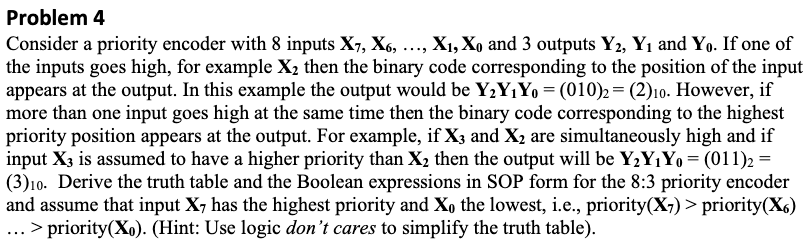
Problem 4 Consider a priority encoder with 8 inputs X1, X6, ..., X1, X, and 3 outputs Y2, Y1 and Yo. If one of the inputs goes high, for example X2 then the binary code corresponding to the position of the input appears at the output. In this example the output would be Y2Y1Y0 = (010)2 = (2)10. However, if more than one input goes high at the same time then the binary code corresponding to the highest priority position appears at the output. For example, if X3 and X2 are simultaneously high and if input X3 is assumed to have a higher priority than X2 then the output will be Y2Y|Y, = (011)2 = (310. Derive the truth table and the Boolean expressions in SOP form for the 8:3 priority encoder and assume that input X, has the highest priority and X, the lowest, i.e., priority(X7) > priority(X) ... > priority(Xo). (Hint: Use logic don't cares to simplify the truth table). Problem 4 Consider a priority encoder with 8 inputs X1, X6, ..., X1, X, and 3 outputs Y2, Y1 and Yo. If one of the inputs goes high, for example X2 then the binary code corresponding to the position of the input appears at the output. In this example the output would be Y2Y1Y0 = (010)2 = (2)10. However, if more than one input goes high at the same time then the binary code corresponding to the highest priority position appears at the output. For example, if X3 and X2 are simultaneously high and if input X3 is assumed to have a higher priority than X2 then the output will be Y2Y|Y, = (011)2 = (310. Derive the truth table and the Boolean expressions in SOP form for the 8:3 priority encoder and assume that input X, has the highest priority and X, the lowest, i.e., priority(X7) > priority(X) ... > priority(Xo). (Hint: Use logic don't cares to simplify the truth table)
Step by Step Solution
There are 3 Steps involved in it

Get step-by-step solutions from verified subject matter experts
 Study Help