







Question: Problem #4: Coupled Masses A 1.22 m diameter, solid disk, with a mass of 15.0 kg, is initially rotating about a central axis perpendicular to
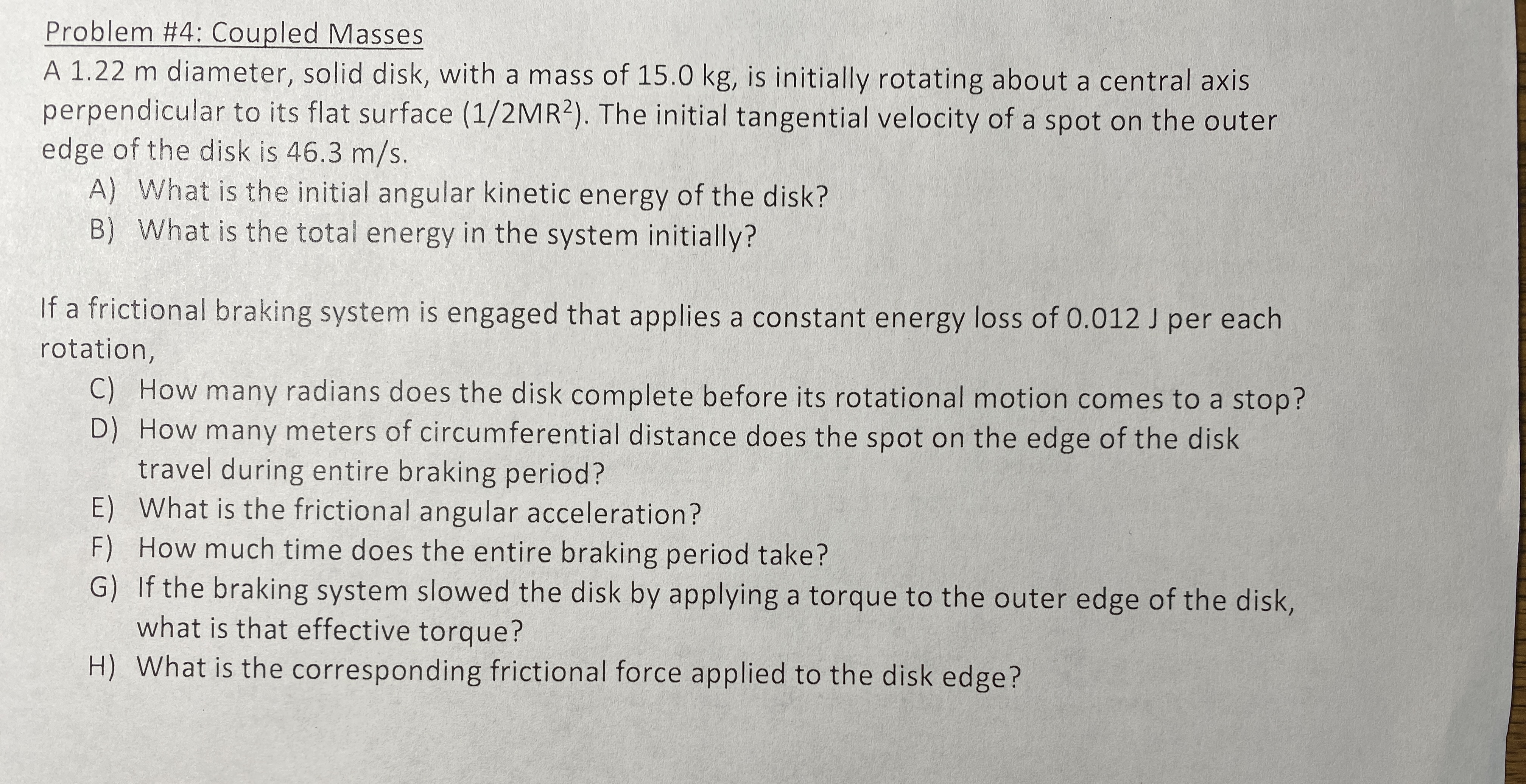
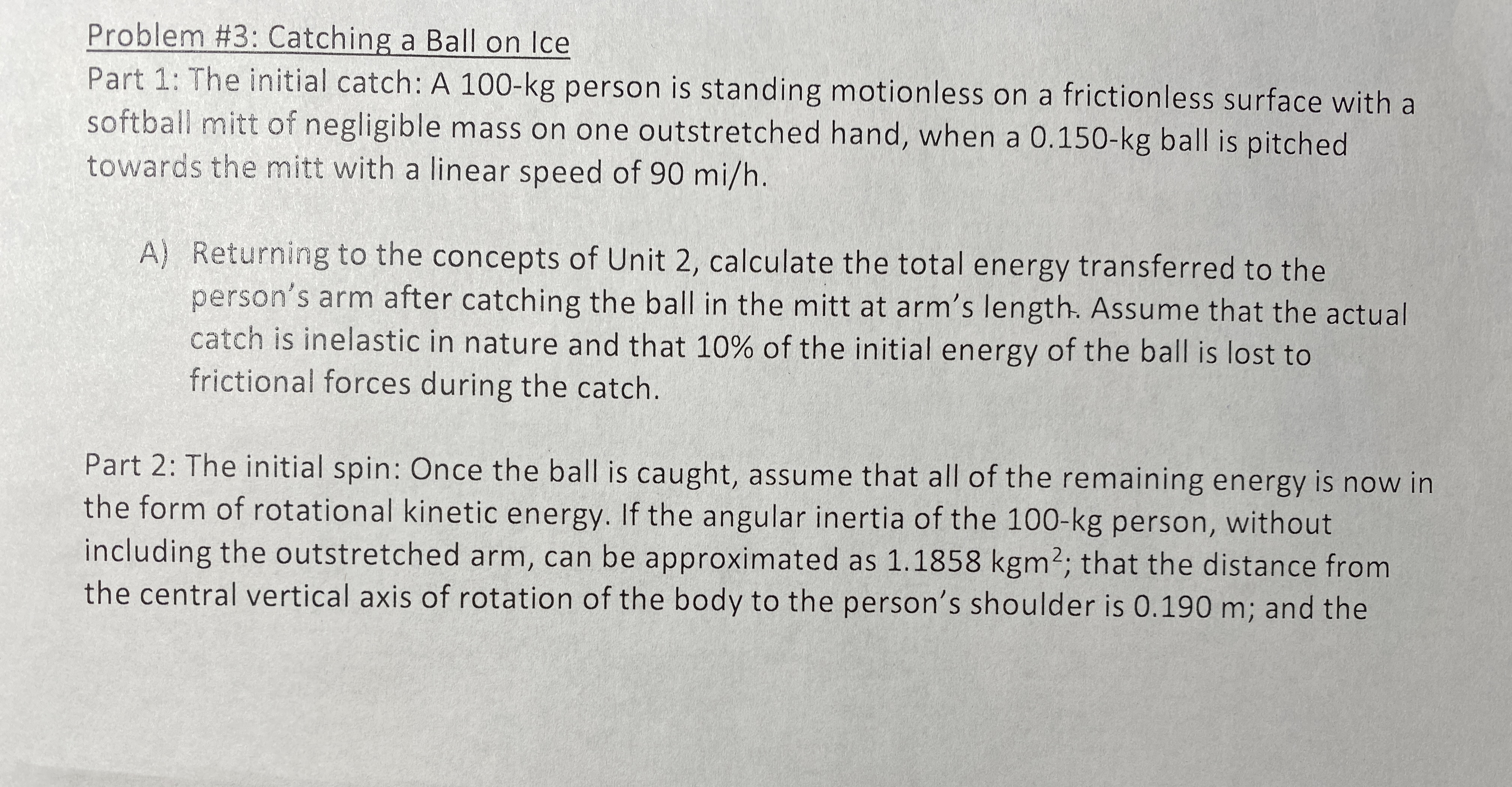
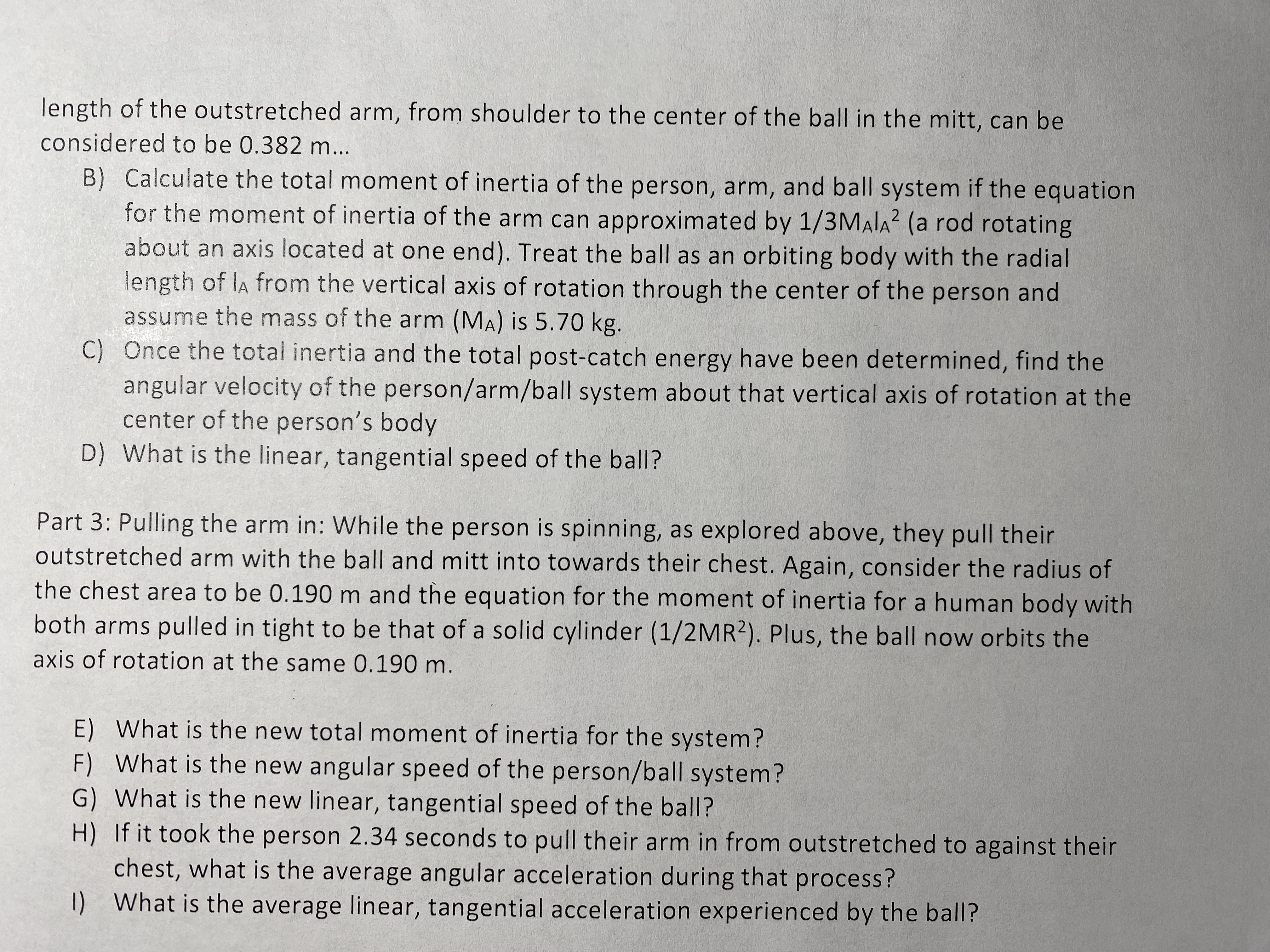
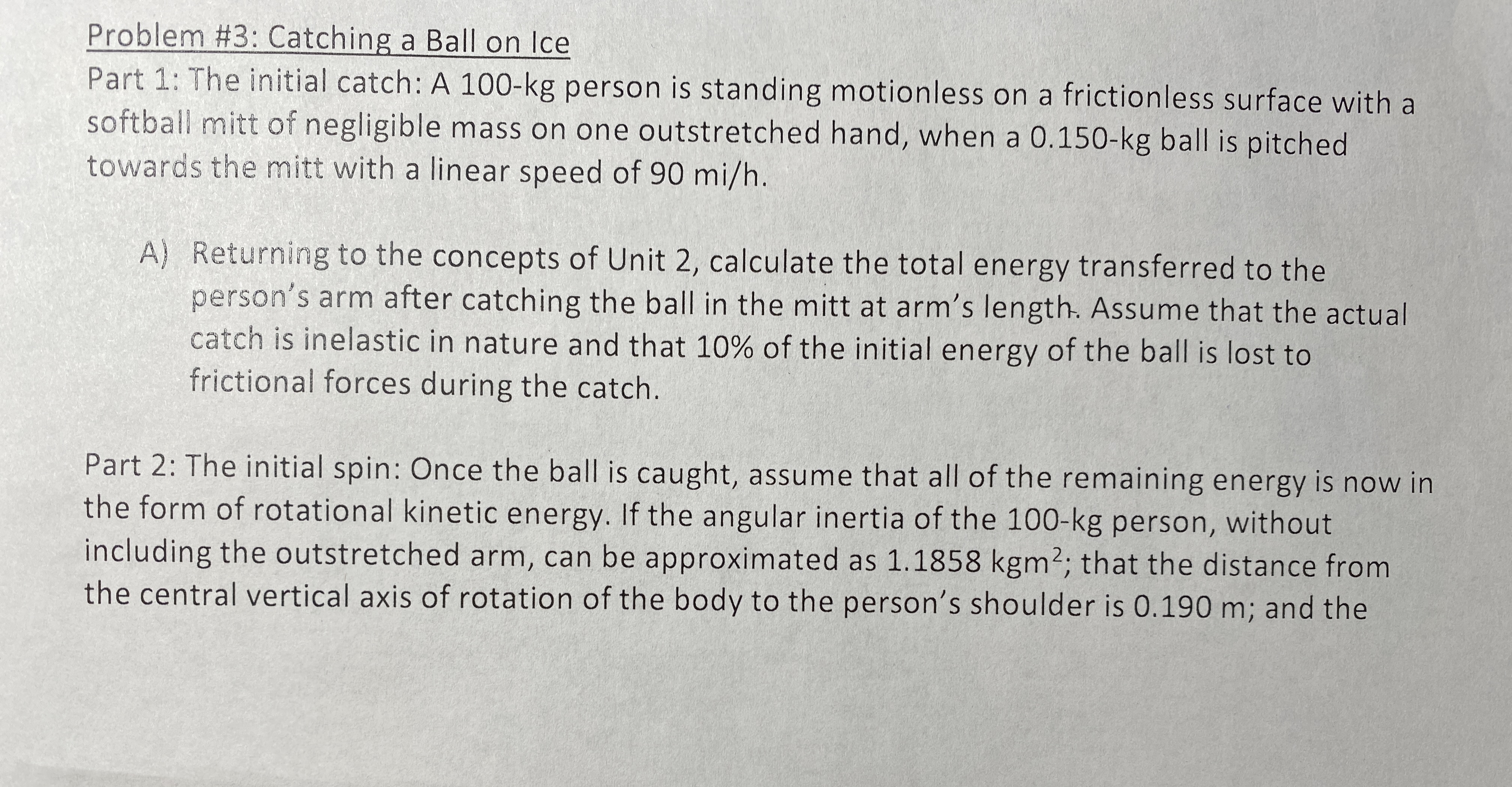
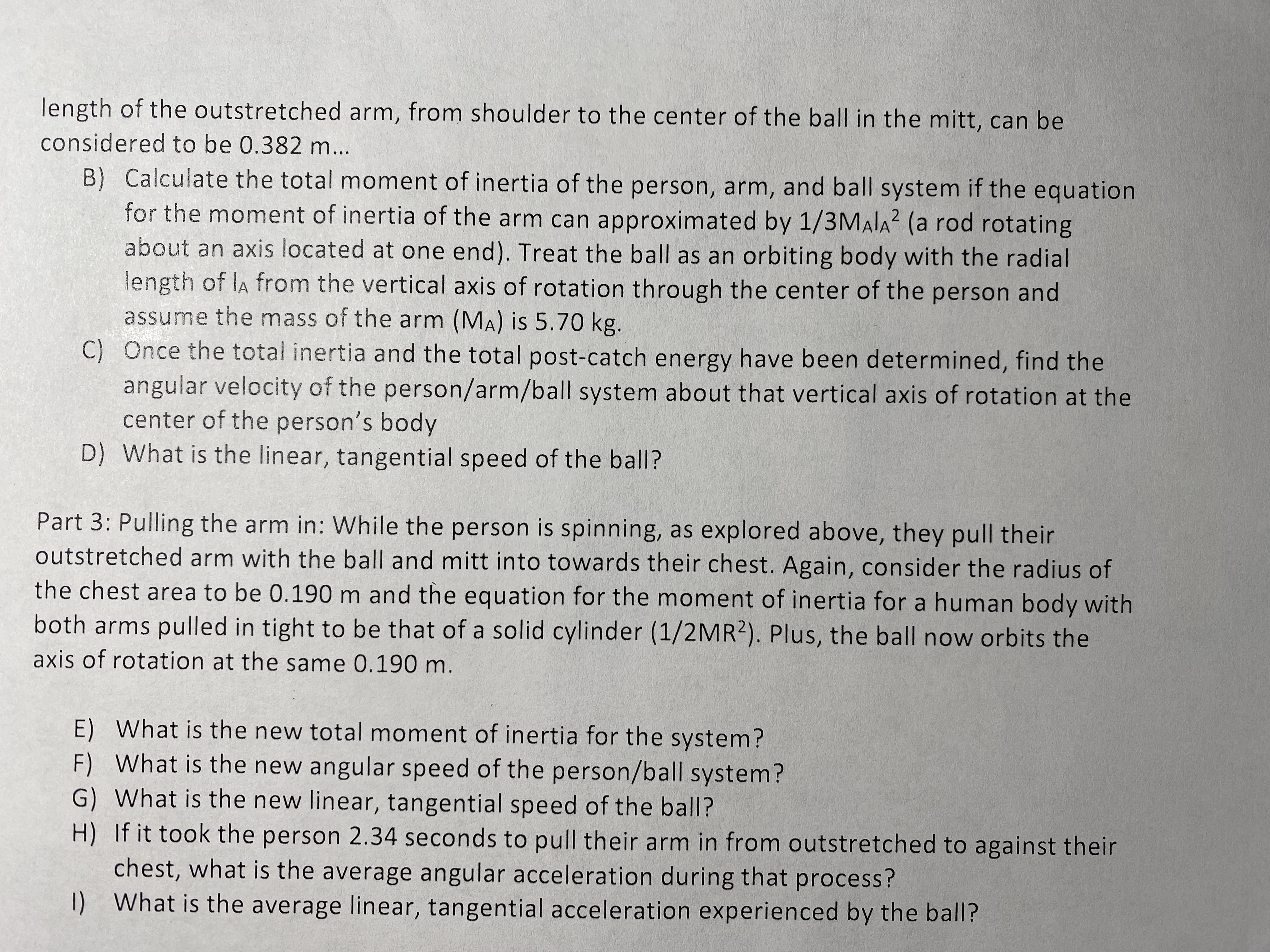
Problem #4: Coupled Masses A 1.22 m diameter, solid disk, with a mass of 15.0 kg, is initially rotating about a central axis perpendicular to its flat surface (1/2MR2). The initial tangential velocity of a spot on the outer edge of the disk is 46.3 m/s. A) What is the initial angular kinetic energy of the disk? B) What is the total energy in the system initially? If a frictional braking system is engaged that applies a constant energy loss of 0.012 J per each rotation, C) How many radians does the disk complete before its rotational motion comes to a stop? D) How many meters of circumferential distance does the spot on the edge of the disk travel during entire braking period? E) What is the frictional angular acceleration? F) How much time does the entire braking period take? G) If the braking system slowed the disk by applying a torque to the outer edge of the disk, what is that effective torque? H) What is the corresponding frictional force applied to the disk edge?Problem #3: Catching a Ball on Ice Part 1: The initial catch: A 100-kg person is standing motionless on a frictionless surface with a softball mitt of negligible mass on one outstretched hand, when a 0.150-kg ball is pitched towards the mitt with a linear speed of 90 mi/h. A) Returning to the concepts of Unit 2, calculate the total energy transferred to the person's arm after catching the ball in the mitt at arm's length. Assume that the actual catch is inelastic in nature and that 10% of the initial energy of the ball is lost to frictional forces during the catch. Part 2: The initial spin: Once the ball is caught, assume that all of the remaining energy is now in the form of rotational kinetic energy. If the angular inertia of the 100-kg person, without including the outstretched arm, can be approximated as 1.1858 kgm2; that the distance from the central vertical axis of rotation of the body to the person's shoulder is 0.190 m; and thelength of the outstretched arm, from shoulder to the center of the ball in the mitt, can be considered to be 0.382 m... B) Calculate the total moment of inertia of the person, arm, and ball system if the equation for the moment of inertia of the arm can approximated by 1/3MAIA (a rod rotating about an axis located at one end). Treat the ball as an orbiting body with the radial length of la from the vertical axis of rotation through the center of the person and assume the mass of the arm (MA) is 5.70 kg. C) Once the total inertia and the total post-catch energy have been determined, find the angular velocity of the person/arm/ball system about that vertical axis of rotation at the center of the person's body D) What is the linear, tangential speed of the ball? Part 3: Pulling the arm in: While the person is spinning, as explored above, they pull their outstretched arm with the ball and mitt into towards their chest. Again, consider the radius of the chest area to be 0.190 m and the equation for the moment of inertia for a human body with both arms pulled in tight to be that of a solid cylinder (1/2MR2). Plus, the ball now orbits the axis of rotation at the same 0.190 m. E) What is the new total moment of inertia for the system? F) What is the new angular speed of the person/ball system? G) What is the new linear, tangential speed of the ball? H) If it took the person 2.34 seconds to pull their arm in from outstretched to against their chest, what is the average angular acceleration during that process? 1) What is the average linear, tangential acceleration experienced by the ball
Step by Step Solution
There are 3 Steps involved in it

Get step-by-step solutions from verified subject matter experts
 Study Help