







Question: Problem 4 (Gould Problem 3.70) 10 marks A random walker is observed to take a total of $N$ steps, $n$ of which are to the
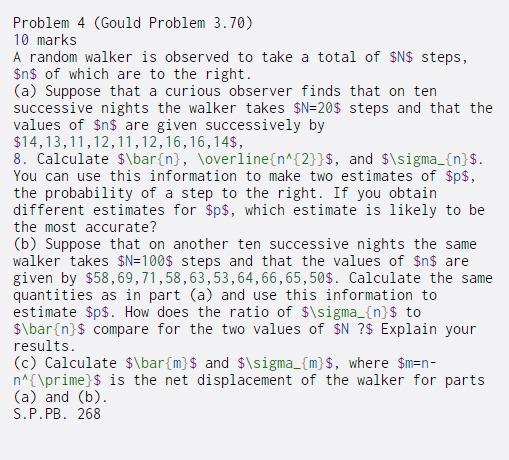
Problem 4 (Gould Problem 3.70) 10 marks A random walker is observed to take a total of $N$ steps, $n$ of which are to the right. (a) Suppose that a curious observer finds that on ten successive nights the walker takes $N=20$ steps and that the values of $n$ are given successively by $14,13,11,12,11,12,16,16,14$, 8. Calculate $\bar{n}, \overline (n^{2}}$, and $\sigma_{n}$. You can use this information to make two estimates of $p$, the probability of a step to the right. If you obtain different estimates for $p$, which estimate is likely to be the most accurate? (b) Suppose that on another ten successive nights the same walker takes $N=100$ steps and that the values of $n$ are given by $58,69,71,58,63,53, 64,66,65,50$. Calculate the same quantities as in part (a) and use this information to estimate $p$. How does the ratio of $\sigma_{n}$ to $\bar{n} $ compare for the two values of $N ?$ Explain your results. (c) Calculate $\bar{m} $ and $\sigma_{m} $, where $m=n- n^{\prime $ is the net displacement of the walker for parts (a) and (b). S.P.PB. 268
Step by Step Solution
There are 3 Steps involved in it

Get step-by-step solutions from verified subject matter experts
 Study Help