







Question: Problem 4. In this problem, you will show that every polynomial parametric curve in the plane R satisfies a polynomial Cartesian equation. We begin with
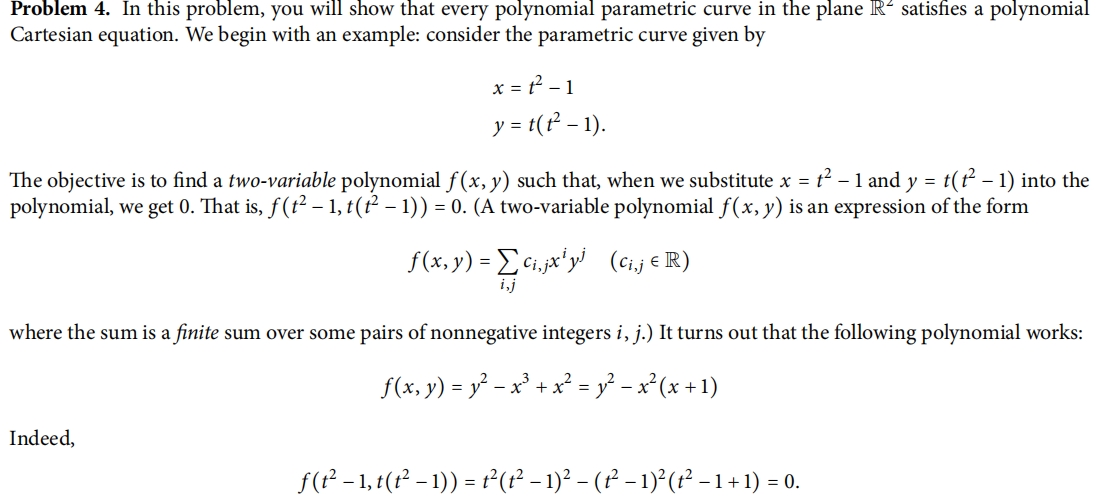
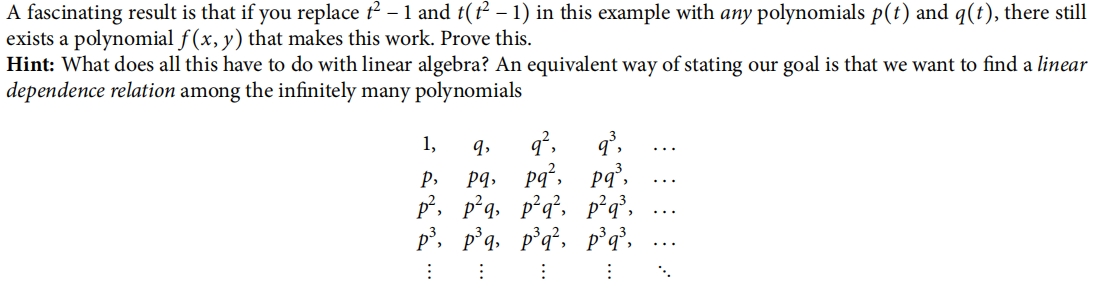
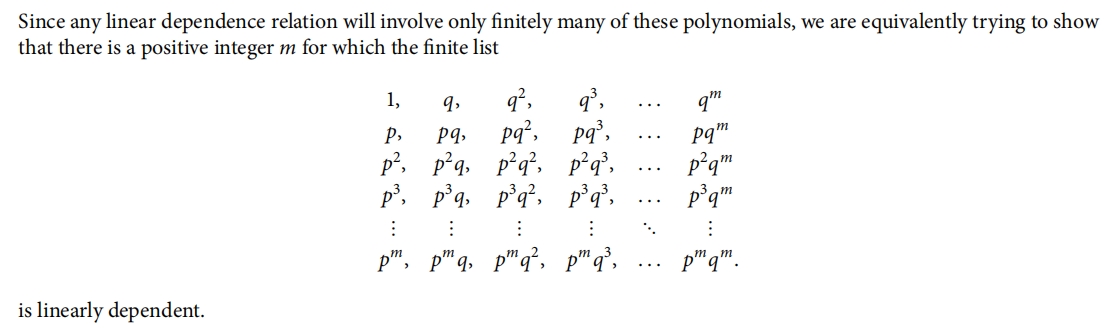
Problem 4. In this problem, you will show that every polynomial parametric curve in the plane R satisfies a polynomial Cartesian equation. We begin with an example: consider the parametric curve given by x=1-1 y = t(12 - 1). The objective is to find a two-variable polynomial f (x, y) such that, when we substitute x = t2 - 1 and y = t(2 - 1) into the polynomial, we get 0. That is, f (t2 - 1, t(12 - 1) ) = 0. (A two-variable polynomial f(x, y) is an expression of the form f ( x, y) = Ecipxly' (cijER) i,j where the sum is a finite sum over some pairs of nonnegative integers i, j.) It turns out that the following polynomial works: f(x, y) = 12 -x3 + x2 = 12 - x2(x+1) Indeed, f ( +2 - 1, t ( 12 - 1) ) = 12(+2 - 1)2 - (12 - 1)2 (12 - 1 + 1) = 0.A fascinating result is that ifyou replace :2 1 and t(t2 1) in this example with any polynomials p(r) and q(t), there still exists a polynomial f (x, y) that makes this work. Prove this. Hint: What does all this have to do with linear algebra? An equivalent way of stating our goal is that we want to nd a linear dependence relation among the innitely many polynomials 1. q. :32. as. a pa. P92: pas. P2: 1729'. fez. P293- 133. .0393 ag: P393: Since any linear dependence relation will involve only finitely many of these polynomials, we are equivalently trying to show that there is a positive integer m for which the finite list 1, 9 , 92, 93, . .. q'm P, pq, pq? , pq3, . . pam p -q, . .. p' , p'q, p q, pq, ... pam . . . . . . . . . . . . ... . . . p" q, p q, pmq', pmam is linearly dependent
Step by Step Solution
There are 3 Steps involved in it

Get step-by-step solutions from verified subject matter experts
 Study Help