







Question: Problem 4 Inside any modern computer, you will have noticed that there are several fans which circulate air around the case to remove the heat
Problem
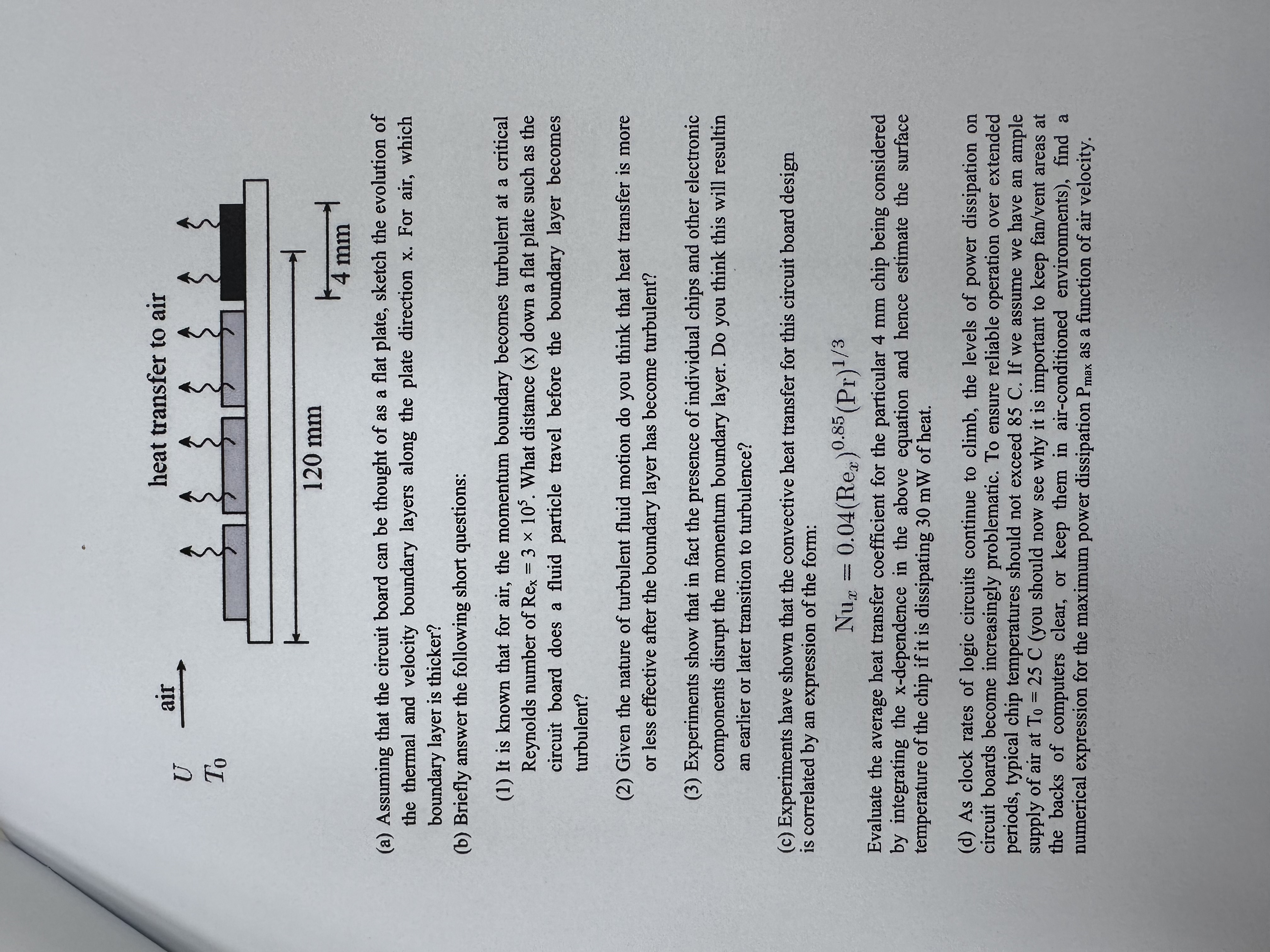
Inside any modern computer, you will have noticed that there are several fans which circulate air around the case to remove the heat generated in the silicon chips. For reliable and extended operation, it is critical that surface temperatures do not exceed preset values. Consider the geometry shown below in which forced air at is blown by a fan at across the silicon components mounted on a circuit board. The component of interest is a sensitive logic chip of size mm by mm located mm from the leading edge of the board.a Assuming that the circuit board can be thought of as a flat plate, sketch the evolution of the thermal and velocity boundary layers along the plate direction x For air, which boundary layer is thicker?
b Briefly answer the following short questions:
It is known that for air, the momentum boundary becomes turbulent at a critical Reynolds number of What distance x down a flat plate such as the circuit board does a fluid particle travel before the boundary layer becomes turbulent?
Given the nature of turbulent fluid motion do you think that heat transfer is more or less effective after the boundary layer has become turbulent?
Experiments show that in fact the presence of individual chips and other electronic components disrupt the momentum boundary layer. Do you think this will resultin an earlier or later transition to turbulence?
c Experiments have shown that the convective heat transfer for this circuit board design is correlated by an expression of the form:
Evaluate the average heat transfer coefficient for the particular mm chip being considered by integrating the dependence in the above equation and hence estimate the surface temperature of the chip if it is dissipating mW of heat.
d As clock rates of logic circuits continue to climb, the levels of power dissipation on circuit boards become increasingly problematic. To ensure reliable operation over extended periods, typical chip temperatures should not exceed C If we assume we have an ample supply of air at you should now see why it is important to keep fanvent areas at the backs of computers clear, or keep them in airconditioned environments find a numerical expression for the maximum power dissipation as a function of air velocity.
Step by Step Solution
There are 3 Steps involved in it
1 Expert Approved Answer
Step: 1 Unlock

Question Has Been Solved by an Expert!
Get step-by-step solutions from verified subject matter experts
Step: 2 Unlock
Step: 3 Unlock
 Study Help