







Question: Problem 4 (Linear Programming - Employee Scheduling): CONVERT INTO AN LP MODEL Manfred Leaks manages a large discount store. His biggest problem has been scheduling
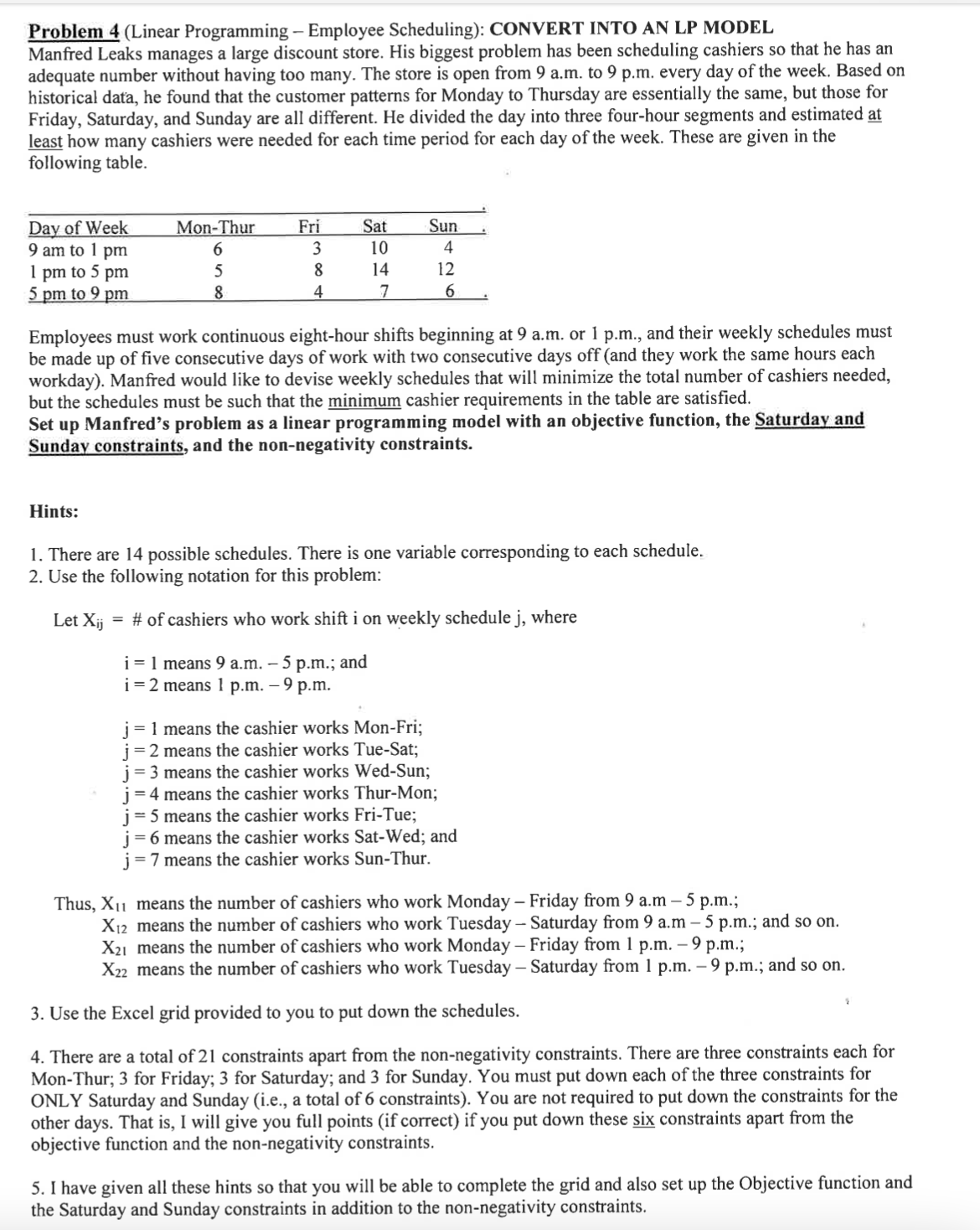
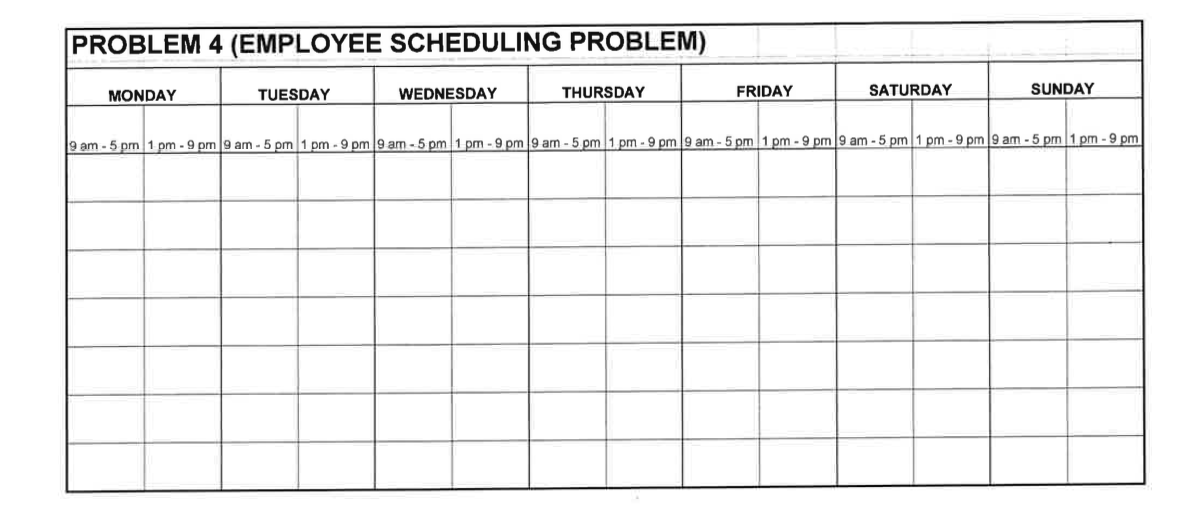
Problem 4 (Linear Programming - Employee Scheduling): CONVERT INTO AN LP MODEL Manfred Leaks manages a large discount store. His biggest problem has been scheduling cashiers so that he has an adequate number without having too many. The store is open from 9a.m. to 9 p.m. every day of the week. Based on historical data, he found that the customer patterns for Monday to Thursday are essentially the same, but those for Friday, Saturday, and Sunday are all different. He divided the day into three four-hour segments and estimated at least how many cashiers were needed for each time period for each day of the week. These are given in the following table. Employees must work continuous eight-hour shifts beginning at 9 a.m. or 1 p.m., and their weekly schedules must be made up of five consecutive days of work with two consecutive days off (and they work the same hours each workday). Manfred would like to devise weekly schedules that will minimize the total number of cashiers needed, but the schedules must be such that the minimum cashier requirements in the table are satisfied. Set up Manfred's problem as a linear programming model with an objective function, the Saturday and Sunday constraints, and the non-negativity constraints. Hints: 1. There are 14 possible schedules. There is one variable corresponding to each schedule. 2. Use the following notation for this problem: Let Xij=# of cashiers who work shift i on weekly schedule j, where i=1means9a.m.5p.m.;andi=2means1p.m.9p.m. j=1 means the cashier works Mon-Fri; j=2 means the cashier works Tue-Sat; j=3 means the cashier works Wed-Sun; j=4 means the cashier works Thur-Mon; j=5 means the cashier works Fri-Tue; j=6 means the cashier works Sat-Wed; and j=7 means the cashier works Sun-Thur. Thus, X11 means the number of cashiers who work Monday - Friday from 9 a.m -5 p.m.; X12 means the number of cashiers who work Tuesday - Saturday from 9 a.m - 5 p.m.; and so on. X21 means the number of cashiers who work Monday - Friday from 1 p.m. -9 p.m.; X22 means the number of cashiers who work Tuesday - Saturday from 1 p.m. -9 p.m.; and so on. 3. Use the Excel grid provided to you to put down the schedules. 4. There are a total of 21 constraints apart from the non-negativity constraints. There are three constraints each for Mon-Thur; 3 for Friday; 3 for Saturday; and 3 for Sunday. You must put down each of the three constraints for ONLY Saturday and Sunday (i.e., a total of 6 constraints). You are not required to put down the constraints for the other days. That is, I will give you full points (if correct) if you put down these six constraints apart from the objective function and the non-negativity constraints. 5. I have given all these hints so that you will be able to complete the grid and also set up the Objective function and the Saturday and Sunday constraints in addition to the non-negativity constraints
Step by Step Solution
There are 3 Steps involved in it

Get step-by-step solutions from verified subject matter experts
 Study Help