







Question: Problem 4. Numerical integration with Excel. Consider the normal distribution of probability density (Gaussian bell curve) with the shape parameters hi and o. N(2;4,0) 1
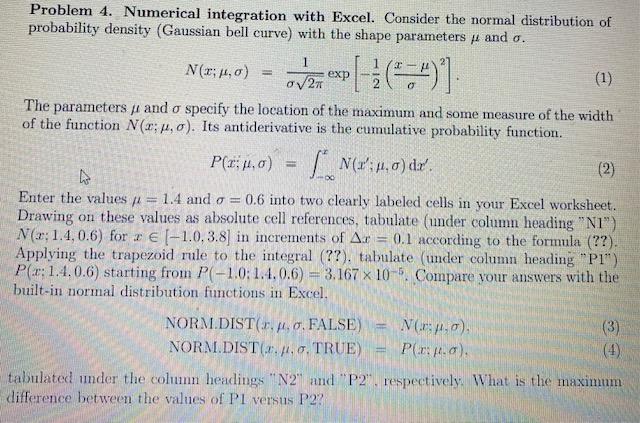
Problem 4. Numerical integration with Excel. Consider the normal distribution of probability density (Gaussian bell curve) with the shape parameters hi and o. N(2;4,0) 1 exp 0 V2 [6) (1) The parameters and o specify the location of the maximum and some measure of the width of the function N(3:44,0). Its antiderivative is the cumulative probability function. P(2:1, 0) = [(": 1, 0) dr. (2) Enter the values = 1.4 and o = 0.6 into two clearly labeled cells in your Excel worksheet. Drawing on these values as absolute cell references, tabulate (under column heading "N1") N(:1.4,0.6) for 2 (-1.0.3.8) in increments of Ar = 0.1 according to the formula (??). Applying the trapezoid rule to the integral (??). tabulate (under column heading "PI") P(4:1.4.0.6) starting from P(-1.0:1.4.0.6) = 3.167 x 10- Compare your answers with the built-in normal distribution functions in Excel. NORM.DIST... FALSE) Nr:2,0) (3) NORN.DIST.2.1. O. TRUE) Por: 1.0), tabulated under the column headings "N2" and "P2, respectively. What is the maximum difference between the values of Pl versus P2? Problem 4. Numerical integration with Excel. Consider the normal distribution of probability density (Gaussian bell curve) with the shape parameters hi and o. N(2;4,0) 1 exp 0 V2 [6) (1) The parameters and o specify the location of the maximum and some measure of the width of the function N(3:44,0). Its antiderivative is the cumulative probability function. P(2:1, 0) = [(": 1, 0) dr. (2) Enter the values = 1.4 and o = 0.6 into two clearly labeled cells in your Excel worksheet. Drawing on these values as absolute cell references, tabulate (under column heading "N1") N(:1.4,0.6) for 2 (-1.0.3.8) in increments of Ar = 0.1 according to the formula (??). Applying the trapezoid rule to the integral (??). tabulate (under column heading "PI") P(4:1.4.0.6) starting from P(-1.0:1.4.0.6) = 3.167 x 10- Compare your answers with the built-in normal distribution functions in Excel. NORM.DIST... FALSE) Nr:2,0) (3) NORN.DIST.2.1. O. TRUE) Por: 1.0), tabulated under the column headings "N2" and "P2, respectively. What is the maximum difference between the values of Pl versus P2
Step by Step Solution
There are 3 Steps involved in it

Get step-by-step solutions from verified subject matter experts
 Study Help