







Question: Problem 4 Packets arrive at a node to be transmitted. The packets arrive at random times Ti. T2. T ..., and are transmitted in the
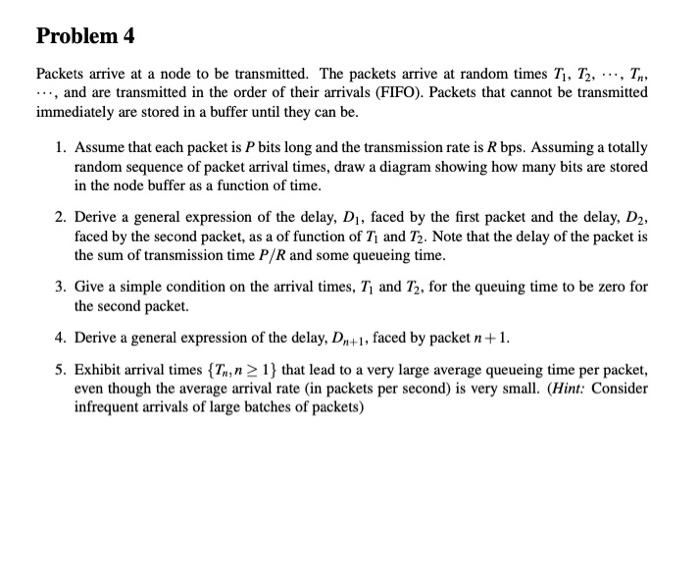
Problem 4 Packets arrive at a node to be transmitted. The packets arrive at random times Ti. T2. T ..., and are transmitted in the order of their arrivals (FIFO). Packets that cannot be transmitted immediately are stored in a buffer until they can be. 1. Assume that each packet is P bits long and the transmission rate is R bps. Assuming a totally random sequence of packet arrival times, draw a diagram showing how many bits are stored in the node buffer as a function of time. 2. Derive a general expression of the delay, Di, faced by the first packet and the delay, D2, faced by the second packet, as a of function of Ti and T. Note that the delay of the packet is the sum of transmission time P/R and some queueing time 3. Give a simple condition on the arrival times, T and T2, for the queuing time to be zero for the second packet. 4. Derive a general expression of the delay, Dn+1, faced by packet 5. Exhibit arrival times {T,n 2 1 that lead to a very large average queueing time per packet, even though the average arrival rate (in packets per second) is very small. (Hint: Consider infrequent arrivals of large batches of packets)
Step by Step Solution
There are 3 Steps involved in it

Get step-by-step solutions from verified subject matter experts
 Study Help