







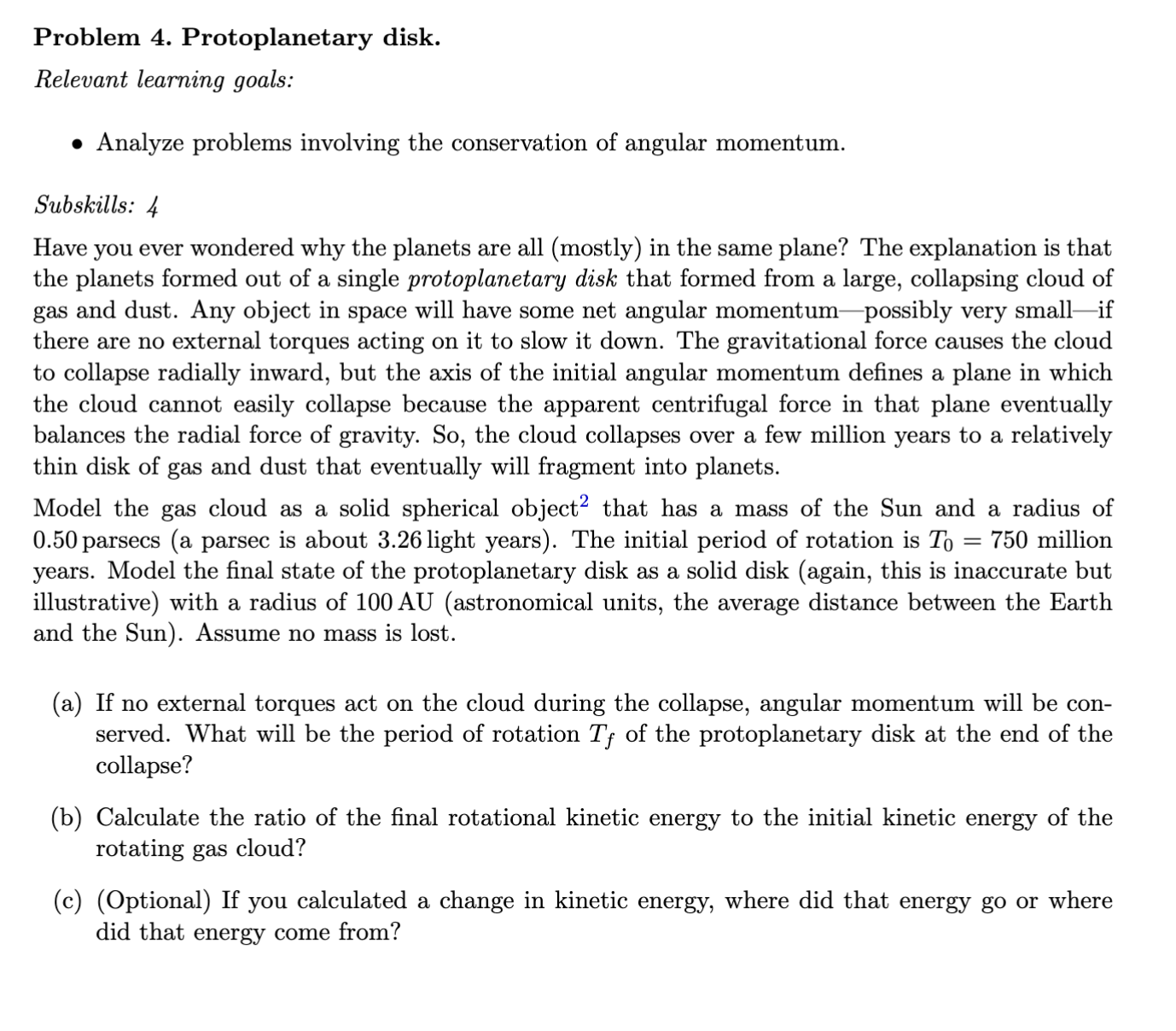
Question: Problem 4 . Protoplanetary disk. Relevant learning goals: - Analyze problems involving the conservation of angular momentum. Subskills: 4 Have you ever wondered why the
Problem Protoplanetary disk.
Relevant learning goals:
Analyze problems involving the conservation of angular momentum.
Subskills:
Have you ever wondered why the planets are all mostly in the same plane? The explanation is that the planets formed out of a single protoplanetary disk that formed from a large, collapsing cloud of gas and dust. Any object in space will have some net angular momentumpossibly very smallif there are no external torques acting on it to slow it down. The gravitational force causes the cloud to collapse radially inward, but the axis of the initial angular momentum defines a plane in which the cloud cannot easily collapse because the apparent centrifugal force in that plane eventually balances the radial force of gravity. So the cloud collapses over a few million years to a relatively thin disk of gas and dust that eventually will fragment into planets.
Model the gas cloud as a solid spherical object that has a mass of the Sun and a radius of parsecs a parsec is about light years The initial period of rotation is T million years. Model the final state of the protoplanetary disk as a solid disk again this is inaccurate but illustrative with a radius of AU astronomical units, the average distance between the Earth and the Sun Assume no mass is lost.
a If no external torques act on the cloud during the collapse, angular momentum will be conserved. What will be the period of rotation Tf of the protoplanetary disk at the end of the collapse?
b Calculate the ratio of the final rotational kinetic energy to the initial kinetic energy of the rotating gas cloud?
cOptional If you calculated a change in kinetic energy, where did that energy go or where did that energy come from?
Step by Step Solution
There are 3 Steps involved in it
1 Expert Approved Answer
Step: 1 Unlock

Question Has Been Solved by an Expert!
Get step-by-step solutions from verified subject matter experts
Step: 2 Unlock
Step: 3 Unlock
 Study Help