





Question: Problem 4: (Queueing Systems) [20 points) An electricity provider receives on average 7.2 service requests per day. The requests are received randomly according to Poisson
Problem 4: (Queueing Systems) [20 points) An

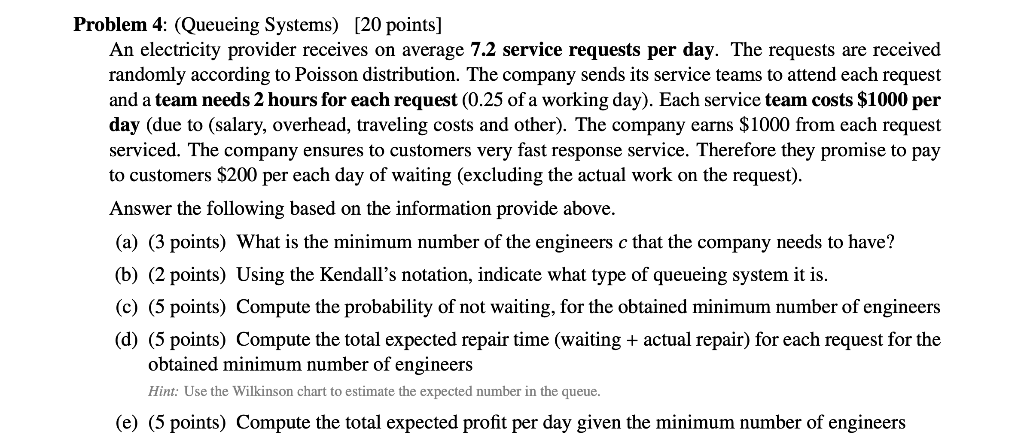
Problem 4: (Queueing Systems) [20 points) An electricity provider receives on average 7.2 service requests per day. The requests are received randomly according to Poisson distribution. The company sends its service teams to attend each request and a team needs 2 hours for each request (0.25 of a working day). Each service team costs $1000 per day (due to (salary, overhead, traveling costs and other). The company earns $1000 from each request serviced. The company ensures to customers very fast response service. Therefore they promise to pay to customers $200 per each day of waiting (excluding the actual work on the request). Answer the following based on the information provide above. (a) (3 points) What is the minimum number of the engineers c that the company needs to have? (b) (2 points) Using the Kendall's notation, indicate what type of queueing system it is. (c) (5 points) Compute the probability of not waiting, for the obtained minimum number of engineers (d) (5 points) Compute the total expected repair time (waiting + actual repair) for each request for the obtained minimum number of engineers Hint: Use the Wilkinson chart to estimate the expected number in the queue. (e) (5 points) Compute the total expected profit per day given the minimum number of engineers

Step by Step Solution

There are 3 Steps involved in it

1 Expert Approved Answer
Step: 1 Unlock blur-text-image

Question Has Been Solved by an Expert!

Get step-by-step solutions from verified subject matter experts

Step: 2 Unlock
Step: 3 Unlock

Students Have Also Explored These Related General Management Questions!