







Question: Problem 4 : Residence time JUST SOLVE PARTS e . , f . , g . You are asked to select and size reactors to
Problem : Residence time
JUST SOLVE PARTS e f g
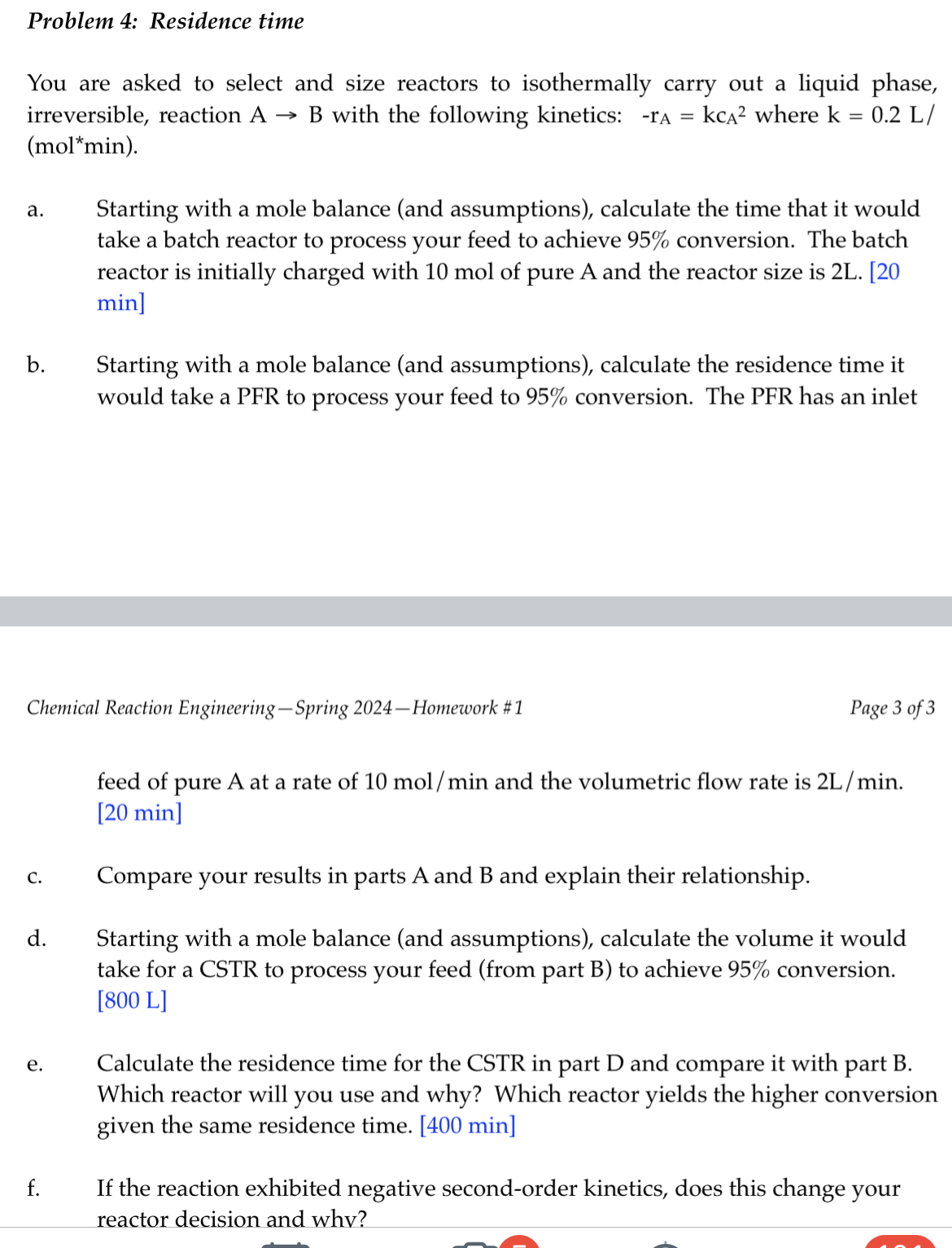
You are asked to select and size reactors to isothermally carry out a liquid phase,
irreversible, reaction A B with the following kinetics: rA kcA where k L
molmin
e Calculate the residence time for the CSTR in part D and compare it with part B
Which reactor will you use and why? Which reactor yields the higher conversion
given the same residence time. min
f If the reaction exhibited negative secondorder kinetics, does this change your
reactor decision and why?
g If the given reaction exhibited zeroorder kinetic behavior, does this influence
your decision from part E Why?Problem : Residence time
You are asked to select and size reactors to isothermally carry out a liquid phase,
irreversible, reaction with the following kinetics: where
molmin
a Starting with a mole balance and assumptions calculate the time that it would
take a batch reactor to process your feed to achieve conversion. The batch
reactor is initially charged with mol of pure A and the reactor size is L
min
b Starting with a mole balance and assumptions calculate the residence time it
would take a PFR to process your feed to conversion. The PFR has an inlet
feed of pure A at a rate of and the volumetric flow rate is
min
c Compare your results in parts A and B and explain their relationship.
d Starting with a mole balance and assumptions calculate the volume it would
take for a CSTR to process your feed from part B to achieve conversion.
L
e Calculate the residence time for the CSTR in part D and compare it with part B
Which reactor will you use and why? Which reactor yields the higher conversion
given the same residence time. min
f If the reaction exhibited negative secondorder kinetics, does this change your
reactor decision and whv
Step by Step Solution
There are 3 Steps involved in it
1 Expert Approved Answer
Step: 1 Unlock

Question Has Been Solved by an Expert!
Get step-by-step solutions from verified subject matter experts
Step: 2 Unlock
Step: 3 Unlock
 Study Help