







Question: Problem 4: Stationarity. A random process X(t, 5), te (-00, 0), is defined over the sample space S = {31 = 1,32 = 2,33 =
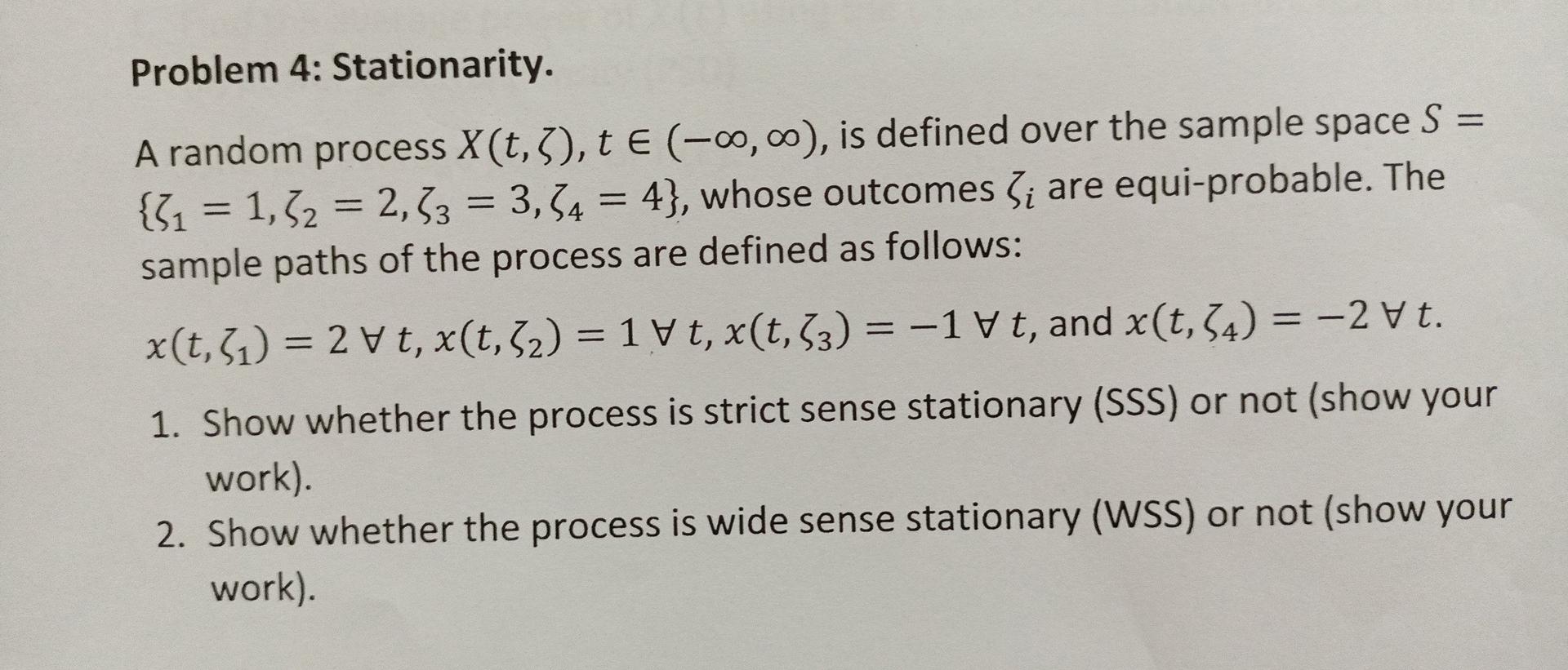
Problem 4: Stationarity. A random process X(t, 5), te (-00, 0), is defined over the sample space S = {31 = 1,32 = 2,33 = 3,34 = 4}, whose outcomes li are equi-probable. The sample paths of the process are defined as follows: x(t, 51) = 2 vt, x(t, 52) = 1 Vt, x(t, 53) = -1 Vt, and x(t, 54) = -2 Vt. 1. Show whether the process is strict sense stationary (SSS) or not (show your work). 2. Show whether the process is wide sense stationary (WSS) or not (show your work). Problem 4: Stationarity. A random process X(t, 5), te (-00, 0), is defined over the sample space S = {31 = 1,32 = 2,33 = 3,34 = 4}, whose outcomes li are equi-probable. The sample paths of the process are defined as follows: x(t, 51) = 2 vt, x(t, 52) = 1 Vt, x(t, 53) = -1 Vt, and x(t, 54) = -2 Vt. 1. Show whether the process is strict sense stationary (SSS) or not (show your work). 2. Show whether the process is wide sense stationary (WSS) or not (show your work)
Step by Step Solution
There are 3 Steps involved in it

Get step-by-step solutions from verified subject matter experts
 Study Help