







Question: Problem 4 : Using your feedback and advice but after the fact, making you a guinea pig... A rigid, cylindrical copper bar with length
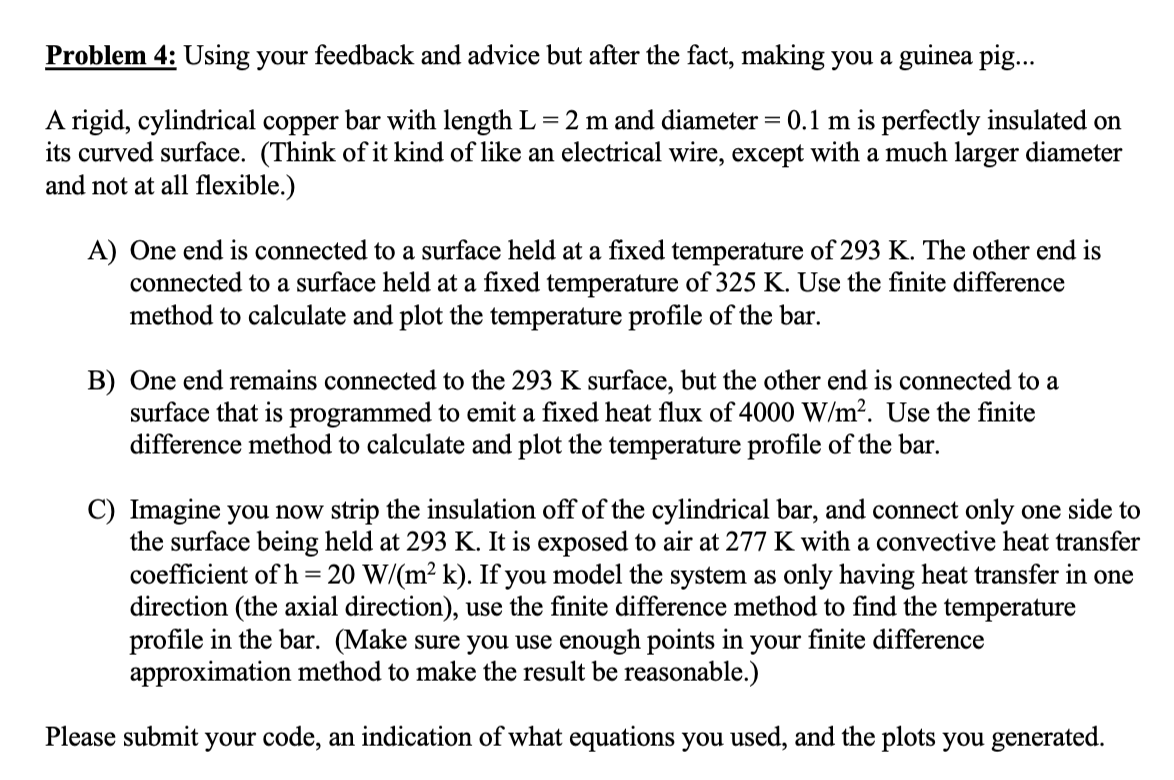
Problem : Using your feedback and advice but after the fact, making you a guinea pig...
A rigid, cylindrical copper bar with length Lmathrm~m and diameter mathrm~m is perfectly insulated on its curved surface. Think of it kind of like an electrical wire, except with a much larger diameter and not at all flexible.
A One end is connected to a surface held at a fixed temperature of K The other end is connected to a surface held at a fixed temperature of K Use the finite difference method to calculate and plot the temperature profile of the bar.
B One end remains connected to the K surface, but the other end is connected to a surface that is programmed to emit a fixed heat flux of mathrm~Wmathrmm Use the finite difference method to calculate and plot the temperature profile of the bar.
C Imagine you now strip the insulation off of the cylindrical bar, and connect only one side to the surface being held at K It is exposed to air at K with a convective heat transfer coefficient of hmathrm~Wleftmathrmmmathrmkright If you model the system as only having heat transfer in one direction the axial direction use the finite difference method to find the temperature profile in the bar. Make sure you use enough points in your finite difference approximation method to make the result be reasonable.
Please submit your code, an indication of what equations you used, and the plots you generated.
Step by Step Solution
There are 3 Steps involved in it
1 Expert Approved Answer
Step: 1 Unlock

Question Has Been Solved by an Expert!
Get step-by-step solutions from verified subject matter experts
Step: 2 Unlock
Step: 3 Unlock
 Study Help