



Question: Problem 4. We will see in lecture that if f is a piecewise continuous function of exponential order 0:, then we have ${tf(t)}(s) = F'(s),
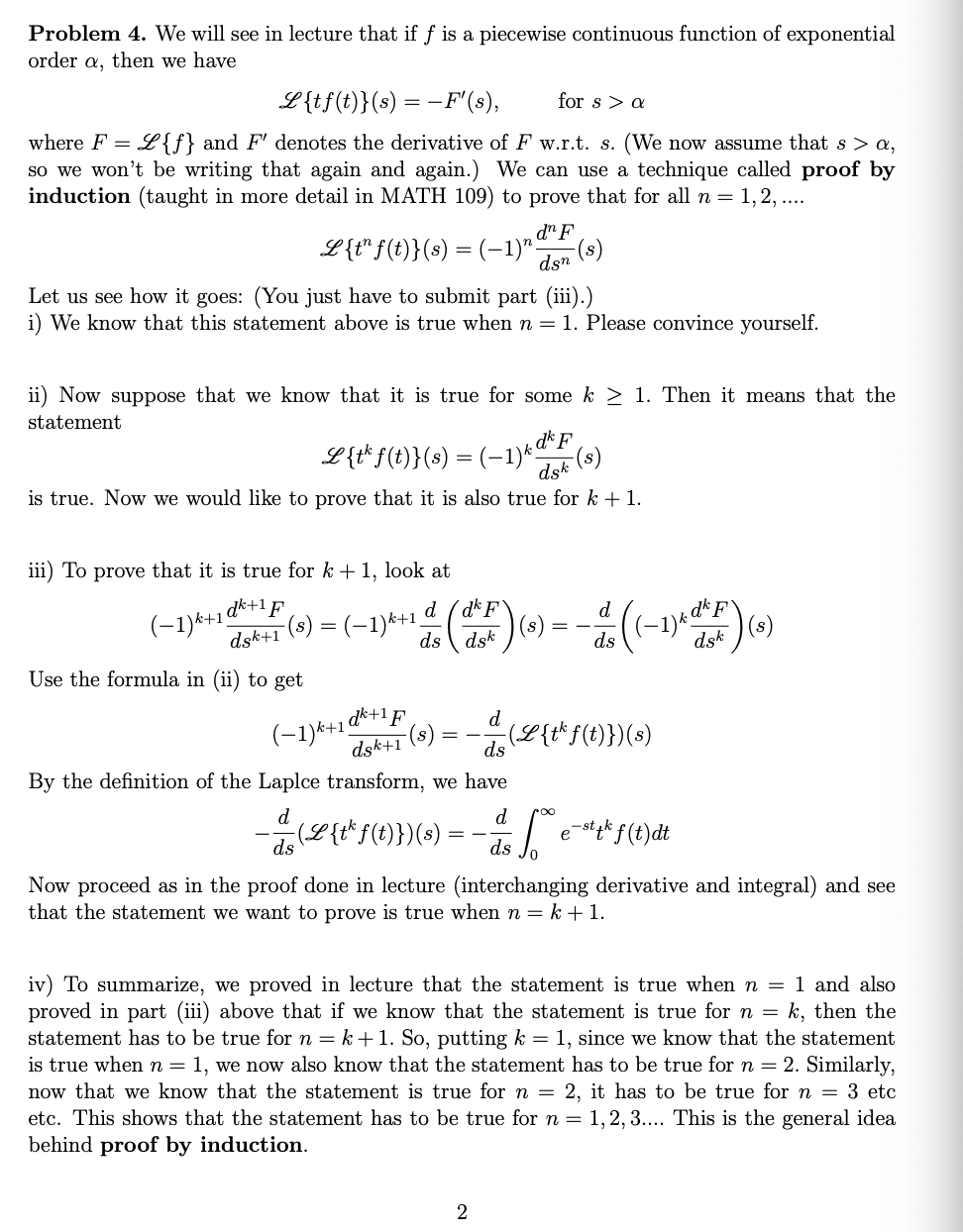
Problem 4. We will see in lecture that if f is a piecewise continuous function of exponential order 0:, then we have ${tf(t)}(s) = F'(s), for s > o: where F = ${f} and F'r denotes the derivative of F w.r.t. s. (We now assume that s > or, so we won't be writing that again and again.) We can use a technique called proof by induction (taught in more detail in MATH 109) to prove that for all n = 1,2, mamas) =(1)r('f,:f(s) Let us see how it goes: (You just have to submit part (111).) i) We know that this statement above is true when n = 1. Please convince yourself. 11) Now suppose that we know that it is true for some 16 Z 1. Then it means that the statement d}: 015 is true. Now we would like to prove that it is also true for k + 1. mamas) = (111 fk+1f,,.f s): mtww By the denition of the Laplce transform, we have 01 d C\" _, E(5f'{t"f(t)}){s) = a f e Want Now proceed as in the proof done in lecture (interchanging derivative and integral) and see that the statement we want to prove is true when n = k | 1. iv) To summarize, we proved in lecture that the statement is true when n = 1 and also proved in part (iii) above that if we know that the statement is true for n = k, then the statement has to be true for n = k + 1. So, putting k = 1, since we know that the statement is true when n = 1, we now also know that the statement has to be true for n = 2. Similarly, now that we know that the statement is true for n = 2, it has to be true for n = 3 etc etc. This shows that the statement has to be true for n = 1, 2, 3.... This is the general idea behind proof by induction
Step by Step Solution
There are 3 Steps involved in it

Get step-by-step solutions from verified subject matter experts