







Question: Problem 41 It's tempting to think that likelihood ratio tests and Wilks's theorem go hand-in-hand, i.e., that the likelihood ratio test is bad when
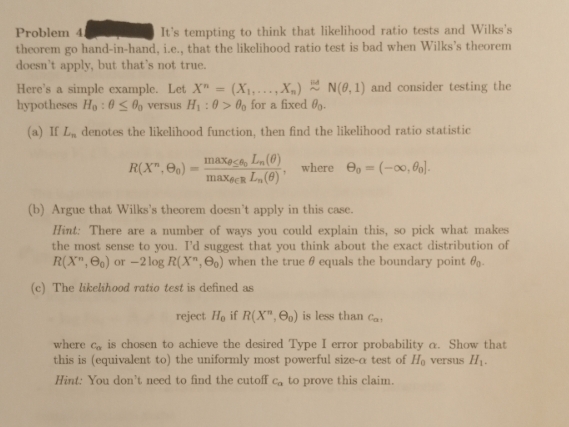
Problem 41 It's tempting to think that likelihood ratio tests and Wilks's theorem go hand-in-hand, i.e., that the likelihood ratio test is bad when Wilks's theorem doesn't apply, but that's not true. Here's a simple example. Let X" = (X....,X) N(0, 1) and consider testing the hypotheses Ho: 000 versus H:0> 0, for a fixed 00. (a) If L,, denotes the likelihood function, then find the likelihood ratio statistic R(X", 0) maxese, Ln(0) maxeek L()' where (-00,00]- (b) Argue that Wilks's theorem doesn't apply in this case. Hint: There are a number of ways you could explain this, so pick what makes the most sense to you. I'd suggest that you think about the exact distribution of R(X",e) or -2log R(X",eo) when the true 6 equals the boundary point 60- (c) The likelihood ratio test is defined as reject Ho if R(X", 80) is less than Ca where ca is chosen to achieve the desired Type I error probability a. Show that this is (equivalent to) the uniformly most powerful size-a test of Ho versus H. Hint: You don't need to find the cutoff ca to prove this claim.
Step by Step Solution
There are 3 Steps involved in it

Get step-by-step solutions from verified subject matter experts
 Study Help