







Question: Problem 4.15 (Return on Equity and Quick Ratio) eBook Problem Walk-Through Lloyd Inc. has sales of $650,000, a net income of $52,000, and the following
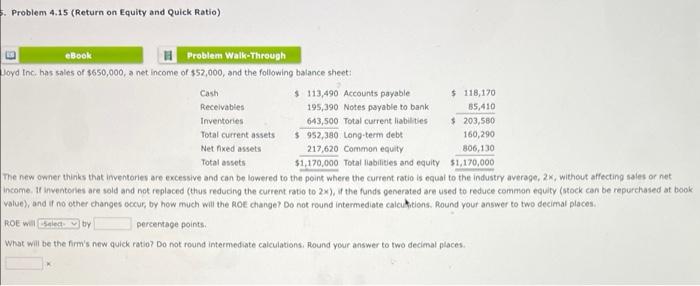

Problem 4.15 (Return on Equity and Quick Ratio) eBook Problem Walk-Through Lloyd Inc. has sales of $650,000, a net income of $52,000, and the following balance sheet: Cash $ 118,170 85,410 Receivables Inventories $113,490 Accounts payable 195,390 Notes payable to bank 643,500 Total current liabilities i $ 952,380 Long-term debt i Total current assets Net fixed assets Total assets $ 203,580 160,290 806,130 217,620 Common equity $1,170,000 Total liabilities and equity $1,170,000 The new owner thinks that inventories are excessive and can be lowered to the point where the current ratio is equal to the industry average, 2x, without affecting sales or net income. If inventories are sold and not replaced (thus reducing the current ratio to 2x), if the funds generated are used to reduce common equity (stock can be repurchased at book value), and if no other changes occur, by how much will the ROE change? Do not round intermediate calcutions. Round your answer to two decimal places. ROE will Select percentage points. What will be the firm's new quick ratio? Do not round intermediate calculations. Round your answer to two decimal places. eBook Problem Walk-Through The Stewart Company has $893,000 in current assets and $401,850 in current liabilities. Its initial inventory level is $214,320, and it will raise funds as additional notes payable and use them to increase inventory. How much can its short-term debt (notes payable) increase without pushing its current ratio below 2.07 Round your answer to the nearest dollar. $
Step by Step Solution
There are 3 Steps involved in it

Get step-by-step solutions from verified subject matter experts
 Study Help