







Question: Problem 4.2 Input e,l) applied to outer cylinder a) Derive the differential equation of motion for the fluid transmission system as shown. Rotor Fluid drive
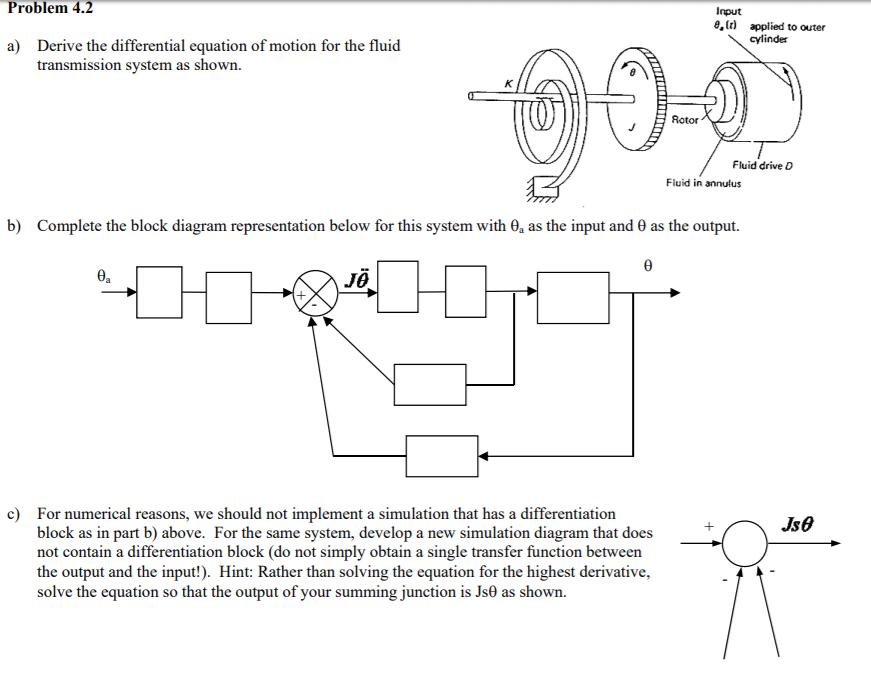
Problem 4.2 Input e,l) applied to outer cylinder a) Derive the differential equation of motion for the fluid transmission system as shown. Rotor Fluid drive D Fluid in annulus b) Complete the block diagram representation below for this system with 6, as the input and as the output. 0a c) For numerical reasons, we should not implement a simulation that has a differentiation block as in part b) above. For the same system, develop a new simulation diagram that does not contain a differentiation block (do not simply obtain a single transfer function between the output and the input!). Hint: Rather than solving the equation for the highest derivative, solve the equation so that the output of your summing junction is Js as shown. Problem 4.2 Input e,l) applied to outer cylinder a) Derive the differential equation of motion for the fluid transmission system as shown. Rotor Fluid drive D Fluid in annulus b) Complete the block diagram representation below for this system with 6, as the input and as the output. 0a c) For numerical reasons, we should not implement a simulation that has a differentiation block as in part b) above. For the same system, develop a new simulation diagram that does not contain a differentiation block (do not simply obtain a single transfer function between the output and the input!). Hint: Rather than solving the equation for the highest derivative, solve the equation so that the output of your summing junction is Js as shown
Step by Step Solution
There are 3 Steps involved in it

Get step-by-step solutions from verified subject matter experts
 Study Help