







Question: Problem 4-38 Operation Costing; Unit Cost; Cost Flow; Journal Entries (LO 4-7) Skip to question [The following information applies to the questions displayed below.] Orbital
Problem 4-38 Operation Costing; Unit Cost; Cost Flow; Journal Entries (LO 4-7)
Skip to question
[The following information applies to the questions displayed below.] Orbital Industries of Canada, Inc., manufactures a variety of materials and equipment for the aerospace industry. A team of R&D engineers in the firm's Winnipeg plant has developed a new material that will be useful for a variety of purposes in orbiting satellites and spacecraft. Tradenamed Ceralam, the material combines some of the best properties of both ceramics and laminated plastics. Ceralam is already being used for a variety of housings in satellites produced in three different countries. Ceralam sheets are produced in an operation called rolling, in which the various materials are rolled together to form a multilayer laminate. Orbital Industries sells many of these Ceralam sheets just after the rolling operation to aerospace firms worldwide. However, Orbital also processes many of the Ceralam sheets further in the Winnipeg plant. After rolling, the sheets are sent to the molding operation, where they are formed into various shapes used to house a variety of instruments. After molding, the sheets are sent to the punching operation, where holes are punched in the molded sheets to accommodate protruding instruments, electrical conduits, and so forth. Some of the molded and punched sheets are then sold. The remaining units are sent to the dipping operation, in which the molded sheets are dipped in a special chemical mixture to give them a reflective surface. During the month of March, the following products were manufactured at the Winnipeg plant. The direct-material costs are also shown.
| Units | Direct Materials Used in Ceralam Sheets | Direct Materials Used in Dipping | ||||||||||
| Ceralam sheets (sold after the rolling operation) | 6,800 | $ | 1,360,000 | |||||||||
| Nonreflective housings (sold after the punching operation) | 3,000 | 600,000 | ||||||||||
| Reflective housings (sold after the dipping operation) | 1,900 | 380,000 | 76,000 | |||||||||
| Total | 11,700 | $ | 2,340,000 | $ | 76,000 | |||||||
The costs incurred in producing the various Ceralam products in the Winnipeg plant during March are shown in the following table. Manufacturing overhead is applied on the basis of direct-labor dollars at the rate of 150 percent.
| Rolling | Molding | Punching | Dipping | ||||||||||||||
| Direct material | $ | 2,340,000 | $ | 0 | $ | 0 | $ | 76,000 | |||||||||
| Direct labor | 702,000 | 215,600 | 372,400 | 114,000 | |||||||||||||
| Manufacturing overhead | 1,053,000 | 323,400 | 558,600 | 171,000 | |||||||||||||
| Total | $ | 4,095,000 | $ | 539,000 | $ | 931,000 | $ | 361,000 | |||||||||
Orbital Industries of Canada uses operation costing for its Ceralam operations in the Winnipeg plant.
![Skip to question [The following information applies to the questions displayed below.]](https://dsd5zvtm8ll6.cloudfront.net/si.experts.images/questions/2024/10/66fe51c047cc2_10366fe51bfbf76e.jpg)
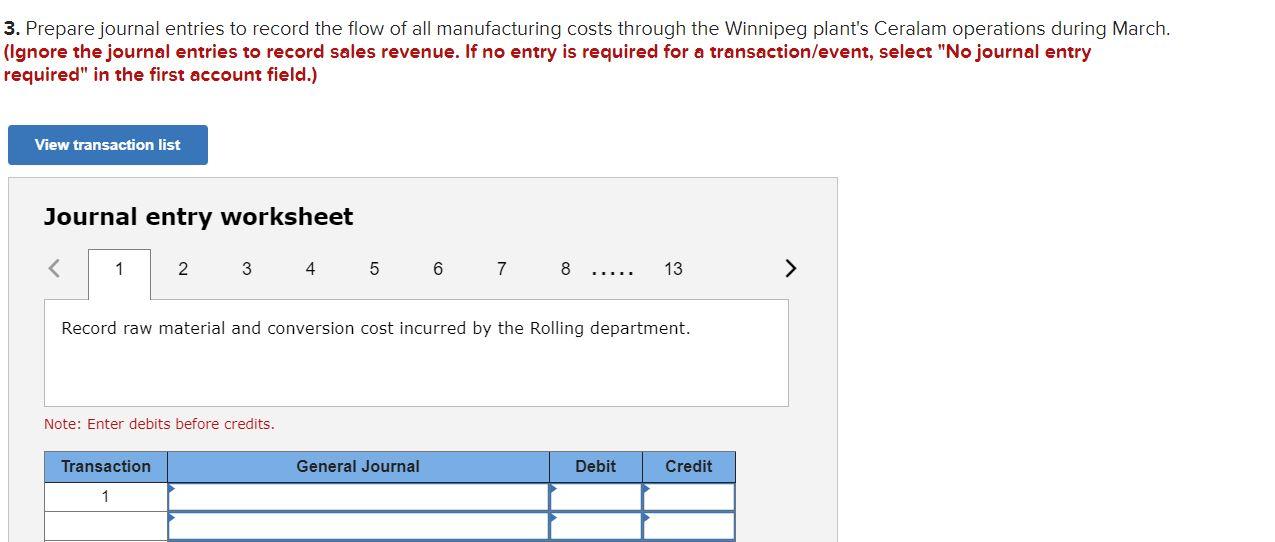
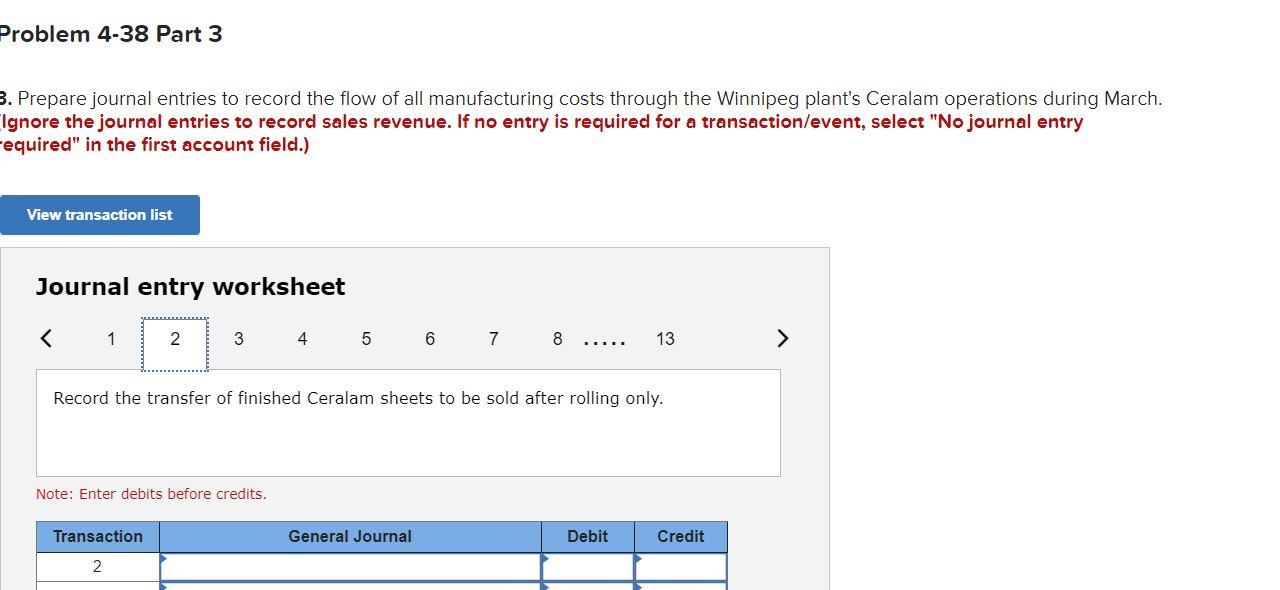
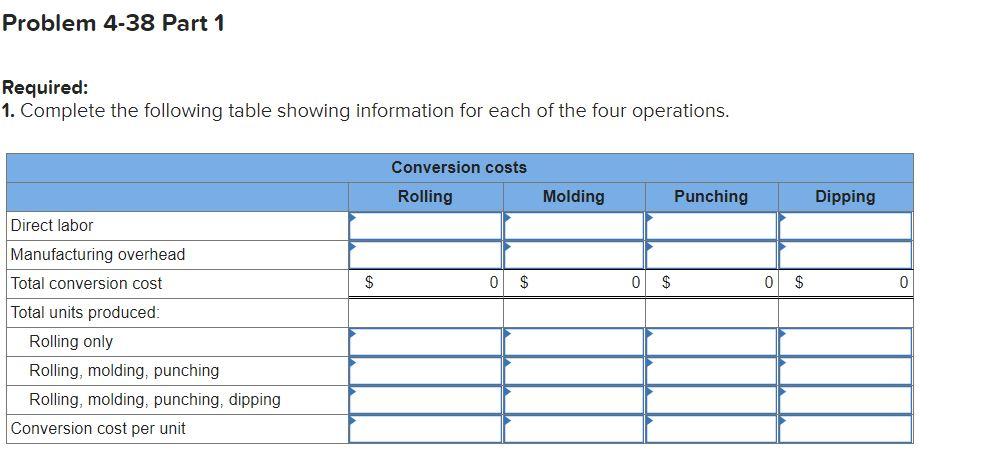
Problem 4-38 Part 1 Required: 1. Complete the following table showing information for each of the four operations. Conversion costs Rolling Molding Punching Dipping $ 0 $ 0 $ 0 $ 0 Direct labor Manufacturing overhead Total conversion cost Total units produced: Rolling only Rolling, molding, punching Rolling, molding, punching, dipping Conversion cost per unit Problem 4-38 Part 2 2. Complete the following table showing information for each product (i.e., rolled Ceralam sheets, nonreflective Ceralam housings, and reflective Ceralam housings). Product Costs Nonreflective Ceralam Sheets Ceralam Sold after Rolling Housings Reflective Ceralam Housings Total Costs Direct material: Ceralam sheets Chemical dip Conversion costs: Rolling Molding Punching Dipping Total cost Units manufactured Unit cost 3. Prepare journal entries to record the flow of all manufacturing costs through the Winnipeg plant's Ceralam operations during March. (Ignore the journal entries to record sales revenue. If no entry is required for a transaction/event, select "No journal entry required" in the first account field.) View transaction list Journal entry worksheet Record the transfer of finished Ceralam sheets to be sold after rolling only. Note: Enter debits before credits. Transaction General Journal Debit Credit 2 Problem 4-38 Part 1 Required: 1. Complete the following table showing information for each of the four operations. Conversion costs Rolling Molding Punching Dipping $ 0 $ 0 $ 0 $ 0 Direct labor Manufacturing overhead Total conversion cost Total units produced: Rolling only Rolling, molding, punching Rolling, molding, punching, dipping Conversion cost per unit Problem 4-38 Part 2 2. Complete the following table showing information for each product (i.e., rolled Ceralam sheets, nonreflective Ceralam housings, and reflective Ceralam housings). Product Costs Nonreflective Ceralam Sheets Ceralam Sold after Rolling Housings Reflective Ceralam Housings Total Costs Direct material: Ceralam sheets Chemical dip Conversion costs: Rolling Molding Punching Dipping Total cost Units manufactured Unit cost 3. Prepare journal entries to record the flow of all manufacturing costs through the Winnipeg plant's Ceralam operations during March. (Ignore the journal entries to record sales revenue. If no entry is required for a transaction/event, select "No journal entry required" in the first account field.) View transaction list Journal entry worksheet Record the transfer of finished Ceralam sheets to be sold after rolling only. Note: Enter debits before credits. Transaction General Journal Debit Credit 2
Step by Step Solution
There are 3 Steps involved in it

Get step-by-step solutions from verified subject matter experts
 Study Help