





Question: Problem 5: (18 Points) You are asked to evaluate the cost of a coastal restoration project for the state of Florida. Florida's Big Bend is
Problem 5: (18 Points) You are asked to evaluate
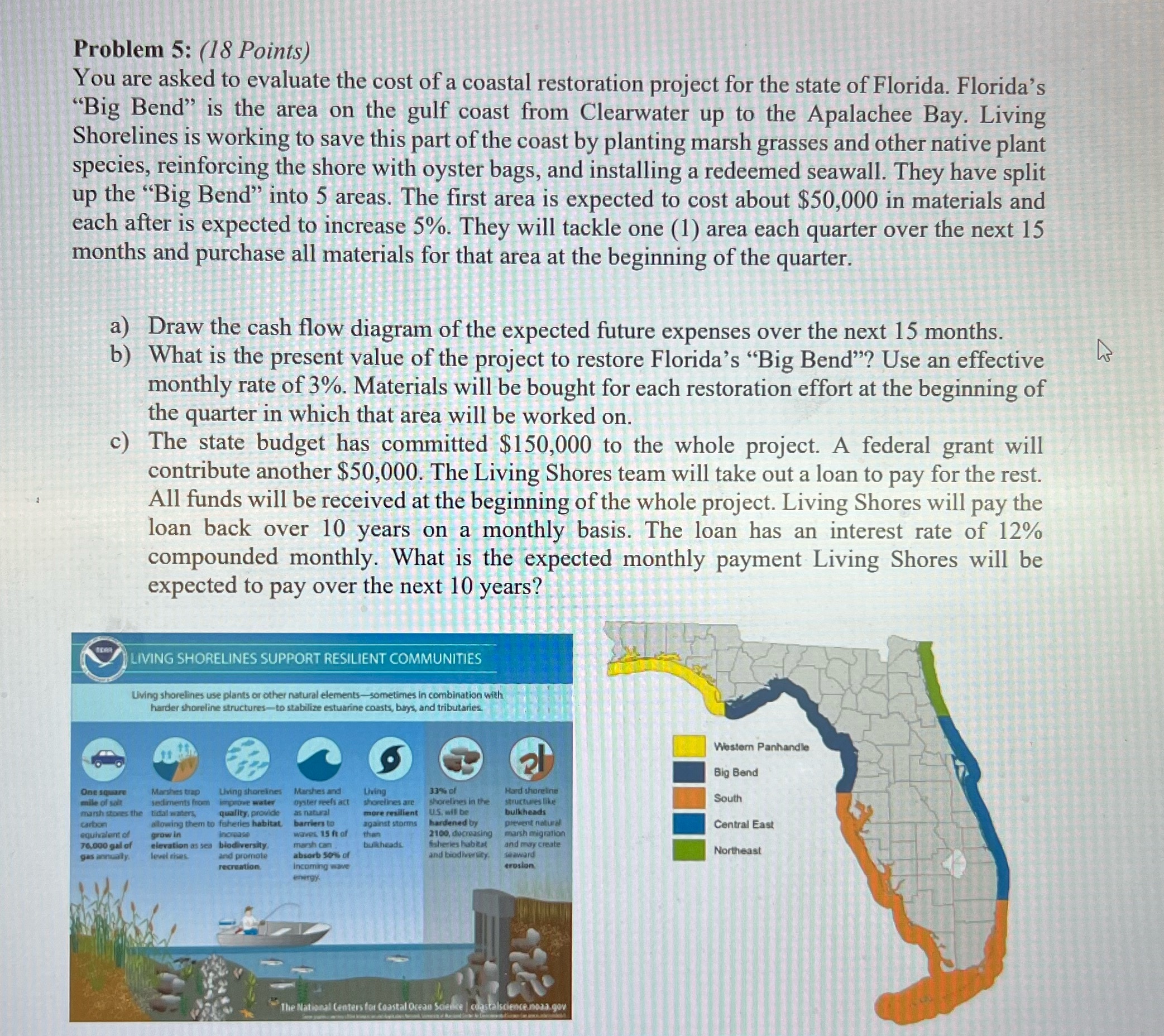
Problem 5: (18 Points) You are asked to evaluate the cost of a coastal restoration project for the state of Florida. Florida's "Big Bend" is the area on the gulf coast from Clearwater up to the Apalachee Bay. Living Shorelines is working to save this part of the coast by planting marsh grasses and other native plant species, reinforcing the shore with oyster bags, and installing a redeemed seawall. They have split up the "Big Bend" into 5 areas. The first area is expected to cost about $50,000 in materials and each after is expected to increase 5%. They will tackle one (1) area each quarter over the next 15 months and purchase all materials for that area at the beginning of the quarter. a) Draw the cash flow diagram of the expected future expenses over the next 15 months. b) What is the present value of the project to restore Florida's "Big Bend"? Use an effective monthly rate of 3%. Materials will be bought for each restoration effort at the beginning of the quarter in which that area will be worked on. c) The state budget has committed $150,000 to the whole project. A federal grant will contribute another $50,000. The Living Shores team will take out a loan to pay for the rest. All funds will be received at the beginning of the whole project. Living Shores will pay the loan back over 10 years on a monthly basis. The loan has an interest rate of 12% compounded monthly. What is the expected monthly payment Living Shores will be expected to pay over the next 10 years? IVING SHORELINES SUPPORT RESILIENT COMMUNITIES Living shorelines use plants or other natural elements-sometimes in combination with harder shoreline structures-to stabilize estuarine coasts, bays, and tributaries. Western Panhandle Big Bend One so Marshes trap Living shorein Marshes and Living Hard shoreline mile of soil sediments from oyster reefs act shorelines art structures like South pure Water shorelines in the marsh stones t tidal waters art natural more resilient U.S. will be bulkheads carbon allowing them to fisheries habitat. barriers to against storms hardened bry prevent natural Central East equivalent of grow in warves. 15 ft of than 2100, decreasing marsh migration 76,000 gal of elevation as sea biodiversity marsh can bulkheads. fisheries habeat and may create gas annualy. level rises. and promote absorb 50% of and biodiversity. seaward Northeast recreation. Incoming wave erosion energy The National Centers for Coastal Ocean Soie Iscience noaa.gov

Step by Step Solution

There are 3 Steps involved in it

1 Expert Approved Answer
Step: 1 Unlock blur-text-image

Question Has Been Solved by an Expert!

Get step-by-step solutions from verified subject matter experts

Step: 2 Unlock
Step: 3 Unlock

Students Have Also Explored These Related Finance Questions!