







Question: Problem 5 : ( 2 0 pts ) In your past fluid mechanics class, you have determined the thrust and / or specific impulse of
Problem : pts
In your past fluid mechanics class, you have determined the thrust andor specific impulse of a rocket engine, but have you ever designed one? This problem will actually teach you how to design a rocket engine!
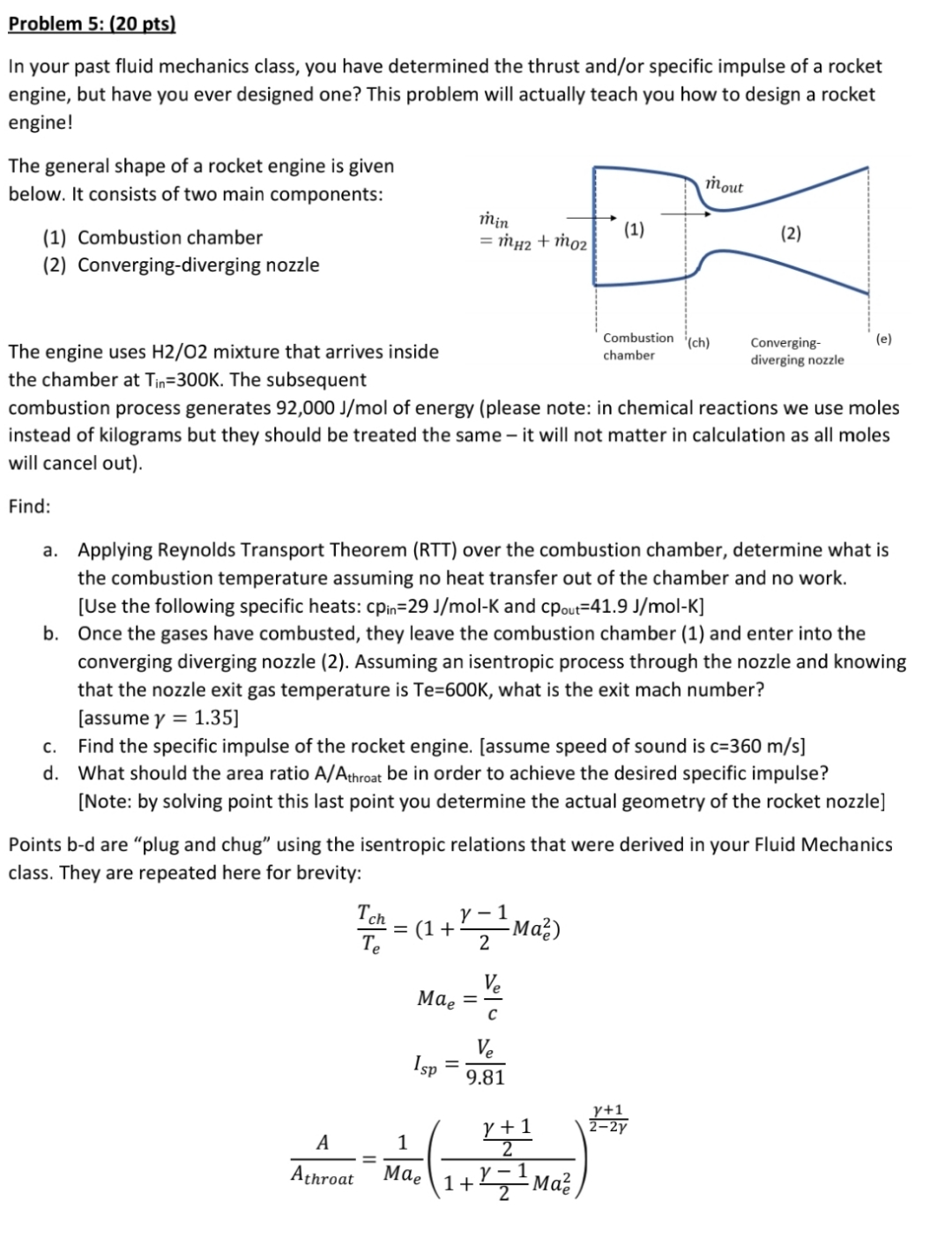
The general shape of a rocket engine is given below. It consists of two main components:
Combustion chamber
Convergingdiverging nozzle
The engine uses mixture that arrives inside the chamber at The subsequent combustion process generates of energy please note: in chemical reactions we use moles instead of kilograms but they should be treated the same it will not matter in calculation as all moles will cancel out
Find:
a Applying Reynolds Transport Theorem RTT over the combustion chamber, determine what is the combustion temperature assuming no heat transfer out of the chamber and no work.
Use the following specific heats: and
b Once the gases have combusted, they leave the combustion chamber and enter into the converging diverging nozzle Assuming an isentropic process through the nozzle and knowing that the nozzle exit gas temperature is what is the exit mach number?
assume
c Find the specific impulse of the rocket engine. assume speed of sound is
d What should the area ratio be in order to achieve the desired specific impulse?
Note: by solving point this last point you determine the actual geometry of the rocket nozzle
Points bd are "plug and chug" using the isentropic relations that were derived in your Fluid Mechanics class. They are repeated here for brevity:
Step by Step Solution
There are 3 Steps involved in it
1 Expert Approved Answer
Step: 1 Unlock

Question Has Been Solved by an Expert!
Get step-by-step solutions from verified subject matter experts
Step: 2 Unlock
Step: 3 Unlock
 Study Help