







Question: Problem 5. (20 pts) Consider the join RMS where the join predicate is R.a = S.6, given the following metadata about R and S: Relation
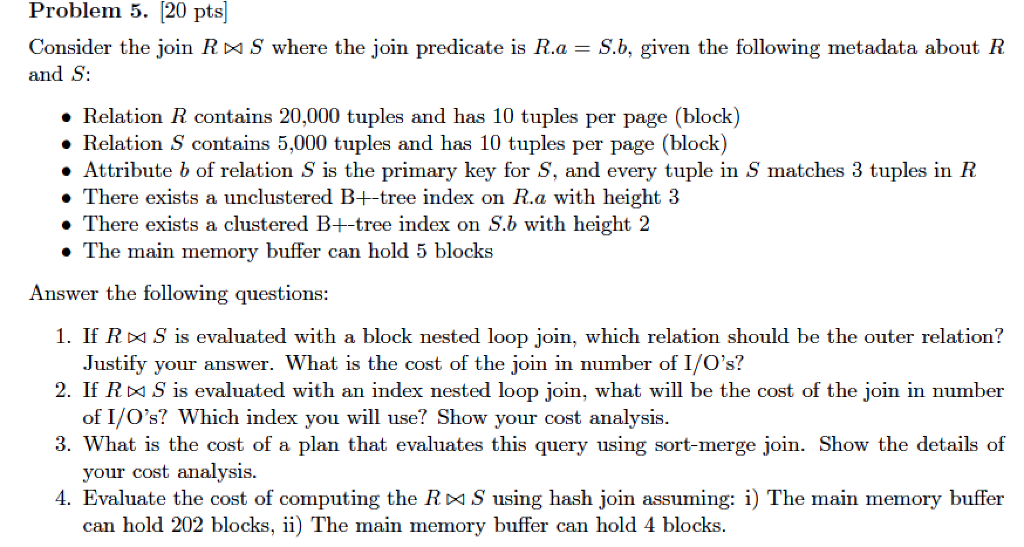
Problem 5. (20 pts) Consider the join RMS where the join predicate is R.a = S.6, given the following metadata about R and S: Relation R contains 20,000 tuples and has 10 tuples per page (block) Relation S contains 5,000 tuples and has 10 tuples per page (block) Attribute b of relation S is the primary key for S, and every tuple in S matches 3 tuples in R There exists a unclustered B+-tree index on R.a with height 3 There exists a clustered B+-tree index on S.b with height 2 The main memory buffer can hold 5 blocks Answer the following questions: 1. If RMS is evaluated with a block nested loop join, which relation should be the outer relation? Justify your answer. What is the cost of the join in number of I/0's? 2. If RM S is evaluated with an index nested loop join, what will be the cost of the join in number of I/0's? Which index you will use? Show your cost analysis. 3. What is the cost of a plan that evaluates this query using sort-merge join. Show the details of your cost analysis. 4. Evaluate the cost of computing the RMS using hash join assuming: i) The main memory buffer can hold 202 blocks, ii) The main memory buffer can hold 4 blocks. Problem 5. (20 pts) Consider the join RMS where the join predicate is R.a = S.6, given the following metadata about R and S: Relation R contains 20,000 tuples and has 10 tuples per page (block) Relation S contains 5,000 tuples and has 10 tuples per page (block) Attribute b of relation S is the primary key for S, and every tuple in S matches 3 tuples in R There exists a unclustered B+-tree index on R.a with height 3 There exists a clustered B+-tree index on S.b with height 2 The main memory buffer can hold 5 blocks Answer the following questions: 1. If RMS is evaluated with a block nested loop join, which relation should be the outer relation? Justify your answer. What is the cost of the join in number of I/0's? 2. If RM S is evaluated with an index nested loop join, what will be the cost of the join in number of I/0's? Which index you will use? Show your cost analysis. 3. What is the cost of a plan that evaluates this query using sort-merge join. Show the details of your cost analysis. 4. Evaluate the cost of computing the RMS using hash join assuming: i) The main memory buffer can hold 202 blocks, ii) The main memory buffer can hold 4 blocks
Step by Step Solution
There are 3 Steps involved in it

Get step-by-step solutions from verified subject matter experts
 Study Help