







Question: PROBLEM 5 3 In this problem we show that the relativistic velocity addition law can be used to explain the Fizeau experiment without invoking the
PROBLEM
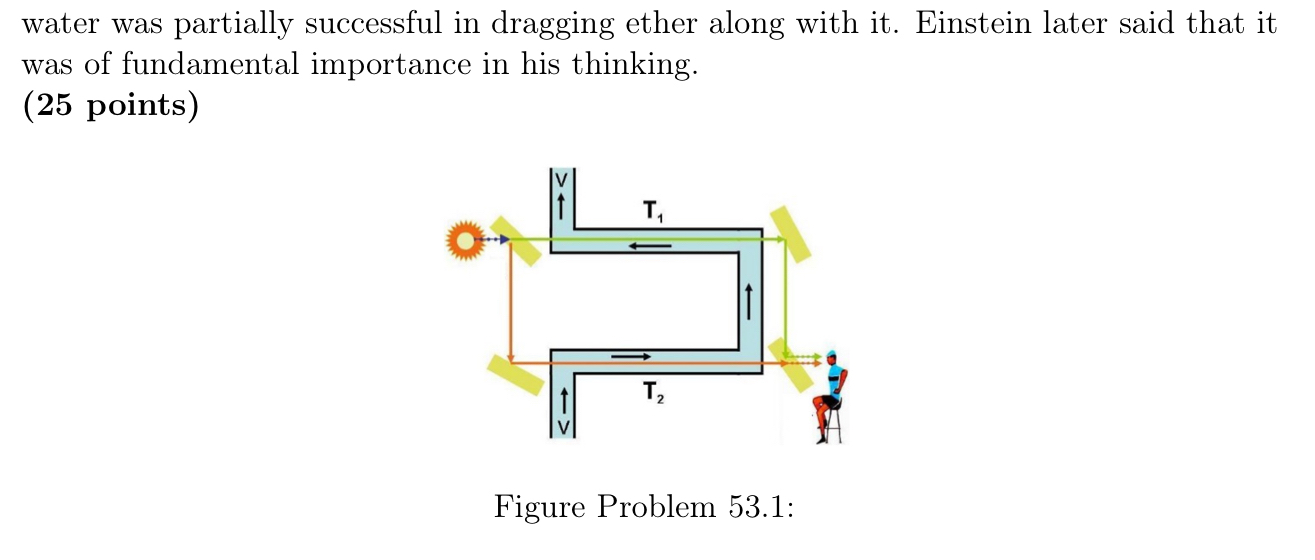
In this problem we show that the relativistic velocity addition law can be used to explain the Fizeau experiment without invoking the existence of ether. The speed of light in stationary water is less than its speed in vacuum. Traditionally it is written as where ~~ is the index of refraction of water. The water flows in the pipe with velocity In the lower arm T of the interferometer as shown in Figure Problem one would expect that, from the nonrelativistic addition law, the speed of light in the moving water would be its speed in stationary water increased by the speed of the water in the pipe: Show that the relativistic velocity addition law leads to up to higher order corrections,
The result was observed by Fizeau in but for long time viewed as a confirmation of a rather elaborate contemporary ethertheoretical calculation based on the idea that the
water was partially successful in dragging ether along with it Einstein later said that it was of fundamental importance in his thinking.
points
lgure r rodiem j:
Step by Step Solution
There are 3 Steps involved in it
1 Expert Approved Answer
Step: 1 Unlock

Question Has Been Solved by an Expert!
Get step-by-step solutions from verified subject matter experts
Step: 2 Unlock
Step: 3 Unlock
 Study Help