







Question: Problem #5: (a) Express the complex number (-2 +57) in the form a + bi. (b) Express the below complex number in the form a
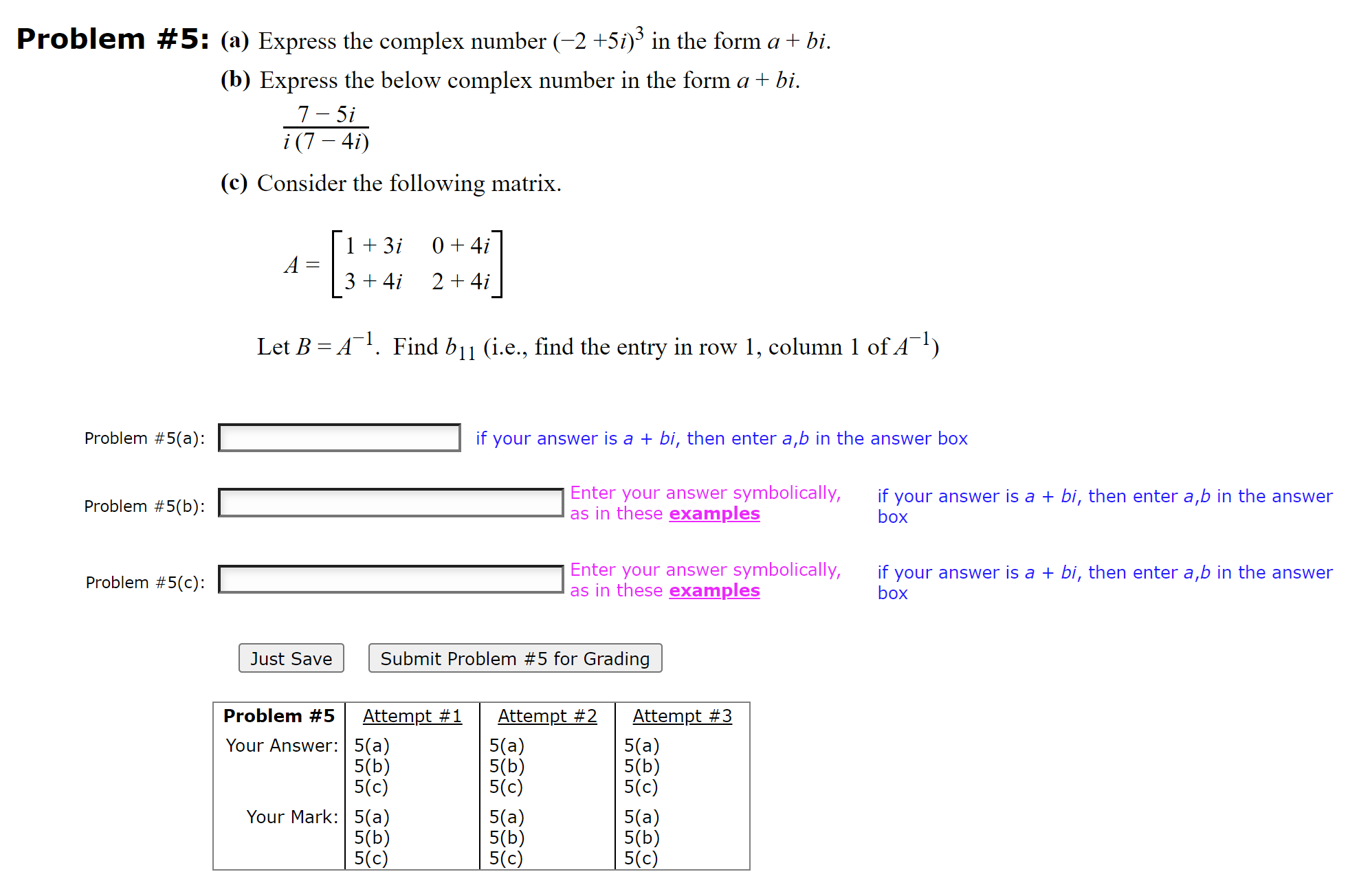
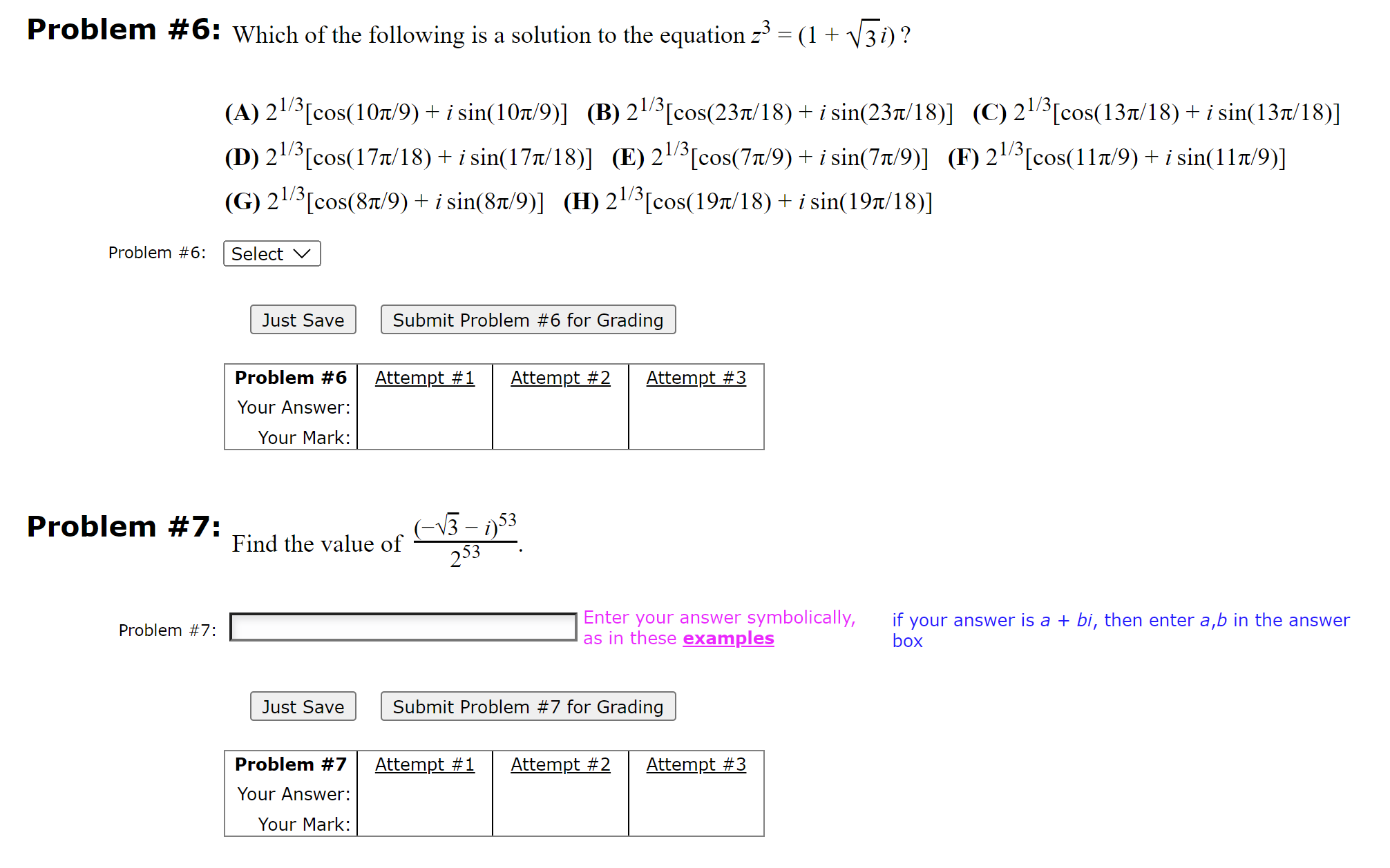
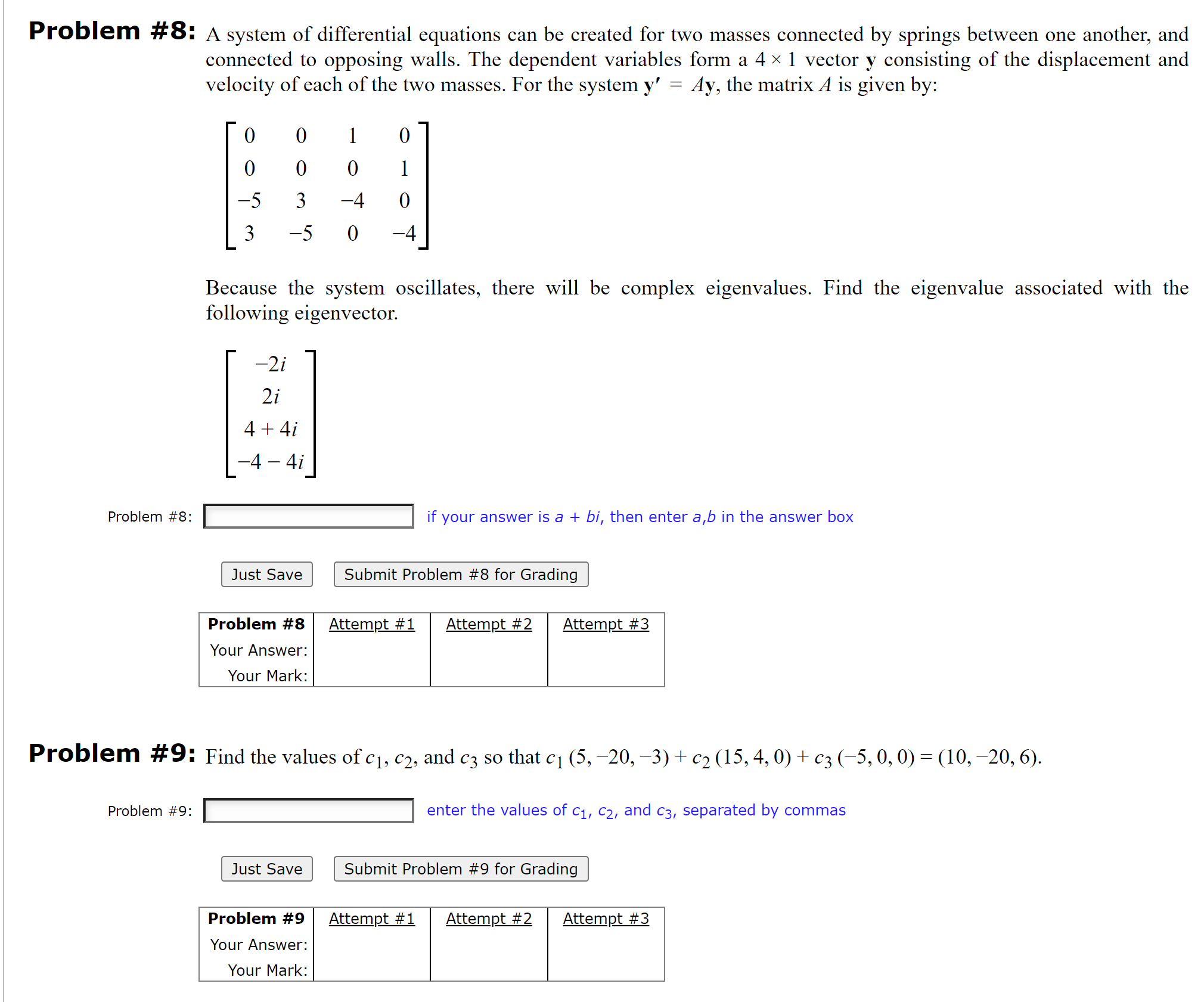
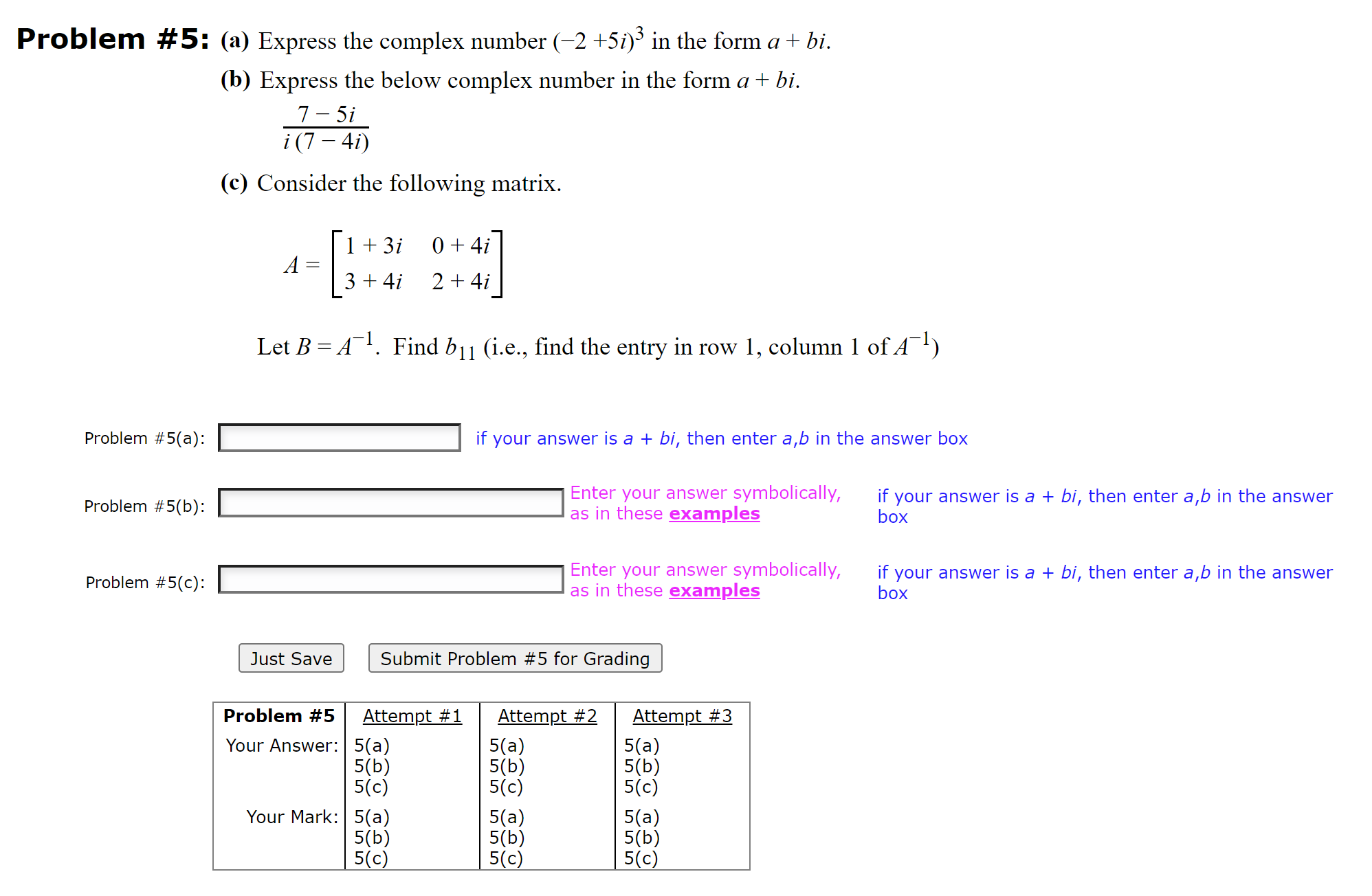
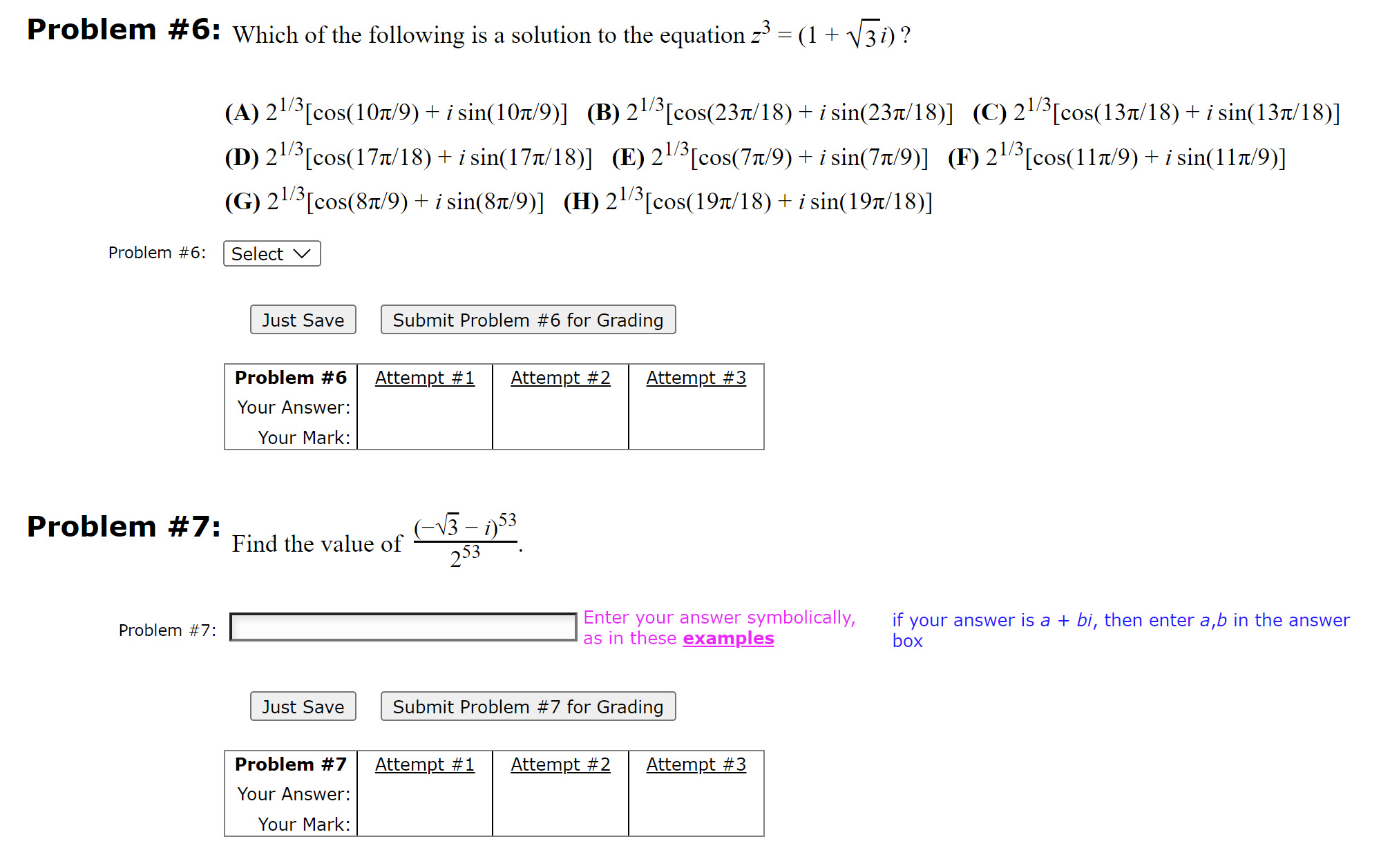
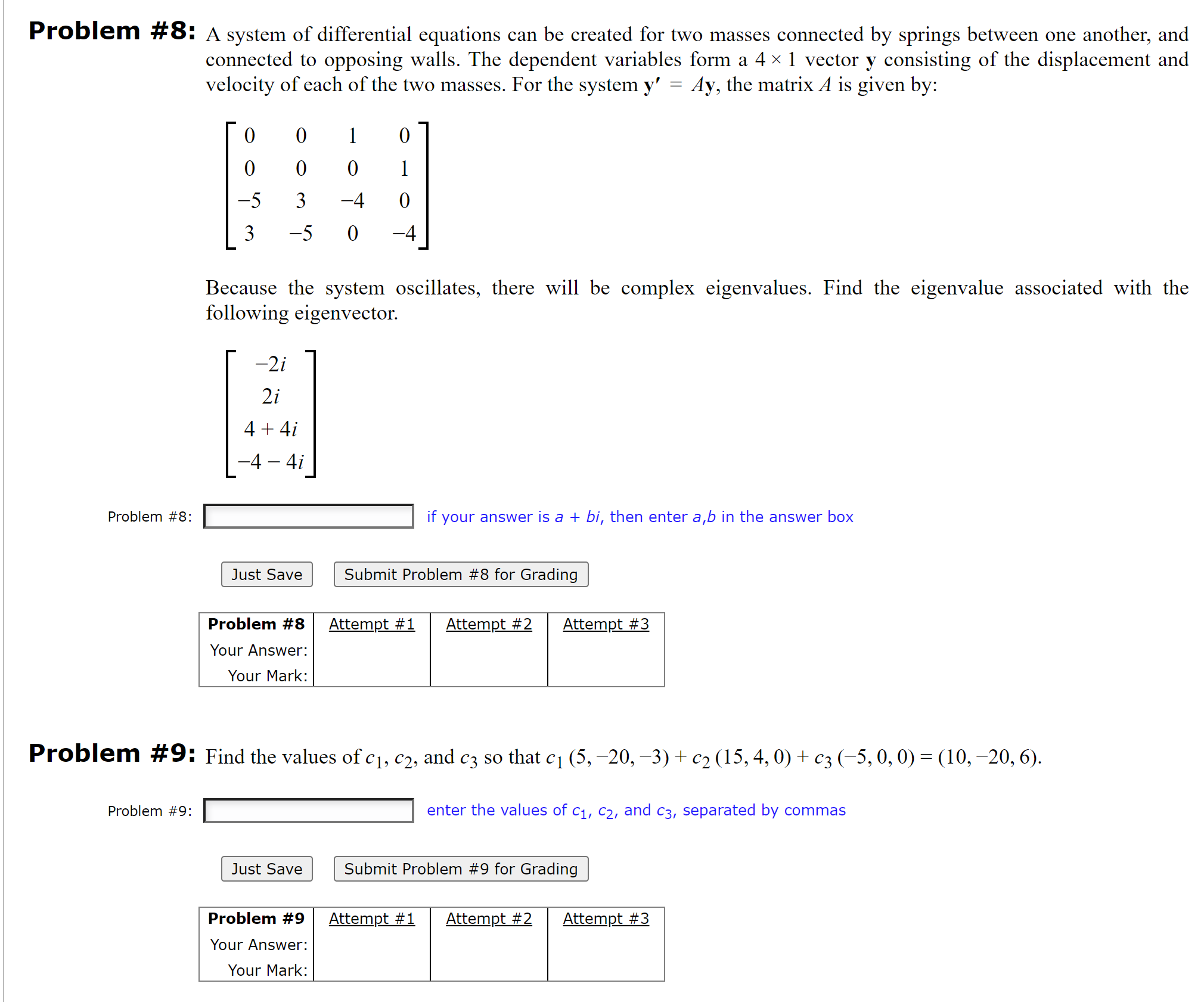
Problem #5: (a) Express the complex number (-2 +57) in the form a + bi. (b) Express the below complex number in the form a + bi. 7 - 5i i (7 - 4i) (c) Consider the following matrix. 1 + 31 0+ 4i A = 3+ 41 2 +4i Let B = A". Find b11 (i.e., find the entry in row 1, column 1 of A!) Problem #5(a): if your answer is a + bi, then enter a,b in the answer box Problem #5(b): Enter your answer symbolically, if your answer is a + bi, then enter a,b in the answer as in these examples box Problem #5(c): Enter your answer symbolically, if your answer is a + bi, then enter a,b in the answer as in these examples box Just Save Submit Problem #5 for Grading Problem #5 Attempt # 1 Attempt #2 Attempt #3 Your Answer: | 5(a) 5 (a) 5(a) 5 (b) 5(b) 5 (b ) 5 (c ) 5(c) 5 (c) Your Mark: |5(a) 5(a) 5(a) 5 (b ) 5(b) 5 (b ) 5 (c) 5 (c) 5 (c )Problem #6: Which of the following is a solution to the equation 23 = (1 + V3i) ? (A) 21/3 [cos(10n/9) + i sin(10x/9)] (B) 21/3 [cos(23x/18) + i sin(23x/18)] (C) 21/3[cos(13/18) + i sin(13x/18)] (D) 21/3 [cos(17/18) + i sin(17/18)] (E) 213[cos(7/9) + i sin(7/9)] (F) 213[cos(11x/9) + i sin(11/9)] (G) 21/3[cos(87/9) + i sin(87/9)] (H) 21/3 [cos(19x/18) + i sin(197/18)] Problem #6: Select V Just Save Submit Problem #6 for Grading Problem #6 Attempt # 1 Attempt #2 Attempt # 3 Your Answer: Your Mark: Problem #7: Find the value of (-V3 - 1)53 253 Problem #7: Enter your answer symbolically, if your answer is a + bi, then enter a,b in the answer as in these examples box Just Save Submit Problem #7 for Grading Problem #7 Attempt #1 Attempt #2 Attempt #3 Your Answer: Your Mark:Problem #8: A system of differential equations can be created for two masses connected by springs between one another, and connected to opposing walls. The dependent variables form a 4 X 1 vector y consisting of the displacement and velocity of each of the two masses. For the system y' : Ay, the matrix A is given by: Because the system oscillates, there will be complex eigenvalues. Find the eigenvalue associated with the following eigenvector. 21' 21' 4 + 41' 4 41' Problem #8: |:| if your answer is a + bi, then enter a,b in the answer box ' Just Save l I Submit Problem #8 for Grading Problem #8 Attempt #1 Attempt #2 Attempt #3 Your Answer: Your Mark: Problem #9: Find the values ofcl, c2, and c3 so that Cl (5, 2o, 3) + c2 (15, 4, 0) + c3 (5, 0, 0) : (10,20, 6). Problem #9: |:| enter the values of cl, c2, and C3, separated by commas ' Just Save I I Submit Problem #9 for Grading Problem #9 Attempt #1 Attempt #2 Attempt #3 Your Answer: Your Mark
Step by Step Solution
There are 3 Steps involved in it

Get step-by-step solutions from verified subject matter experts
 Study Help