







Question: Problem #5 a) In the 1919 regular season, Swede Risberg of the Chicago White Sox had 106 hits in 414 atbats. What percentage of his
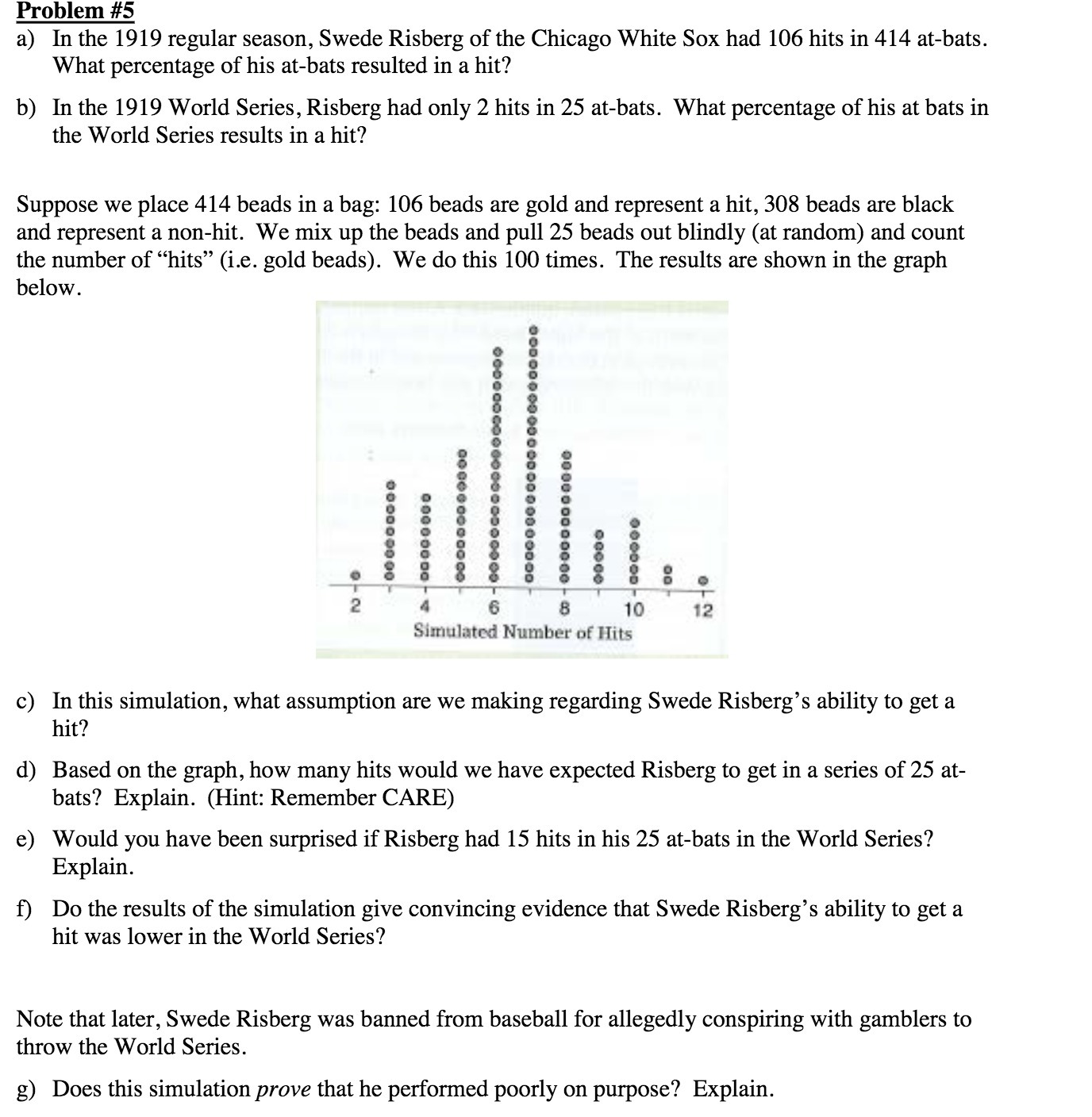
Problem #5 a) In the 1919 regular season, Swede Risberg of the Chicago White Sox had 106 hits in 414 atbats. What percentage of his atbats resulted in a hit? b) In the 1919 World Series, Risberg had only 2 hits in 25 atbats. What percentage of his at bats in the World Series results in a hit? Suppose we place 414 beads in a bag: 106 beads are gold and represent a hit, 308 beads are black and represent a nonhit. We mix up the beads and pull 25 beads out blindly (at random) and count the number of \"hits\" (i.e. gold beads). We do this 100 times. The results are shown in the graph below . 2 4 8 1 Simulated Number of Hits 0.0000000000000000000 00000000000000.00000000 000000000000 00000 000000 I. 0 1 0 m h] c) In this simulation, what assumption are we making regarding Swede Risberg's ability to get a hit? (1) Based on the graph, how many hits would we have expected Risberg to get in a series of 25 at- bats? Explain. (Hint: Remember CARE) e) Would you have been surprised if Risberg had 15 hits in his 25 atbats in the World Series? Explain. f) Do the results of the simulation give convincing evidence that Swede Risberg's ability to get a hit was lower in the World Series? Note that later, Swede Risberg was banned from baseball for allegedly conspiring with gamblers to throw the World Series. g) Does this simulation prove that he performed poorly on purpose? Explain
Step by Step Solution
There are 3 Steps involved in it

Get step-by-step solutions from verified subject matter experts
 Study Help