







Question: - Problem 5. Consider a transaction schedule S = R(A), W2(B), R3(C), R3(B), W.(C), W3(B), COMMIT3, ABORT2, COMMIT). The notation uses R:(X) and W:(X), respectively,
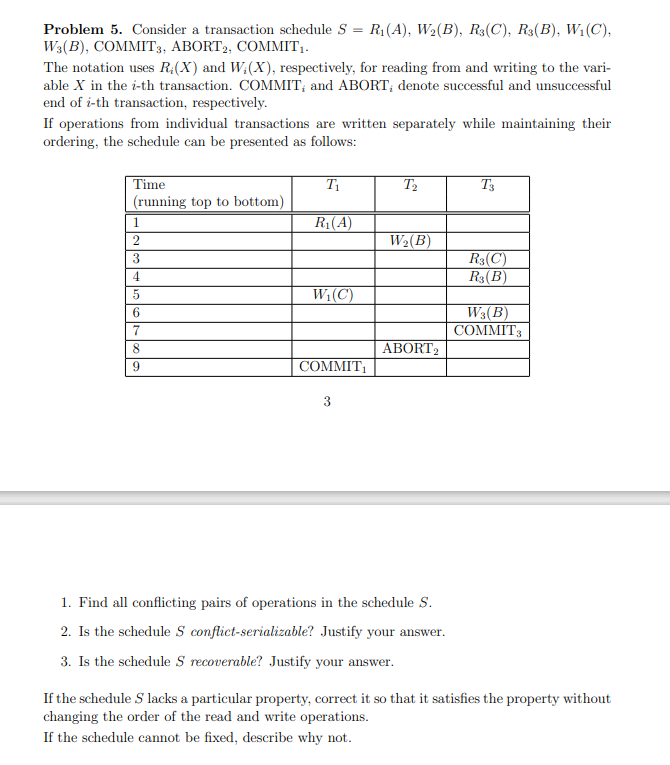
- Problem 5. Consider a transaction schedule S = R(A), W2(B), R3(C), R3(B), W.(C), W3(B), COMMIT3, ABORT2, COMMIT). The notation uses R:(X) and W:(X), respectively, for reading from and writing to the vari- able X in the i-th transaction. COMMIT, and ABORT, denote successful and unsuccessful end of i-th transaction, respectively. If operations from individual transactions are written separately while maintaining their ordering, the schedule can be presented as follows: T T Time (running top to bottom) T: 1 R1(A) W2(B) R(C) R3(B) 2 3 4 5 6 7 8 9 Wi(0) W3(B) COMMIT: ABORT, COMMIT 3 1. Find all conflicting pairs of operations in the schedule S. 2. Is the schedule S conflict-serializable? Justify your answer. 3. Is the schedule S recoverable? Justify your answer. If the schedule Slacks a particular property, correct it so that it satisfies the property without changing the order of the read and write operations. If the schedule cannot be fixed, describe why not
Step by Step Solution
There are 3 Steps involved in it

Get step-by-step solutions from verified subject matter experts
 Study Help