







Question: Problem 5: Matlab problem: O In this assignment, we will examine the design of digital IIR filters via the bilinear transform and impulse invariance techniques.
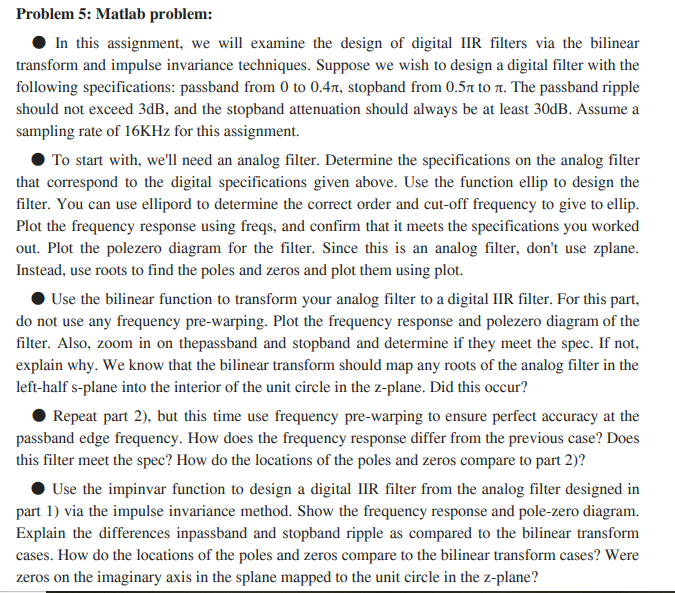
Problem 5: Matlab problem: O In this assignment, we will examine the design of digital IIR filters via the bilinear transform and impulse invariance techniques. Suppose we wish to design a digital filter with the following specifications: passband from 0 to 0.4, stopband from 0.5 to . The passband ripple should not exceed 3dB, and the stopband attenuation should always be at least 30dB. Assume a sampling rate of 16KHz for this assignment. To start with, we'll need an analog filter. Determine the specifications on the analog filter that correspond to the digital specifications given above. Use the function ellip to design the filter. You can use ellipord to determine the correct order and cut-off frequency to give to ellip Plot the frequency response using freqs, and confirm that it meets the specifications you worked out. Plot the polezero diagram for the filter. Since this is an analog filter, don't use zplane Instead, use roots to find the poles and zeros and plot them using plot. O Use the bilinear function to transform your analog filter to a digital IIR filter. For this part, do not use any frequency pre-warping. Plot the frequency response and polezero diagram of the filter. Also, zoom in on thepassband and stopband and determine if they meet the spec. If not, explain why. We know that the bilinear transform should map any roots of the analog filter in the left-half s-plane into the interior of the unit circle in the z-plane. Did this occur? O Repeat part 2), but this time use frequency pre-warping to ensure perfect accuracy at the passband edge frequency. How does the frequency response differ from the previous case? Does this filter meet the spec? How do the locations of the poles and zeros compare to part 2)? Use the impinvar function to design a digital IIR filter from the analog filter designed in part 1) via the impulse invariance method. Show the frequency response and pole-zero diagram. Explain the differences inpassband and stopband ripple as compared to the bilinear transform cases. How do the locations of the poles and zeros compare to the bilinear transform cases? Were zeros on the imaginary axis in the splane mapped to the unit circle in the z-plane? Problem 5: Matlab problem: O In this assignment, we will examine the design of digital IIR filters via the bilinear transform and impulse invariance techniques. Suppose we wish to design a digital filter with the following specifications: passband from 0 to 0.4, stopband from 0.5 to . The passband ripple should not exceed 3dB, and the stopband attenuation should always be at least 30dB. Assume a sampling rate of 16KHz for this assignment. To start with, we'll need an analog filter. Determine the specifications on the analog filter that correspond to the digital specifications given above. Use the function ellip to design the filter. You can use ellipord to determine the correct order and cut-off frequency to give to ellip Plot the frequency response using freqs, and confirm that it meets the specifications you worked out. Plot the polezero diagram for the filter. Since this is an analog filter, don't use zplane Instead, use roots to find the poles and zeros and plot them using plot. O Use the bilinear function to transform your analog filter to a digital IIR filter. For this part, do not use any frequency pre-warping. Plot the frequency response and polezero diagram of the filter. Also, zoom in on thepassband and stopband and determine if they meet the spec. If not, explain why. We know that the bilinear transform should map any roots of the analog filter in the left-half s-plane into the interior of the unit circle in the z-plane. Did this occur? O Repeat part 2), but this time use frequency pre-warping to ensure perfect accuracy at the passband edge frequency. How does the frequency response differ from the previous case? Does this filter meet the spec? How do the locations of the poles and zeros compare to part 2)? Use the impinvar function to design a digital IIR filter from the analog filter designed in part 1) via the impulse invariance method. Show the frequency response and pole-zero diagram. Explain the differences inpassband and stopband ripple as compared to the bilinear transform cases. How do the locations of the poles and zeros compare to the bilinear transform cases? Were zeros on the imaginary axis in the splane mapped to the unit circle in the z-plane
Step by Step Solution
There are 3 Steps involved in it

Get step-by-step solutions from verified subject matter experts
 Study Help