







Question: Problem 5: Study time 2 Use the same information from Problem 4 to conduct a hypothesis test to test whether the average study hours for
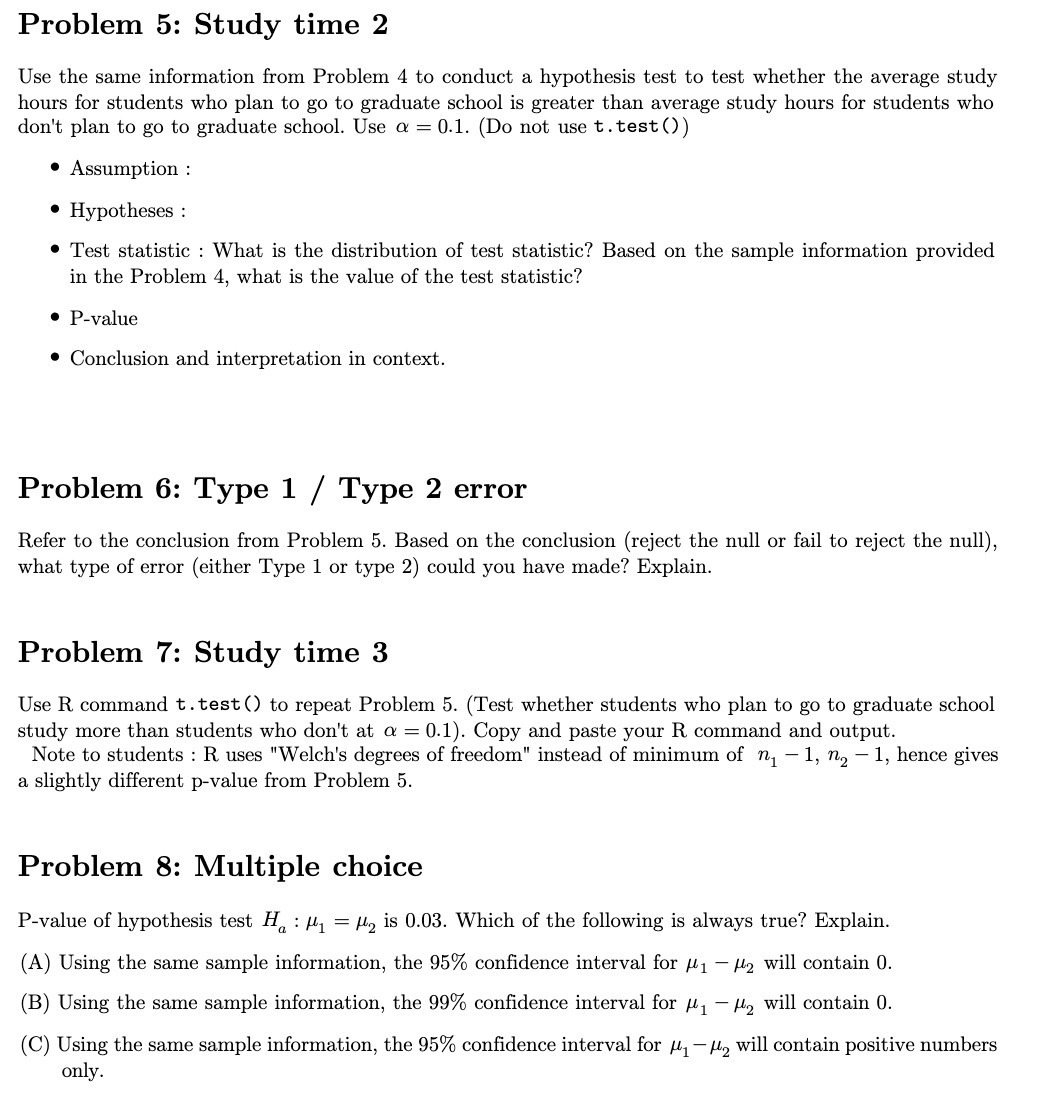
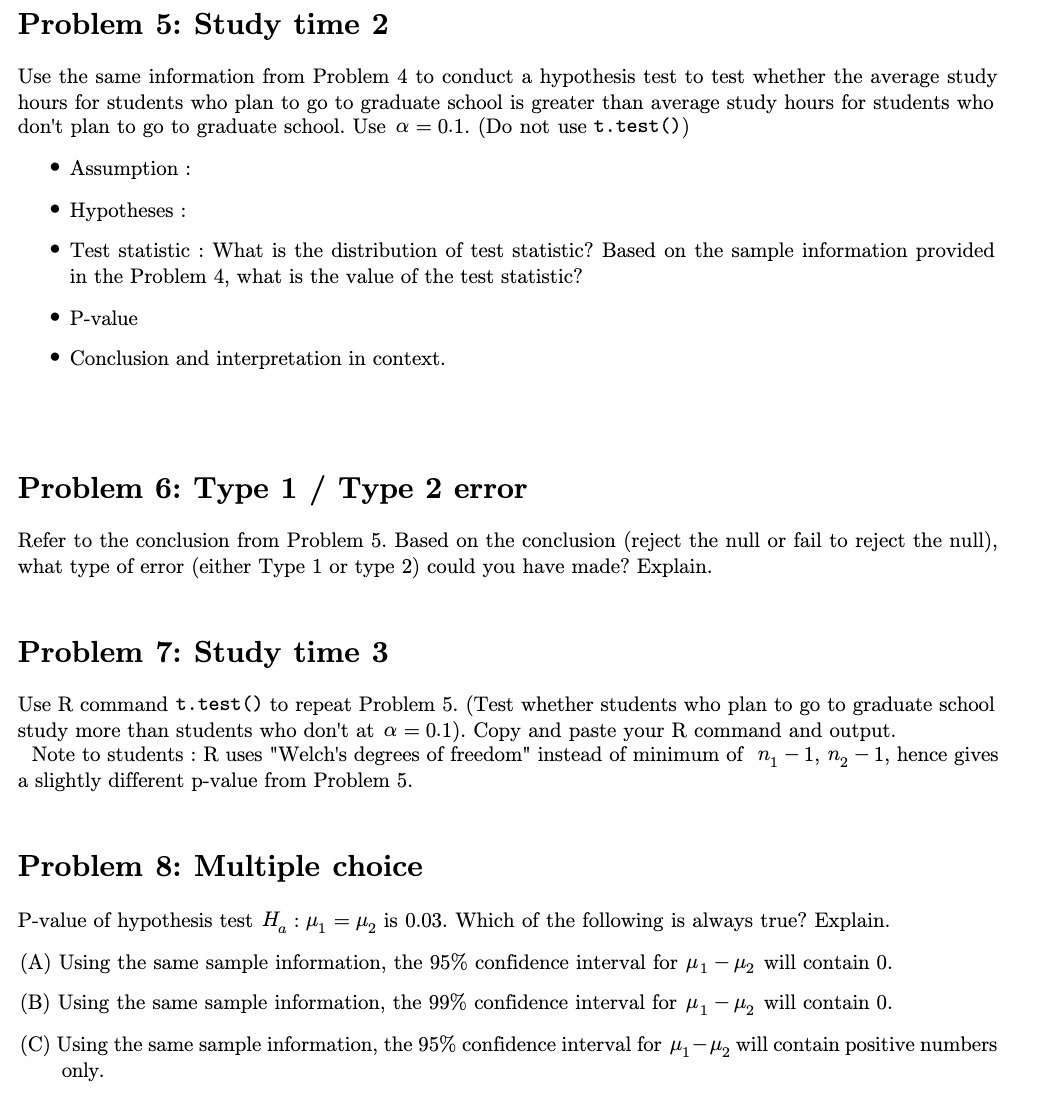
Problem 5: Study time 2 Use the same information from Problem 4 to conduct a hypothesis test to test whether the average study hours for students who plan to go to graduate school is greater than average study hours for students who don't plan to go to graduate school. Use o = 0.1. (Do not use t. test () ) . Assumption : . Hypotheses : . Test statistic : What is the distribution of test statistic? Based on the sample information provided in the Problem 4, what is the value of the test statistic? . P-value . Conclusion and interpretation in context. Problem 6: Type 1 / Type 2 error Refer to the conclusion from Problem 5. Based on the conclusion (reject the null or fail to reject the null), what type of error (either Type 1 or type 2) could you have made? Explain. Problem 7: Study time 3 Use R command t. test () to repeat Problem 5. (Test whether students who plan to go to graduate school study more than students who don't at a = 0.1). Copy and paste your R command and output. Note to students : R uses "Welch's degrees of freedom" instead of minimum of n -1, 2 -1, hence gives a slightly different p-value from Problem 5. Problem 8: Multiple choice P-value of hypothesis test Ha : / = /2 is 0.03. Which of the following is always true? Explain. (A) Using the same sample information, the 95% confidence interval for /1 - /2 will contain 0. (B) Using the same sample information, the 99% confidence interval for /1 - /2 will contain 0. (C) Using the same sample information, the 95% confidence interval for My -/, will contain positive numbers only
Step by Step Solution
There are 3 Steps involved in it

Get step-by-step solutions from verified subject matter experts
 Study Help