



Question: Problem 5: You are given a series of boxes. Each box i has a rectangular base with width Wi, and length Li, as well as
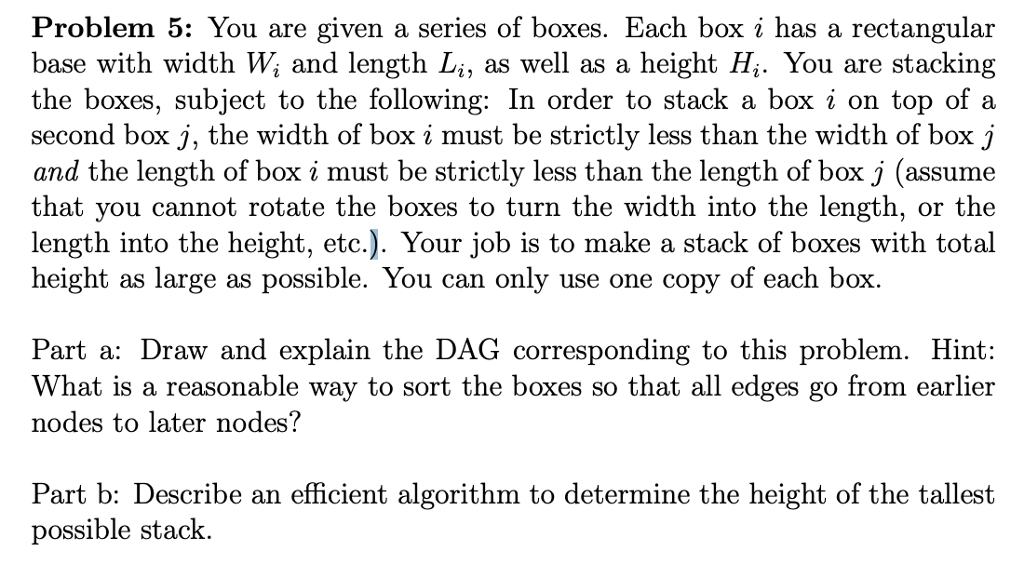
Problem 5: You are given a series of boxes. Each box i has a rectangular base with width Wi, and length Li, as well as a height Hi. You are stacking the boxes, subject to the following: In order to stack a box i on top of a second box j, the width of box i must be strictly less than the width of box j and the length of box i must be strictly less than the length of box j (assume that you cannot rotate the boxes to turn the width into the length, or the length into the height, etc.). Your job is to make a stack of boxes with total height as large as possible. You can only use one copy of each box Part a: Draw and explain the DAG corresponding to this problem. Hint: What is a reasonable way to sort the boxes so that all edges go from earlier nodes to later nodes? Part b: Describe an efficient algorithm to determine the height of the tallest possible stack. Problem 5: You are given a series of boxes. Each box i has a rectangular base with width Wi, and length Li, as well as a height Hi. You are stacking the boxes, subject to the following: In order to stack a box i on top of a second box j, the width of box i must be strictly less than the width of box j and the length of box i must be strictly less than the length of box j (assume that you cannot rotate the boxes to turn the width into the length, or the length into the height, etc.). Your job is to make a stack of boxes with total height as large as possible. You can only use one copy of each box Part a: Draw and explain the DAG corresponding to this problem. Hint: What is a reasonable way to sort the boxes so that all edges go from earlier nodes to later nodes? Part b: Describe an efficient algorithm to determine the height of the tallest possible stack
Step by Step Solution
There are 3 Steps involved in it

Get step-by-step solutions from verified subject matter experts