







Question: Problem 5.1 Assume that a 10Dbase cuboid contains only three base cells: (1) (a1, d2, d3, d4, (19, {110), [2} ((11, b2, d3, d4,..., d9,
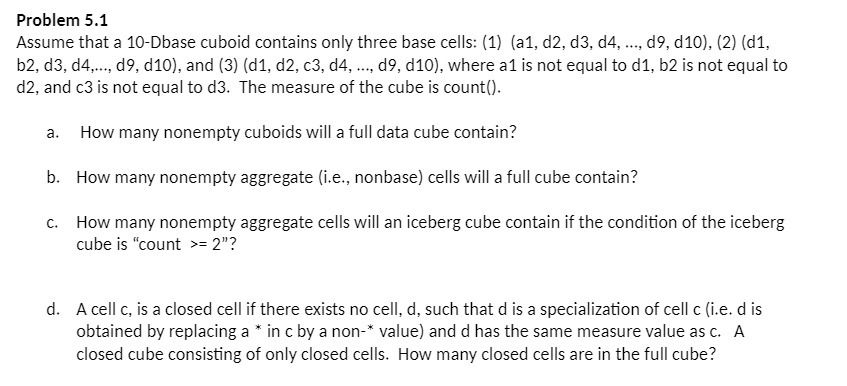
Problem 5.1 Assume that a 10Dbase cuboid contains only three base cells: (1) (a1, d2, d3, d4, (19, {110), [2} ((11, b2, d3, d4,..., d9, d101, and {3] [d1, d2, c3, d4, d9, d101, where a1 is not equal to di, b2 is not equal to d2, and c3 is not equal to d3. The measure of the cube is countl}. a. How many nonempty cu boids will a full data cube contain? b. How many nonempty aggregate lie, nonbase] cells will a full cube contain? c. How many nonempty aggregate cells will an iceberg cube contain if the condition of the iceberg cube is "count >= 2\"? d. A cell c, is a closed cell it there exists no cell, d. such that d is a specialization of cell c [i.e. d is obtained by replacing a * in c by a non* value} and d has the same measure value as c. A closed cube consisting of only closed cells. How many closed cells are in the full cu be
Step by Step Solution
There are 3 Steps involved in it

Get step-by-step solutions from verified subject matter experts
 Study Help