







Question: Problem 5.1: properties of function compositions (1+1+1 = 3 points) Let f : X - Y and g : Y - Z be two functions.
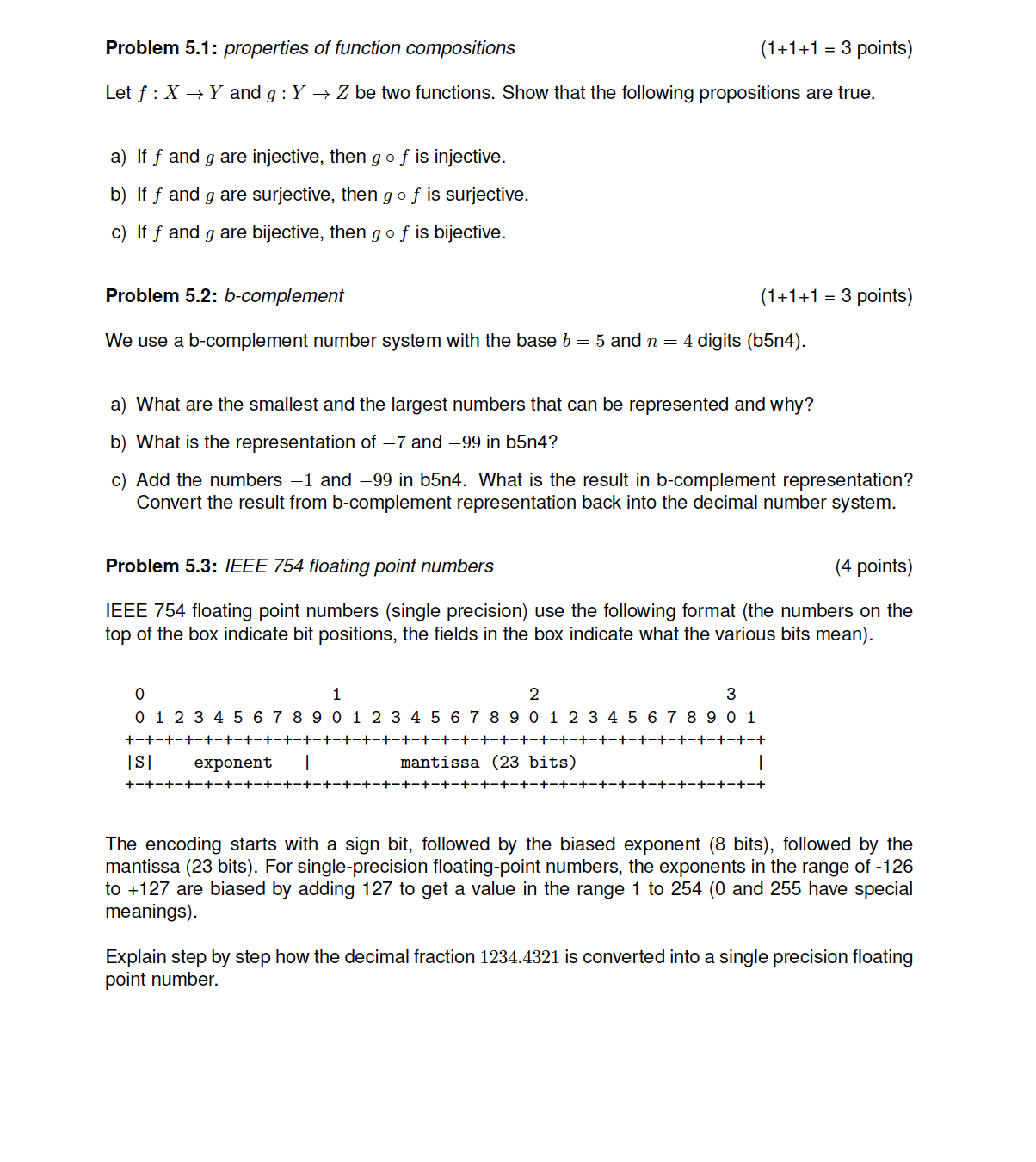
Problem 5.1: properties of function compositions (1+1+1 = 3 points) Let f : X - Y and g : Y - Z be two functions. Show that the following propositions are true. a) If f and g are injective, then go f is injective. b) If f and g are surjective, then go f is surjective. c) If f and g are bijective, then go f is bijective. Problem 5.2: b-complement (1+1+1 = 3 points) We use a b-complement number system with the base b = 5 and n = 4 digits (b5n4). a) What are the smallest and the largest numbers that can be represented and why? b) What is the representation of -7 and -99 in b5n4? c) Add the numbers -1 and -99 in b5n4. What is the result in b-complement representation? Convert the result from b-complement representation back into the decimal number system. Problem 5.3: IEEE 754 floating point numbers (4 points) IEEE 754 floating point numbers (single precision) use the following format (the numbers on the top of the box indicate bit positions, the fields in the box indicate what the various bits mean). 0 1 2 3 4 5 6 7 8 9 0 1 2 3 4 5 6 7 8 9 0 1 2 3 4 5 6 7 8 9 0 1 +-+-+-+-+-+-+-+-+-+-+-+-+-- - +-+-1 --+-+-+-+-+-+-+-+-+ ISI exponent mantissa (23 bits) +-+-+-+-+-+-+-+-+-+-+-+-+-+-+-+-+-+-+-+-+-+-+-+-+-+-+-+-+-+-+-+-+ The encoding starts with a sign bit, followed by the biased exponent (8 bits), followed by the mantissa (23 bits). For single-precision floating-point numbers, the exponents in the range of -126 to +127 are biased by adding 127 to get a value in the range 1 to 254 (0 and 255 have special meanings). Explain step by step how the decimal fraction 1234.4321 is converted into a single precision floating point number
Step by Step Solution
There are 3 Steps involved in it

Get step-by-step solutions from verified subject matter experts
 Study Help