







Question: Problem 5(20 points) Assume that you are using union adFND with path compression. Also assume that we start out with 10 singleton sets from the
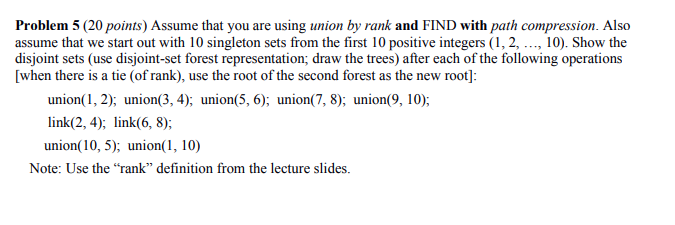
Problem 5(20 points) Assume that you are using union adFND with path compression. Also assume that we start out with 10 singleton sets from the first 10 positive integers (1,2,..., 10). Show the disjoint sets (use disjoint-set forest representation; draw the trees) after each of the following operations [when there is a tie (of rank), use the root of the second forest as the new root]: union(1, 2); union(3, 4); union(5, 6), union(7, 8), union(9, 10) link(2,4) ink(6, 8) union(10, 5); union(1, 10) Note: Use the "rank" definition from the lecture slides. Problem 5(20 points) Assume that you are using union adFND with path compression. Also assume that we start out with 10 singleton sets from the first 10 positive integers (1,2,..., 10). Show the disjoint sets (use disjoint-set forest representation; draw the trees) after each of the following operations [when there is a tie (of rank), use the root of the second forest as the new root]: union(1, 2); union(3, 4); union(5, 6), union(7, 8), union(9, 10) link(2,4) ink(6, 8) union(10, 5); union(1, 10) Note: Use the "rank" definition from the lecture slides
Step by Step Solution
There are 3 Steps involved in it

Get step-by-step solutions from verified subject matter experts
 Study Help