





Question: Problem 5.4 Consider a social choice mction that operates as follows: Three special voters are identied. The rst is the near-dictator and the other two
Problem 5.4 Consider a social choice mction that
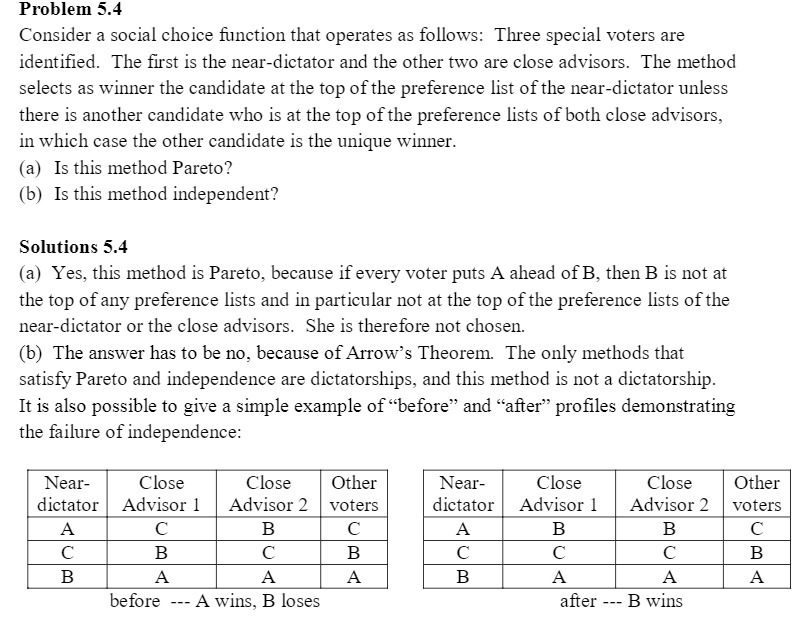
Problem 5.4 Consider a social choice mction that operates as follows: Three special voters are identied. The rst is the near-dictator and the other two are close advisers. The method selects as winner the candidate at the top of the preference list of the near-dictator unless there is another candidate who is at the top of the preference lists of both close advisers, in which case the other candidate is the unique winner. (a) Is this method Pareto? (b) Is this method independent? Solutions 5.4 (a) Yes, this method is Pareto, because if every voter puts A ahead of B, then B is not at the top of any preference lists and in particular not at the top of the preference lists of the near-dictator or the close advisers. She is therefore not chosen. (1)} The answer has to be no, because of Arrow's Theorem. The only methods that satisfy Pareto and independence are dictaterships, and this method is not a dictatorship. It is also possible to give a simple example of \"before\" and \"after\" proles demonstrating the failure of independence: Near- Close Close lOther Near- Close Close Clthe dictator Adviser] Adviser 2 voters dictator Advisorl Adviser 2 voters before --- A wins, B loses after --- B wins

Step by Step Solution

There are 3 Steps involved in it

1 Expert Approved Answer
Step: 1 Unlock blur-text-image

Question Has Been Solved by an Expert!

Get step-by-step solutions from verified subject matter experts

Step: 2 Unlock
Step: 3 Unlock

Students Have Also Explored These Related Mathematics Questions!