







Question: Problem 6 ( 1 5 pts . ) : A low subsonic closed - loop wind tunnel is to be fitted with a flow straightener
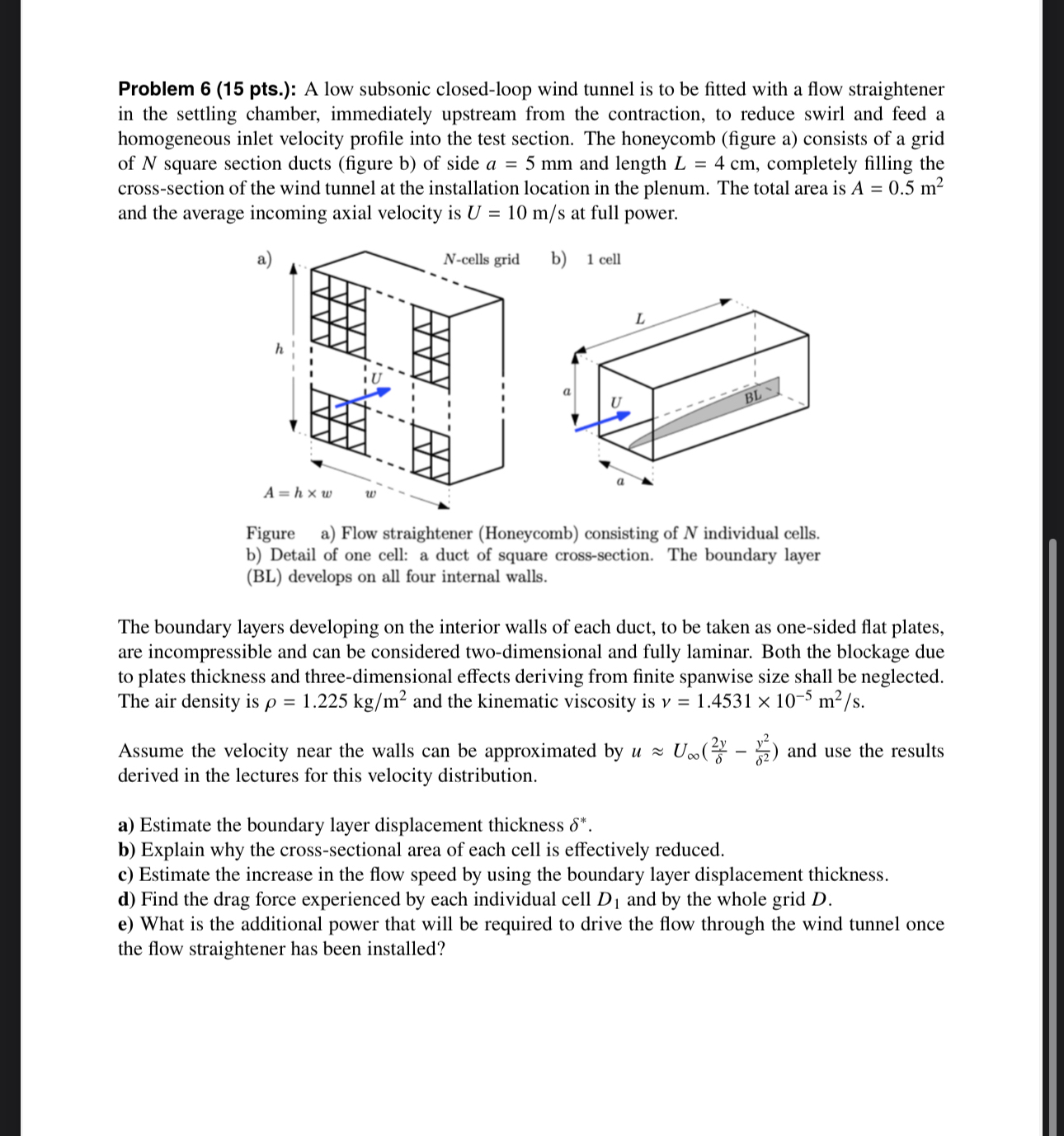
Problem pts: A low subsonic closedloop wind tunnel is to be fitted with a flow straightener in the settling chamber, immediately upstream from the contraction, to reduce swirl and feed a homogeneous inlet velocity profile into the test section. The honeycomb figure a consists of a grid of square section ducts figure b of side and length completely filling the crosssection of the wind tunnel at the installation location in the plenum. The total area is and the average incoming axial velocity is at full power.
Figure a Flow straightener Honeycomb consisting of individual cells. b Detail of one cell: a duct of square crosssection. The boundary layer BL develops on all four internal walls.
The boundary layers developing on the interior walls of each duct, to be taken as onesided flat plates, are incompressible and can be considered twodimensional and fully laminar. Both the blockage due to plates thickness and threedimensional effects deriving from finite spanwise size shall be neglected. The air density is and the kinematic viscosity is
Assume the velocity near the walls can be approximated by ~~ and use the results derived in the lectures for this velocity distribution.
a Estimate the boundary layer displacement thickness
b Explain why the crosssectional area of each cell is effectively reduced.
c Estimate the increase in the flow speed by using the boundary layer displacement thickness.
d Find the drag force experienced by each individual cell and by the whole grid
e What is the additional power that will be required to drive the flow through the wind tunnel once the flow straightener has been installed?
Step by Step Solution
There are 3 Steps involved in it
1 Expert Approved Answer
Step: 1 Unlock

Question Has Been Solved by an Expert!
Get step-by-step solutions from verified subject matter experts
Step: 2 Unlock
Step: 3 Unlock
 Study Help