







Question: Problem 6 (15 points): Floating point--mind the gap With integers, the gap between representations is always 1. This means that rounding a decimal to an
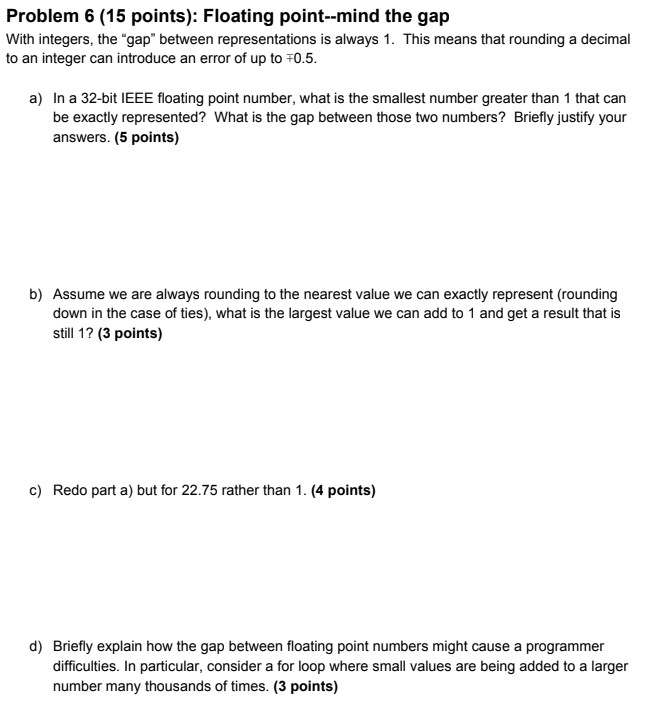
Problem 6 (15 points): Floating point--mind the gap With integers, the "gap" between representations is always 1. This means that rounding a decimal to an integer can introduce an error of up to 70.5. a) In a 32-bit IEEE floating point number, what is the smallest number greater than 1 that can be exactly represented? What is the gap between those two numbers? Briefly justify your answers. (5 points) b) Assume we are always rounding to the nearest value we can exactly represent (rounding down in the case of ties), what is the largest value we can add to 1 and get a result that is still 1? (3 points) C) Redo part a) but for 22.75 rather than 1. (4 points) d) Briefly explain how the gap between floating point numbers might cause a programmer difficulties. In particular, consider a for loop where small values are being added to a larger number many thousands of times. (3 points)
Step by Step Solution
There are 3 Steps involved in it

Get step-by-step solutions from verified subject matter experts
 Study Help