







Question: Problem 6. (15 points) Let n > 3. If P1, P2, ..., Pn are n propositions, explain why n-1 n V V (Pi^P;) i=1 j=i+1
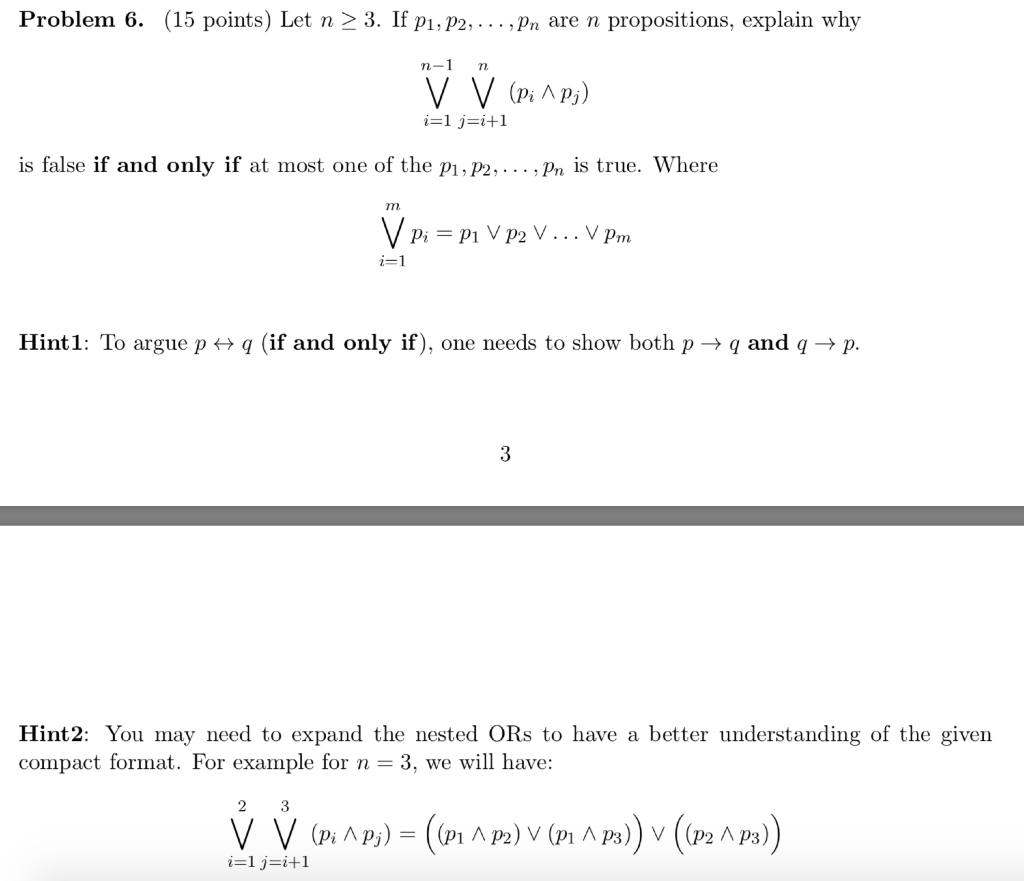
Problem 6. (15 points) Let n > 3. If P1, P2, ..., Pn are n propositions, explain why n-1 n V V (Pi^P;) i=1 j=i+1 is false if and only if at most one of the P1, P2, ..., Pn is true. Where m V Pi = pi V p2 V... V Pm i=1 Hint1: To argue p Hq (if and only if), one needs to show both p q and q + p. 3 Hint2: You may need to expand the nested ORs to have a better understanding of the given compact format. For example for n = 3, we will have: 2 3 V V (pi ^P;) = ((p1 ^ p2) V (p ^p3 Ps)) v ((P2 ^ p:)) i=lj=i+1
Step by Step Solution
There are 3 Steps involved in it
1 Expert Approved Answer
Step: 1 Unlock

Question Has Been Solved by an Expert!
Get step-by-step solutions from verified subject matter experts
Step: 2 Unlock
Step: 3 Unlock
 Study Help