







Question: PROBLEM 6 (50 points) It is September and an exporter (a business looking to purchase commodity to sell it later) in New Orleans has made
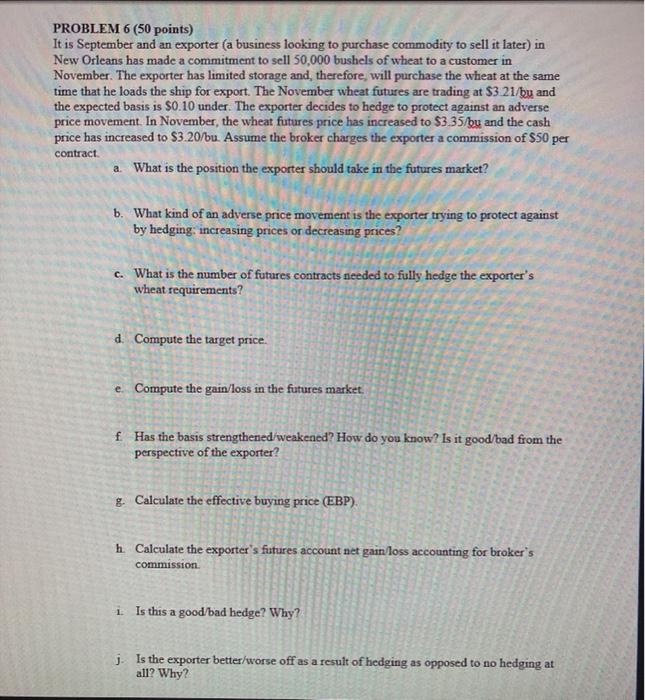
PROBLEM 6 (50 points) It is September and an exporter (a business looking to purchase commodity to sell it later) in New Orleans has made a commitment to sell 50,000 bushels of wheat to a customer in November. The exporter has limited storage and therefore, will purchase the wheat at the same time that he loads the ship for export. The November wheat futures are trading at $3 21/bu and the expected basis is $0.10 under. The exporter decides to hedge to protect against an adverse price movement. In November, the wheat futures price has increased to $3.35/bu and the cash price has increased to $3.20/bu. Assume the broker charges the exporter a commission of $50 per contract a What is the position the exporter should take in the futures market? b. What kind of an adverse price movement is the exporter trying to protect against by hedging increasing prices or decreasing prices? c. What is the number of futures contracts needed to fully hedge the exporter's wheat requirements? d Compute the target price. e Compute the gain/loss in the futures market f Has the basis strengthened weakened? How do you know? Is it good/bad from the perspective of the exporter? g. Calculate the effective buying price (EBP). h Calculate the exporter's futures account net gain loss accounting for broker's commission 1 Is this a good bad hedge? Why? j. Is the exporter better/worse off as a result of hedging as opposed to no hedging at all? Why? PROBLEM 6 (50 points) It is September and an exporter (a business looking to purchase commodity to sell it later) in New Orleans has made a commitment to sell 50,000 bushels of wheat to a customer in November. The exporter has limited storage and therefore, will purchase the wheat at the same time that he loads the ship for export. The November wheat futures are trading at $3 21/bu and the expected basis is $0.10 under. The exporter decides to hedge to protect against an adverse price movement. In November, the wheat futures price has increased to $3.35/bu and the cash price has increased to $3.20/bu. Assume the broker charges the exporter a commission of $50 per contract a What is the position the exporter should take in the futures market? b. What kind of an adverse price movement is the exporter trying to protect against by hedging increasing prices or decreasing prices? c. What is the number of futures contracts needed to fully hedge the exporter's wheat requirements? d Compute the target price. e Compute the gain/loss in the futures market f Has the basis strengthened weakened? How do you know? Is it good/bad from the perspective of the exporter? g. Calculate the effective buying price (EBP). h Calculate the exporter's futures account net gain loss accounting for broker's commission 1 Is this a good bad hedge? Why? j. Is the exporter better/worse off as a result of hedging as opposed to no hedging at all? Why
Step by Step Solution
There are 3 Steps involved in it

Get step-by-step solutions from verified subject matter experts
 Study Help