







Question: PROBLEM 6 6 In class we calculated the root - mean - square speed of the water molecules at room temperature. Following the same line
PROBLEM
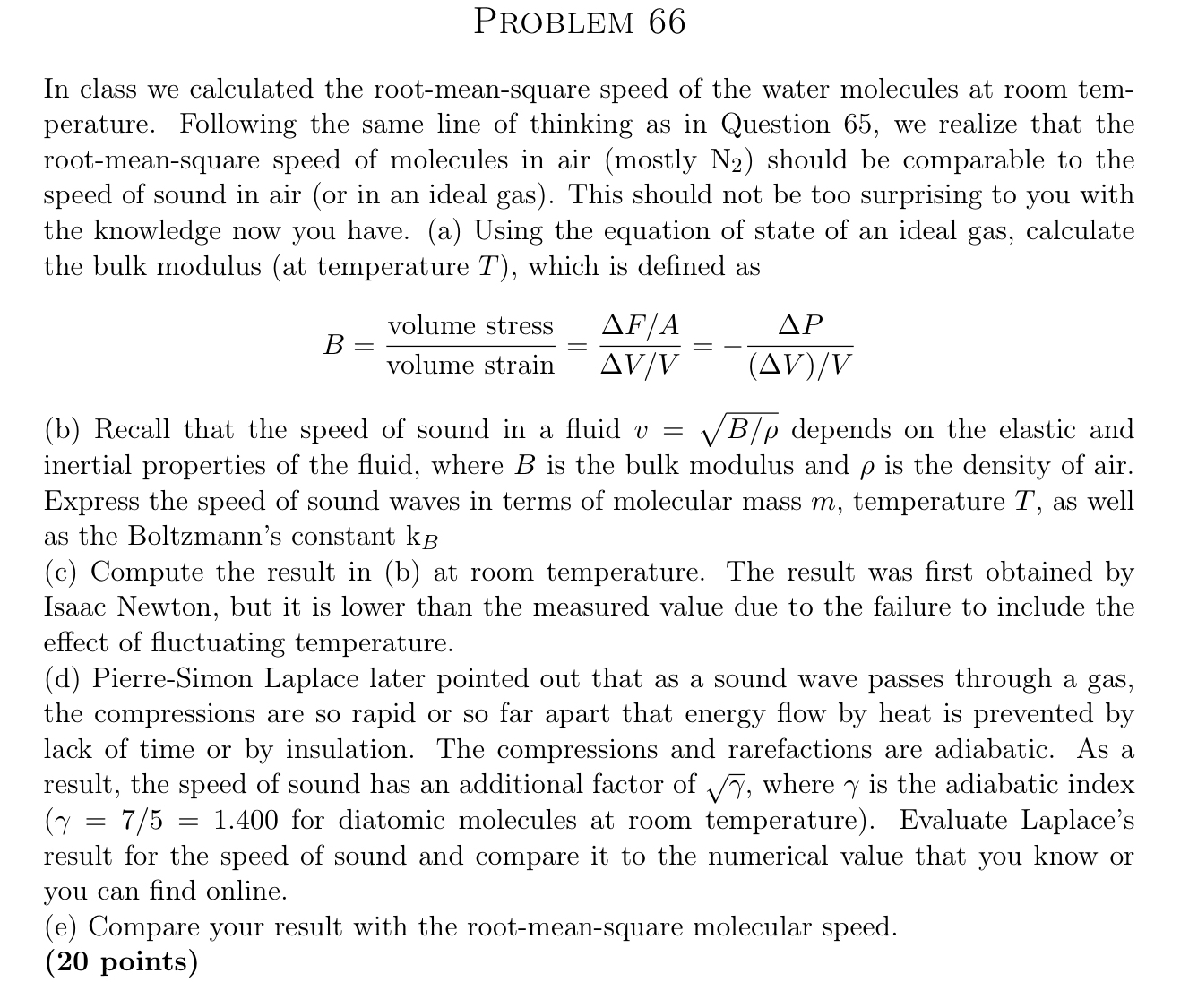
In class we calculated the rootmeansquare speed of the water molecules at room temperature. Following the same line of thinking as in Question we realize that the rootmeansquare speed of molecules in air mostly should be comparable to the speed of sound in air or in an ideal gas This should not be too surprising to you with the knowledge now you have. a Using the equation of state of an ideal gas, calculate the bulk modulus at temperature which is defined as
b Recall that the speed of sound in a fluid depends on the elastic and inertial properties of the fluid, where is the bulk modulus and is the density of air. Express the speed of sound waves in terms of molecular mass temperature as well as the Boltzmann's constant
c Compute the result in b at room temperature. The result was first obtained by Isaac Newton, but it is lower than the measured value due to the failure to include the effect of fluctuating temperature.
d PierreSimon Laplace later pointed out that as a sound wave passes through a gas, the compressions are so rapid or so far apart that energy flow by heat is prevented by lack of time or by insulation. The compressions and rarefactions are adiabatic. As a result, the speed of sound has an additional factor of where is the adiabatic index for diatomic molecules at room temperature Evaluate Laplace's result for the speed of sound and compare it to the numerical value that you know or you can find online.
e Compare your result with the rootmeansquare molecular speed.
points
Step by Step Solution
There are 3 Steps involved in it
1 Expert Approved Answer
Step: 1 Unlock

Question Has Been Solved by an Expert!
Get step-by-step solutions from verified subject matter experts
Step: 2 Unlock
Step: 3 Unlock
 Study Help