







Question: Problem 6: A server receives packets from two different clients. The time between the generation of two consecutive packets at each client is exponentially distributed
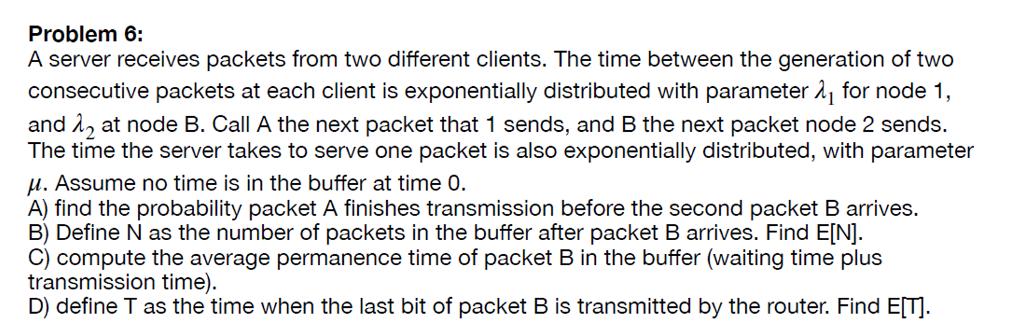
Problem 6: A server receives packets from two different clients. The time between the generation of two consecutive packets at each client is exponentially distributed with parameter for node 1, and at node B. Call A the next packet that I sends, and B the next packet node 2 sends. The time the server takes to serve one packet is also exponentially distributed, with parameter Assume no time is in the buffer at time 0. A) find the probability packet A finishes transmission before the second packet B arrives. B) Define N as the number of packets in the buffer after packet B arrives. Find E[N] C) compute the average permanence time of packet B in the buffer (waiting time plus transmission time) D) define T as the time when the last bit of packet B is transmitted by the router. Find E[T Problem 6: A server receives packets from two different clients. The time between the generation of two consecutive packets at each client is exponentially distributed with parameter for node 1, and at node B. Call A the next packet that I sends, and B the next packet node 2 sends. The time the server takes to serve one packet is also exponentially distributed, with parameter Assume no time is in the buffer at time 0. A) find the probability packet A finishes transmission before the second packet B arrives. B) Define N as the number of packets in the buffer after packet B arrives. Find E[N] C) compute the average permanence time of packet B in the buffer (waiting time plus transmission time) D) define T as the time when the last bit of packet B is transmitted by the router. Find E[T
Step by Step Solution
There are 3 Steps involved in it

Get step-by-step solutions from verified subject matter experts
 Study Help