







Question: Problem #6: et Let f(x) = 1 + 4x . On what interval is f increasing? (A) (- - In 3, 00) (B) (-= In

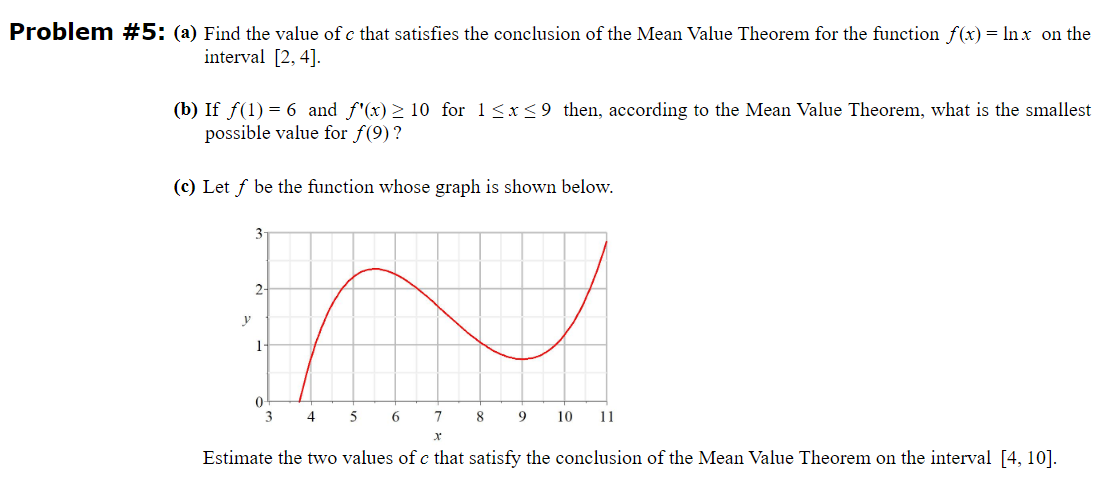


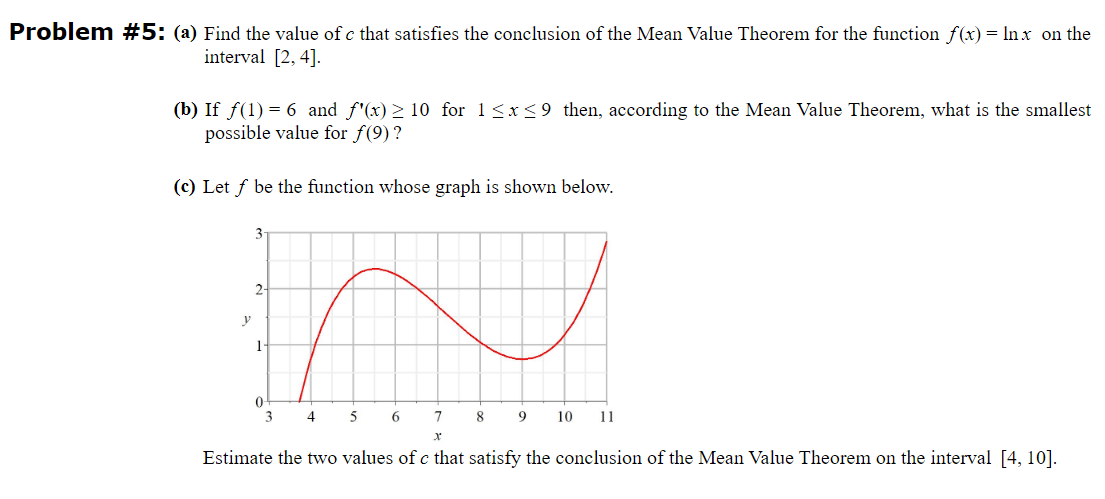
![x on the interval [2= 4]. (b) If f [1} = 6](https://s3.amazonaws.com/si.experts.images/answers/2024/06/66642e3fe6457_47166642e3fd8fb7.jpg)
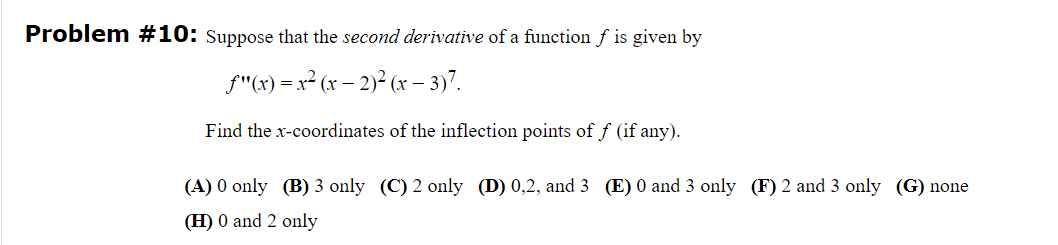
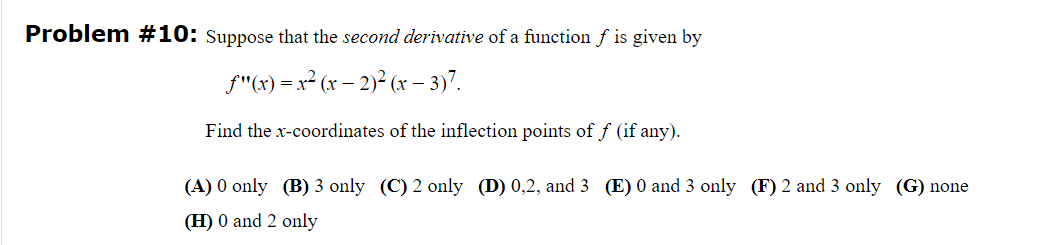
Problem #6: et Let f(x) = 1 + 4x . On what interval is f increasing? (A) (- - In 3, 00) (B) (-= In 4, 00) (C) (= In 4, 00) (D) (-20, = In 4) (E) (-oo, - - In 4) (F) (-oo, - - In 3) (G) (-20, - In 3) (H) ( - In 3, 00)Problem # 5: (51) Find the value of c that satises the conclusion of the Mean Value Theorem for the function f(x) = 111 x on the interval [2= 4]. (b) If f [1} = 6 and f '{x} 2 10 for l 5 x 5 9 then. according to the Mean Value Theorem. what is the smallest possible value for f[9) \"P (c) Let f be the function whose graph is shown below. 3 l-J u . . . 3 4 5 6 7 f4 9 It! I | I Estimate the two values of c that satisfy the conclusion of the Mean Value Theorem on the interval [4. 10]. Problem #10: Suppose that the second derivative of a function f is given by f" (x) =x- (x-2)2 (x -3)?. Find the x-coordinates of the inflection points of f (if any). (A) 0 only (B) 3 only (C) 2 only (D) 0,2, and 3 (E) 0 and 3 only (F) 2 and 3 only (G) none (H) 0 and 2 onlyProblem #3: Find the two critical values of the function f(x) = x > (5 - 3x)
Step by Step Solution
There are 3 Steps involved in it

Get step-by-step solutions from verified subject matter experts
 Study Help