







Question: Problem 6 for reference: 7. Leverage and Stock Value [L01] Ignoring taxes in Problem 6, what is the price per share of equity under Plan
![Problem 6 for reference: 7. Leverage and Stock Value [L01] Ignoring](https://dsd5zvtm8ll6.cloudfront.net/si.experts.images/questions/2024/10/67020e1ea0718_93467020e1e47b1b.jpg)
Problem 6 for reference:
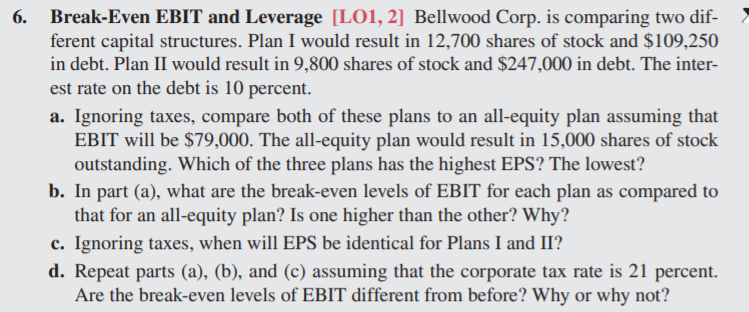
7. Leverage and Stock Value [L01] Ignoring taxes in Problem 6, what is the price per share of equity under Plan I? Plan II? What principle is illustrated by your answers? 6. Break-Even EBIT and Leverage [L01, 2] Bellwood Corp. is comparing two dif- ferent capital structures. Plan I would result in 12,700 shares of stock and $109,250 in debt. Plan II would result in 9,800 shares of stock and $247,000 in debt. The inter- est rate on the debt is 10 percent. a. Ignoring taxes, compare both of these plans to an all-equity plan assuming that EBIT will be $79,000. The all-equity plan would result in 15,000 shares of stock outstanding. Which of the three plans has the highest EPS? The lowest? b. In part (a), what are the break-even levels of EBIT for each plan as compared to that for an all-equity plan? Is one higher than the other? Why? c. Ignoring taxes, when will EPS be identical for Plans I and II? d. Repeat parts (a), (b), and (c) assuming that the corporate tax rate is 21 percent. Are the break-even levels of EBIT different from before? Why or why not
Step by Step Solution
There are 3 Steps involved in it

Get step-by-step solutions from verified subject matter experts
 Study Help