







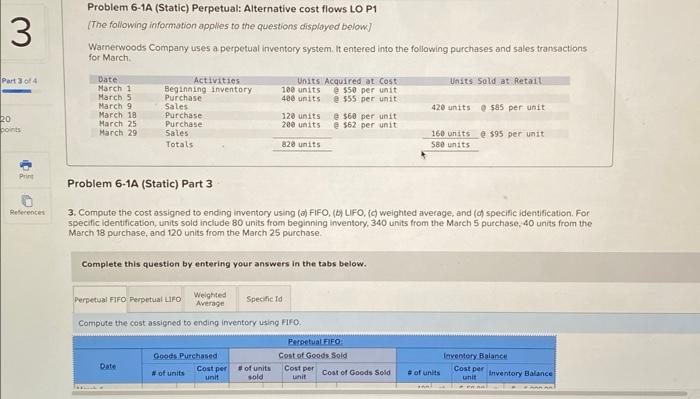
Question: Problem 6-1A (Static) Perpetual: Alternative cost flows LO P1 [The following information applies to the questions displayed below] Warnerwoods Company uses a perpetual inventory system.
![information applies to the questions displayed below] Warnerwoods Company uses a perpetual](https://s3.amazonaws.com/si.experts.images/answers/2024/09/66d5bd3887abb_64066d5bd382368d.jpg)
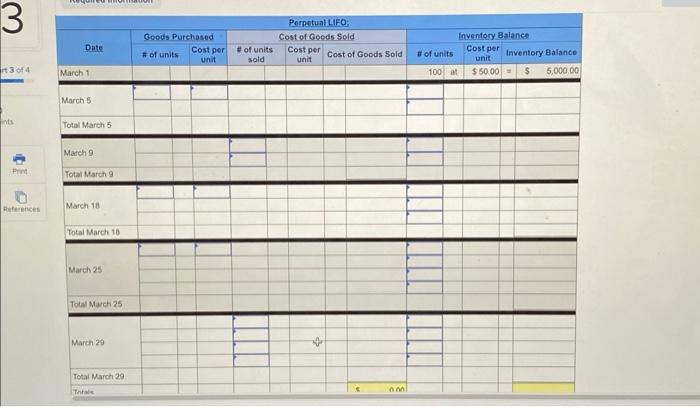
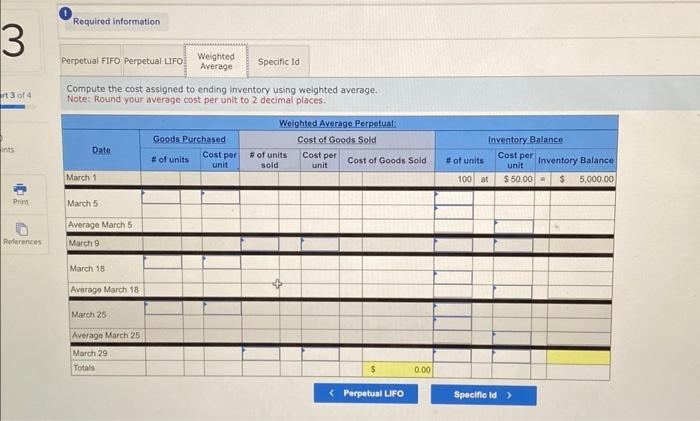
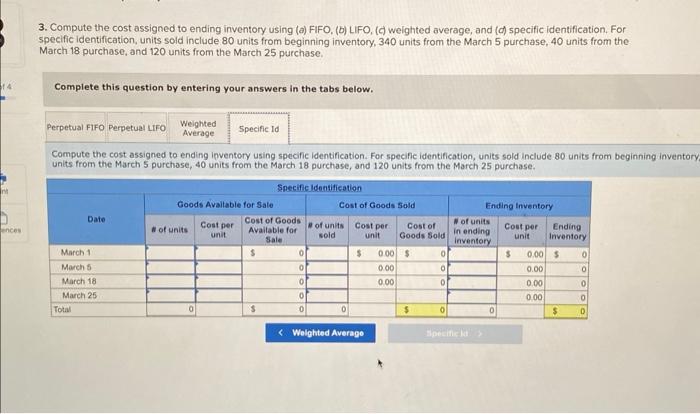
Problem 6-1A (Static) Perpetual: Alternative cost flows LO P1 [The following information applies to the questions displayed below] Warnerwoods Company uses a perpetual inventory system. It entered into the following purchases and sales transactions for March. Problem 6-1A (Static) Part 3 3. Compute the cost assigned to ending inventory using (a) FIFO, (b) LIFO, (c) weighted average, and (c) specific identification. For specific identification, units sold include 80 units from beginning inventory, 340 units from the March 5 purchase, 40 units from the March 18 purchase, and 120 units from the March 25 purchase. Complete this question by entering your answers in the tabs below. Compute the cost assigned to ending inventory using fifo. Required information \begin{tabular}{|c|c|c|c|c|c|c|c|c|c|c|c|} \hline \multicolumn{12}{|c|}{ Perpotual LIFO: } \\ \hline \multirow[b]{2}{*}{ Date } & \multicolumn{2}{|c|}{ Goeds Purchased } & \multicolumn{3}{|c|}{ Cost of Goeds sold. } & \multicolumn{6}{|c|}{ Inventory Balance } \\ \hline & \# of units & \multirow[t]{2}{*}{\begin{tabular}{c} Cost per \\ unit \end{tabular}} & \multirow[t]{2}{*}{\begin{tabular}{c} \# of units \\ sold \end{tabular}} & \multirow[t]{2}{*}{\begin{tabular}{c} Cost per \\ unit \end{tabular}} & Cost of Goods Sold & \multicolumn{2}{|c|}{ it of units } & \multirow{2}{*}{\begin{tabular}{c} Cost per \\ unit \end{tabular}} & \multicolumn{3}{|c|}{ Inventory Balance } \\ \hline March 1 & & & & & & 100 & at & & = & $ & 5,000.00 \\ \hline \multirow[t]{2}{*}{ March 5} & & & & & & & & & & & \\ \hline & & & & & & & & & & & \\ \hline \multicolumn{12}{|l|}{ Total March 5} \\ \hline \multicolumn{12}{|l|}{ March 9} \\ \hline & & & & & & & & & & & \\ \hline \multicolumn{12}{|l|}{ Total March 9} \\ \hline \multirow{3}{*}{ March 18 } & & & & & & & & & & + & \\ \hline & & & & & & & & & & & \\ \hline & & & & & & & & & & & \\ \hline \multicolumn{12}{|l|}{ Total March 18} \\ \hline & & & & & & & & & & & \\ \hline \multirow{2}{*}{ March 25} & & & & & & & & 4 & & & \\ \hline & & & & & & & & & & & \\ \hline & & & & & & & & & & & \\ \hline \multicolumn{12}{|l|}{ Total March 25} \\ \hline & & & & & & & & & & & \\ \hline \multirow{2}{*}{\multicolumn{12}{|c|}{ March 29}} \\ \hline & & & & & & & & & & & \\ \hline \multirow{2}{*}{\multicolumn{12}{|c|}{ Total March 29}} \\ \hline & & & & & & & & & & & \\ \hline Tintale: & & & & & nanl & & & & & & \\ \hline \end{tabular} Compute the cost assigned to ending inventory using weighted average. Note: Round your average cost per unit to 2 decimal places: Compute the cost assigned to ending inventory using (a) FIFO, (b) LIFO, (C) weighted average, and (d) specific identification, For pecific identification, units sold include 80 units from beginning inventory, 340 units from the March 5 purchase, 40 units from the harch 18 purchase, and 120 units from the March 25 purchase. Complete this question by entering your answers in the tabs below. Compute the cost assigned to ending inventory using specific identification. For specific identification, units sold include 80 units from beginning invent units from the March 5 purchose, 40 units from the March 18 purchase, and 120 units from the March 25 purchase
Step by Step Solution
There are 3 Steps involved in it

Get step-by-step solutions from verified subject matter experts
 Study Help