







Question: Problem 6.4: Do parts c) and d) and do them by hand. Show every step of iteration. For part d), use the secant method first
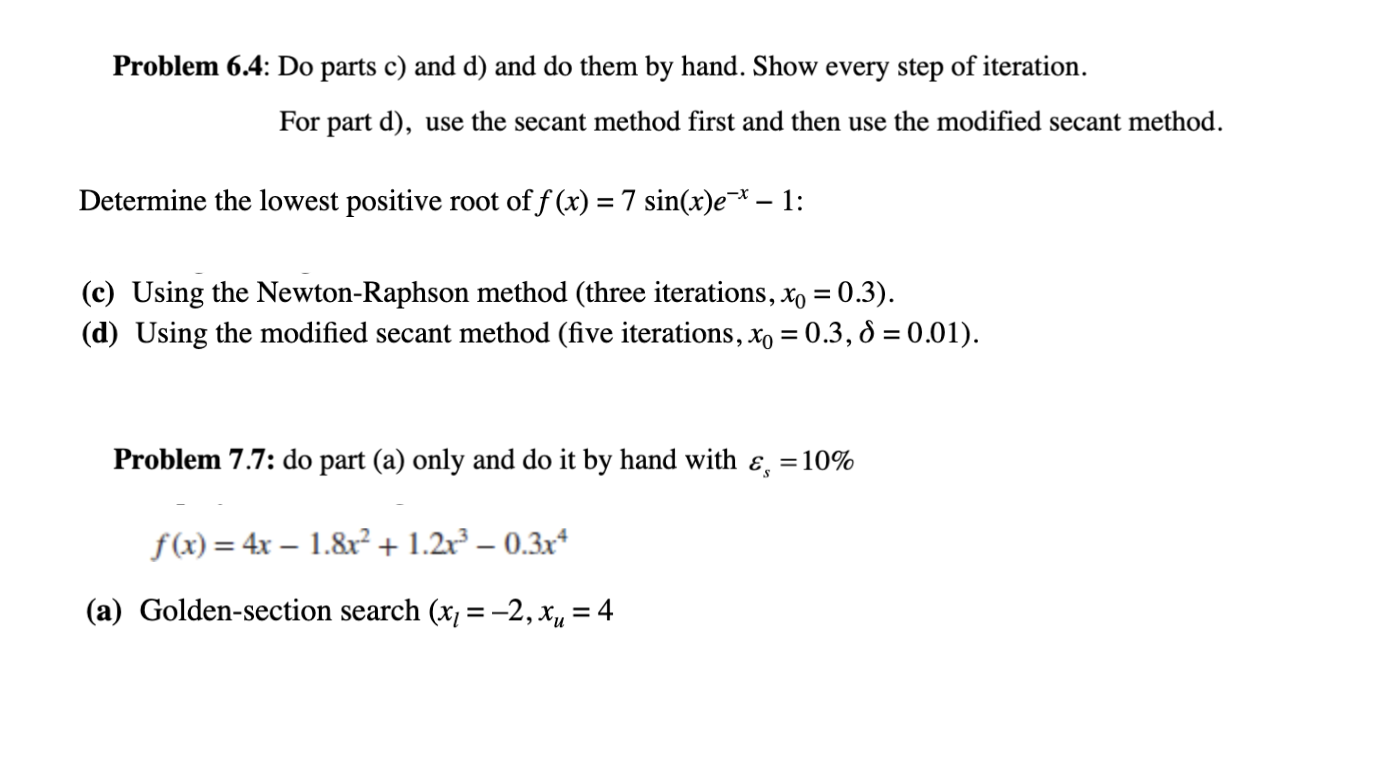
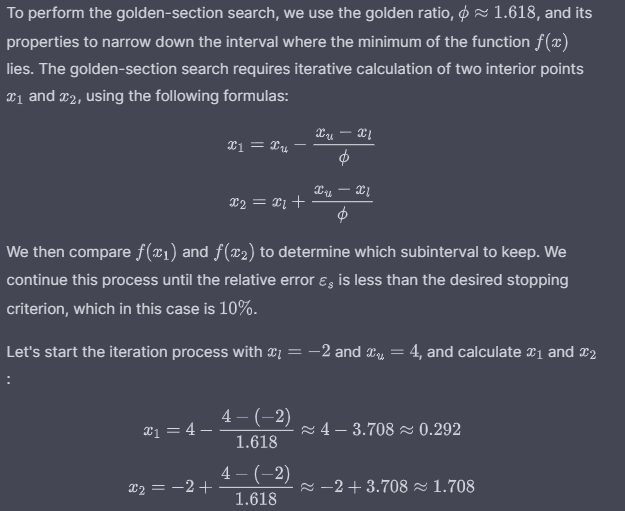
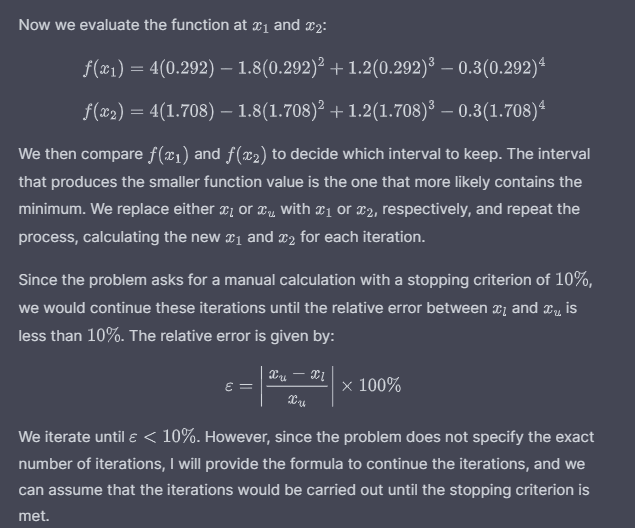
Problem 6.4: Do parts c) and d) and do them by hand. Show every step of iteration. For part d), use the secant method first and then use the modified secant method. Determine the lowest positive root of f (x) = 7 sin(x)e 1: (c) Using the NeWtonRaphson method (three iterations, x, = 0.3). (d) Using the modified secant method (five iterations, x, = 0.3, d = 0.01). Problem 7.7: do part (a) only and do it by hand with =10% f(x) =4x 1.8 + 1.2 0.3x* (a) Golden-section search (x; =-2,x,=4 To perform the golden-section search, we use the golden ratio, =~ 1.618, and its properties to narrow down the interval where the minimum of the function j(x lies. The golden-section search requires iterative calculation of two interior points o1 and T3, using the following formulas: We then compare _fl::::lq 'a and fl:: a to determine which subinterval to keep. We continue this process until the relative error , is less than the desired stopping criterion, which in this case is 10%. Let's start the iteration process with ; = 2 and z,, = 4, and calculate 1 and z2 Mow we evaluate the function at z; and z-: f(z1) = 4(0.292) 1.8(0.292)? 202)% 0.3(0.292)* ;) = 4(1.708) 1.8(1.708) 8) 0.3(1.708)* We then compare f(x,) and f(z;) to decide which interval to keep. The interval that produces the smaller function value is the one that more likely contains the minimum. We replace either z; or x,, with z; or -, respectively, and repeat the process, calculating the new x; and x4 for each iteration. Since the problem asks for a manual calculation with a stopping criterion of 10%, we would continue these iterations until the relative error between z; and z,, is less than 10%. The relative error is given by: T a1 We iterate until
Step by Step Solution
There are 3 Steps involved in it

Get step-by-step solutions from verified subject matter experts
 Study Help