







Question: Problem 7 - 2 ( page 1 8 6 ) on quicksort with equal element values . 7 - 2 Quicksort with equal element values
Problem page on quicksort with equal element values Quicksort with equal element values
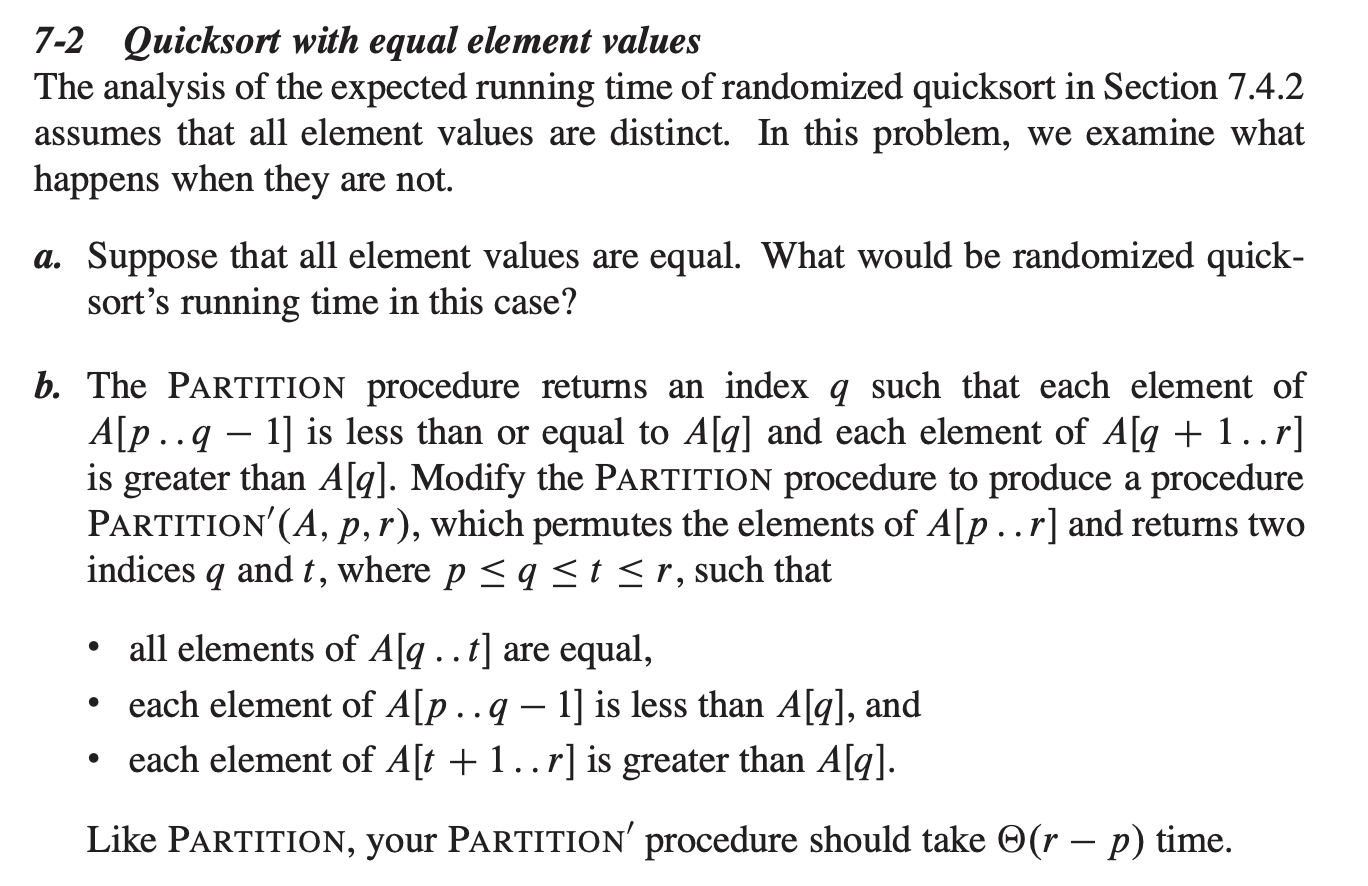
The analysis of the expected running time of randomized quicksort in Section
assumes that all element values are distinct. In this problem, we examine what
happens when they are not.
a Suppose that all element values are equal. What would be randomized quick
sort's running time in this case?
b The PARtition procedure returns an index such that each element of
is less than or equal to and each element of dotsr
is greater than Modify the PARTITION procedure to produce a procedure
PARtition which permutes the elements of and returns two
indices and where such that
all elements of are equal,
each element of is less than and
each element of dotsr is greater than
Like PARTITION, your PARTITION' procedure should take time.
Do parts a and b from the textbook. Do not do c or d Instead:
Show the steps of your Partition' algorithm on the input array with and
That is partition the entire array. Similar to Figure on page
State the loop invariant for your Partition' algorithm. You are not required to write the proof
of correctness, but the loop invariant you state must be correct and it must be strong enough to
prove the correctness of your algorithm.
Your Partition' procedure must not be randomized; it should use the final element of the array range
as the pivot, like Partition does. It should make a single pass over the array range. I recommend using
a while loop instead of a for loop, but it can be solved either way.
Step by Step Solution
There are 3 Steps involved in it
1 Expert Approved Answer
Step: 1 Unlock

Question Has Been Solved by an Expert!
Get step-by-step solutions from verified subject matter experts
Step: 2 Unlock
Step: 3 Unlock
 Study Help