







Question: Problem 7: A HIM-kg spaceship is in a circular orbit 210 km above the surface of Earth. It needs to be moved into a higher
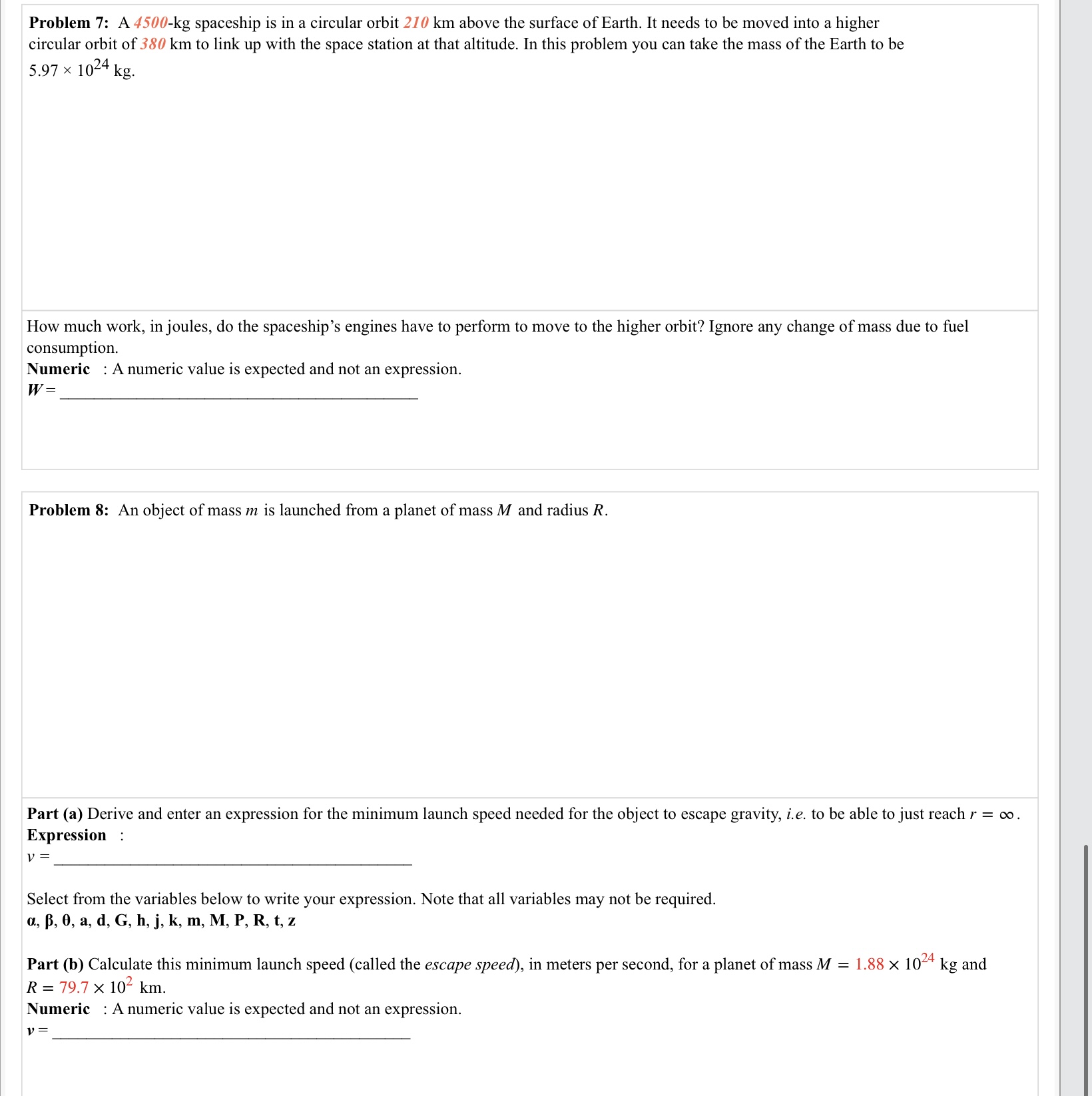
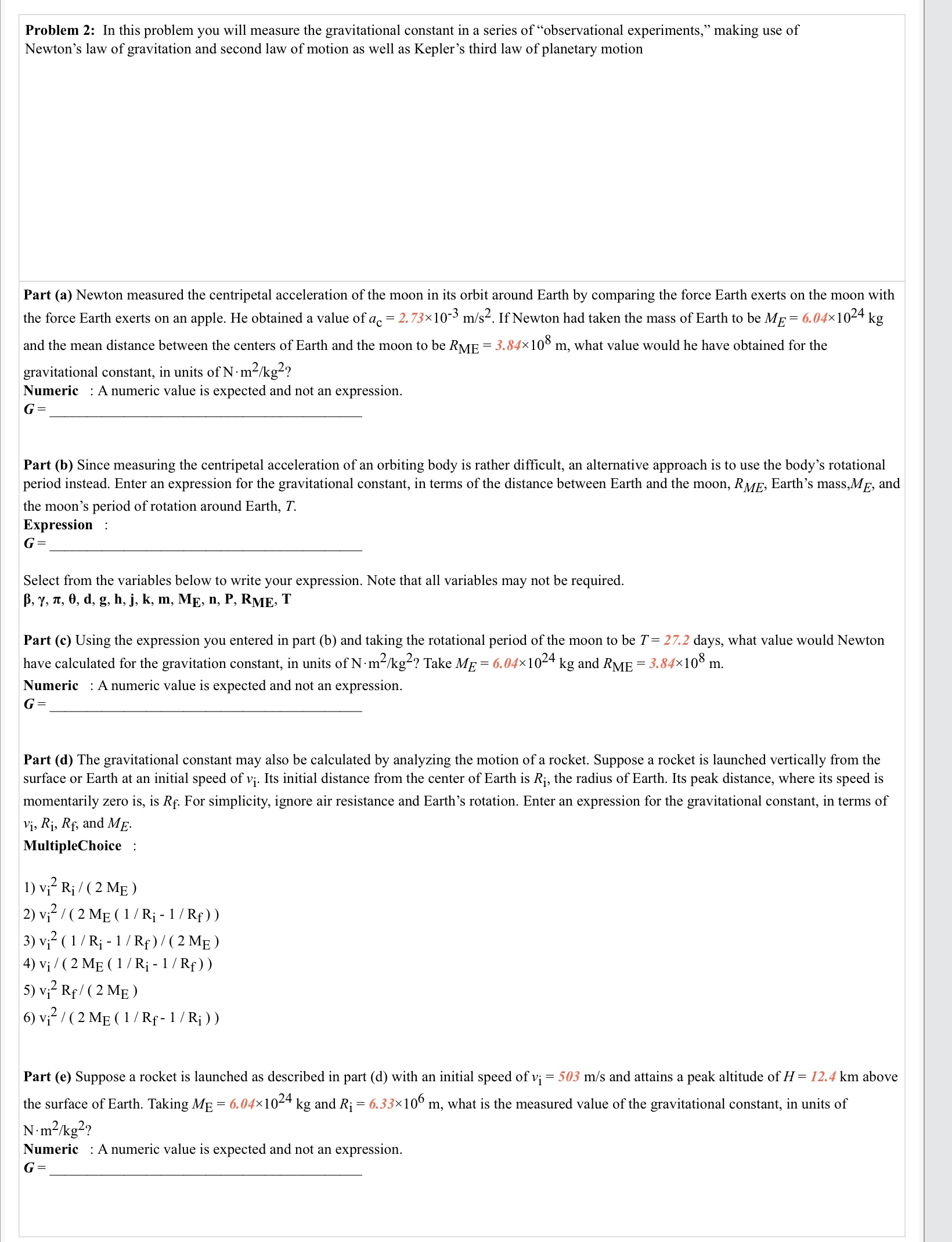
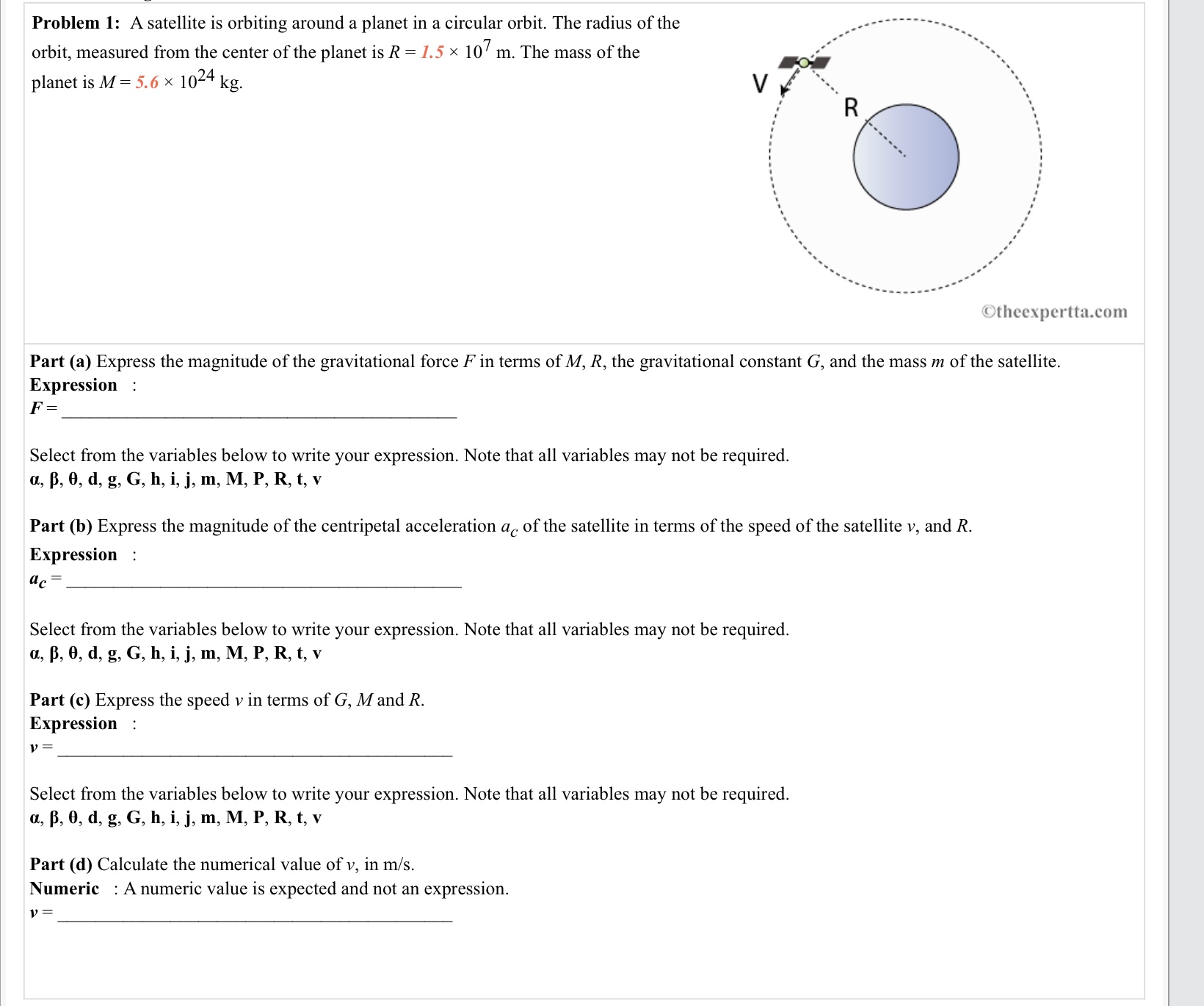
Problem 7: A HIM-kg spaceship is in a circular orbit 210 km above the surface of Earth. It needs to be moved into a higher circular orbit of 3'80 km to link up with the space station at that altitude. In this problem you can take the mass of the Earth to be 5.97 x 1024 kg. How much work, in joules, do the spaceship's engines have to perform to move to the higher orbit? Ignore any change of mass due to fuel consumption. Numeric : A numeric value is expected and not an expression. W: Problem 8: An object of mass m is launched from a planet of mass M and radius R. Part (a) Derive and enter an expression for the minimum launch speed needed for the object to escape gravity, 1'. e. to be able to just reach r = 00. Expression v 2 Select from the variables below to write your expression. Note that all variables may not be required. a, B. 9, a, d, C, h, j, k, m, M. P, R, t, 2 Part (b) Calculate this minimum launch speed (called the escape speed), in meters per second, for a planet of mass M = 1.88 X 1024 kg and R = 79.7 x10² km. Numeric : A numeric value is expected and not an expression. v : Problem 2: In this problem you will measure the gravitational constant in a series of "observational experiments," making use of Newton's law of gravitation and second law of motion as well as Kepler's third law of planetary motion Part (a) Newton measured the centripetal acceleration of the moon in its orbit around Earth by comparing the force Earth exerts on the moon with the force Earth exerts on an apple. He obtained a value of ac - 2.73x10⁻⁵ m/s. If Newton had taken the mass of Earth to be ME = 6.04x1024 kg and the mean distance between the centers of Earth and the moon to be RME = 3.84x10⁸ m, what value would he have obtained for the gravitational constant, in units of N. m2/kg2? Numeric : A numeric value is expected and not an expression. G= Part (b) Since measuring the centripetal acceleration of an orbiting body is rather difficult, an alternative approach is to use the body's rotational period instead. Enter an expression for the gravitational constant, in terms of the distance between Earth and the moon, RME, Earth's mass,ME, and the moon's period of rotation around Earth, T. Expression : GS Select from the variables below to write your expression. Note that all variables may not be required. B, Y, n, 0, d, g, h, j, k, m, ME, n, P, RME, T Part (c) Using the expression you entered in part (b) and taking the rotational period of the moon to be T= 27.2 days, what value would Newton have calculated for the gravitation constant, in units of N. m-/kg2? Take ME = 6.04x1024 kg and RME = 3.84x10⁸ m. Numeric : A numeric value is expected and not an expression. G = Part (d) The gravitational constant may also be calculated by analyzing the motion of a rocket. Suppose a rocket is launched vertically from the surface or Earth at an initial speed of vi. Its initial distance from the center of Earth is Ri, the radius of Earth. Its peak distance, where its speed is momentarily zero is, is Rf. For simplicity, ignore air resistance and Earth's rotation. Enter an expression for the gravitational constant, in terms of vi, Ri, Rf, and ME. MultipleChoice : 1) vi Ri / (2 ME ) 2) viz / ( 2 ME ( 1 / R; - 1/ Rf) ) 3) vi2 ( 1 / R; - 1 / Rf) / (2 ME) 4) vi / (2 ME ( 1 / R; - 1/ Rf) ) 5) viz Rf/ (2 ME) 6) viz / (2 ME ( 1 / Rf- 1/ R; ) ) Part (e) Suppose a rocket is launched as described in part (d) with an initial speed of vi = 503 m/s and attains a peak altitude of H = 12.4 km above the surface of Earth. Taking ME = 6.04x1024 kg and Ri = 6.33x100 m, what is the measured value of the gravitational constant, in units of N. m2/kg2? Numeric : A numeric value is expected and not an expression. G =Problem 1: A satellite is orbiting around a planet in a circular orbit. The radius of the ' ' --~. orbit, measured from the center of the planet is R = 1.5 X 10"1 m. The mass of the planet is M: 5.6 X 1024 kg. V If ' thee\\pcr'lluxum Part (3) Express the magnitude of the gravitational force F in terms of M, R, the gravitational constant G, and the mass m of the satellite. Expression F 2 Select from the variables below to write your expression. Note that all variables may not be required. a. B. 9. cl. g. G, 11. U. m. M. P, R. t. v Part ([1) Express the magnitude of the centripetal acceleration ac. of the satellite in terms of the speed of the satellite v, and R. Expression ac = Select from the variables below to write your expression. Note that all variables may not be required. (1,3,9, d, g, G, IL i,j, 111, M. P, R, t. V Part (1:) Express the speed v in terms of G, Mand R. Expression v : Select from the variables below to write your expression. Note that all variables may not be required. (1,3,9, d, g, G, 1L i,j, 111, M, P, R, t. V Part ((1) Calculate the numerical value of v, in oils. Numeric : A numeric value is expected and not an expression. v =
Step by Step Solution
There are 3 Steps involved in it

Get step-by-step solutions from verified subject matter experts
 Study Help